
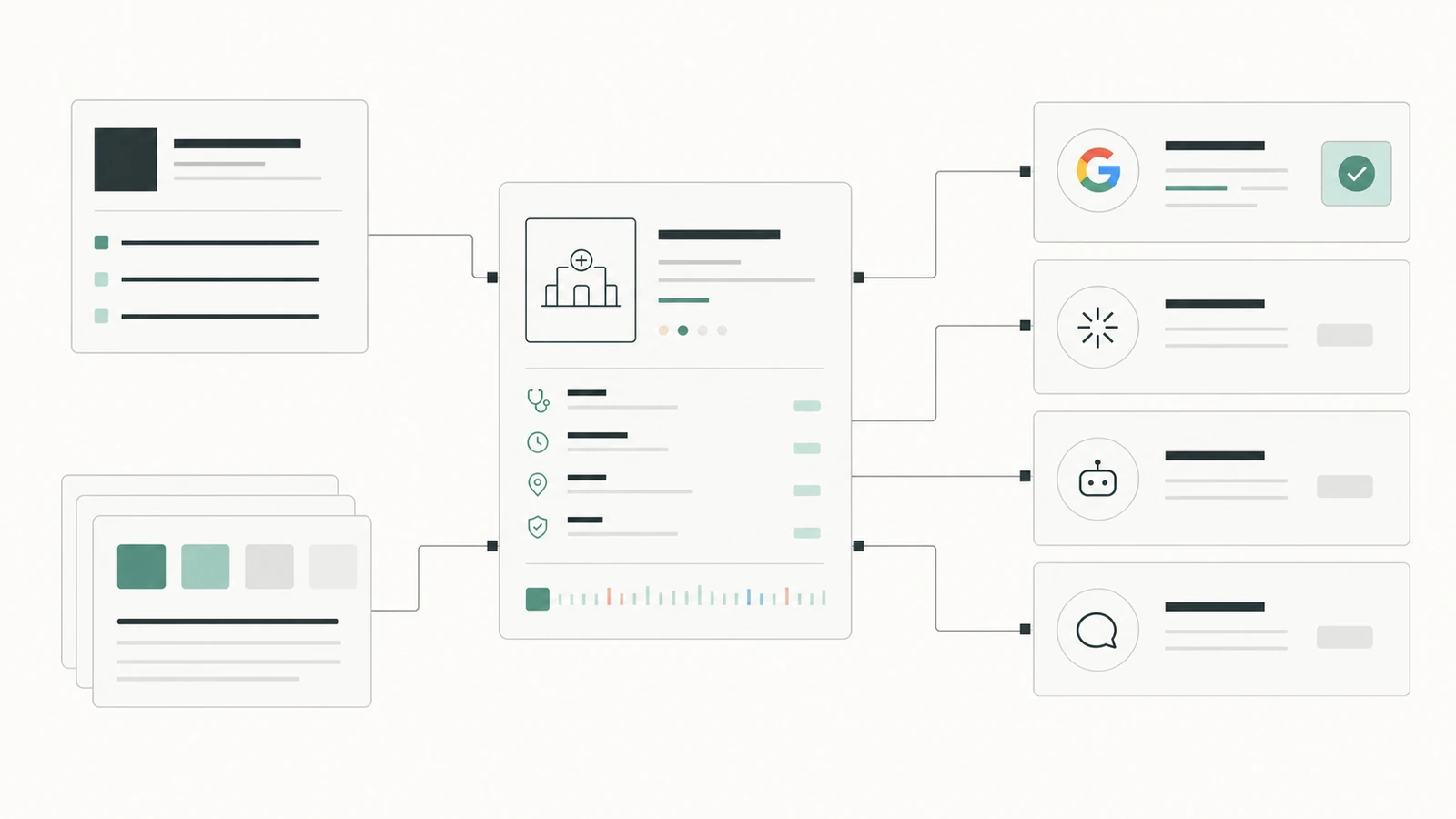
AI search optimization improves how an organization is discovered and represented in generated answers. For medical organizations, the practical sequence is to measure current visibility, protect the Google Search foundation, clarify the clinic entity, improve answer-bearing pages and supporting sources, then recheck Google AI Overviews separately from ChatGPT and Gemini.
What does AI search optimization include?
AI search optimization is an umbrella term for work aimed at generated search and assistant answers. It overlaps with generative engine optimization, answer engine optimization and LLM SEO, but those labels emphasize different parts of the same system.
| Term | Useful meaning in this guide |
|---|---|
| AI search optimization | The complete program across generated search and assistants |
| AEO | Answer structure and attribution, especially for Google AI Overviews |
| GEO | Entity, content and source signals for generated answers |
| LLM SEO | The ChatGPT and Gemini part of GEO |
| AI visibility | The observable outcome: mentions, citations, recommendations and sentiment |
The labels matter less than keeping the patient journeys and measurements clear.
Step 1: define the patient decisions that matter
Do not begin with a generic list of AI prompts. Begin with the treatments, services, locations, markets and patient languages that matter to the organization. Then map the stages where a generated answer may influence a decision.
A patient may research a treatment category in ChatGPT or Gemini, refine the question to an appropriate specialist, and later use Google Search or Maps to select a nearby provider. The audit should follow that journey without pretending every step happens on one platform.
Step 2: record the current baseline
Test the relevant Google queries and assistant prompts before changing pages. Record brand presence, citations or source links, named competitors and what each answer says about the organization. Save enough context to repeat the check.
Use a question set sized to the clinic’s scope. Rotgar does not publish an arbitrary limit because a single-location specialist practice and a multilingual hospital group require different coverage. The full protocol is in AI visibility measurement.
Step 3: protect the SEO foundation
Generated visibility does not excuse basic search problems. Confirm that priority pages are indexable, accessible in the initial HTML, internally linked and aligned with the service or location they represent. Resolve canonical, duplication and mobile usability problems before adding more content.
Google Search + Maps remains Door 1 because it is a distinct patient-discovery system and an important foundation for the other two doors. AI search optimization complements it; it does not replace it.
Step 4: clarify the medical organization as an entity
An entity is the identifiable organization, clinician, location or service that a system is trying to resolve. Clarity comes from agreement between visible pages, structured data and credible external profiles.
Check that:
- the organization and locations use consistent names;
- services are connected to the correct locations and clinicians;
- schema describes what is visibly present rather than adding hidden claims;
- author and reviewer roles are accurate;
- unsupported clinical or performance claims are removed;
- external profiles do not contradict the website.
Entity clarity is not the same as adding more schema types. Consistency matters more than volume.
Step 5: make priority content answer-ready
Each important section should answer one question directly. Place the answer near the heading, add the qualifications necessary to keep it accurate and link to deeper evidence when needed. Avoid long introductions that delay the useful information.
For medical content, extractability must not come at the expense of safety or nuance. If a short answer would be misleading, include the limitation in the same passage. Clinical review belongs to an appropriately qualified reviewer; SEO review covers discoverability and structure.
Step 6: improve the source environment
Generated answers may rely on the clinic’s own pages and on outside sources. Compare the sources visible for priority questions with the clinic’s existing profiles, publications and references. Fix contradictions and pursue legitimate coverage where the clinic has real expertise or evidence to contribute.
Do not manufacture citations or mass-post promotional answers. The objective is a coherent, verifiable source environment.
Step 7: recheck Door 2 and Door 3 separately
For Google AI Overviews, repeat the relevant search queries and capture overview presence, citations and competitors. For ChatGPT and Gemini, repeat the relevant prompts and capture mentions, citations where shown, recommendations, competitors and sentiment.
Compare each result with its own baseline. Do not turn unlike observations into a single opaque score. The AI visibility score page explains how to build a transparent summary without losing the underlying evidence.
A compact implementation checklist
- Priority services, markets and languages are defined.
- Existing Google and assistant visibility is captured.
- Priority pages are indexable and internally linked.
- Organization, location, clinician and service entities agree.
- Important sections answer questions directly and accurately.
- Visible structured data matches the page.
- Authors, reviewers and dates are clear.
- Relevant outside sources are checked for support or contradiction.
- Google AI Overviews and ChatGPT + Gemini are rechecked separately.
- Actions are prioritized from observed gaps, not from a generic checklist.
What this process will not do
It will not guarantee a citation or recommendation. It will not replace technical SEO, local visibility or good clinical governance. It will not prove patient enquiries without separate conversion evidence. And it should not create a large library of overlapping pages merely to repeat AI terminology.
Start with the baseline
The free Google + AI visibility audit establishes the starting point across all three doors. Ongoing assistant work is described in ChatGPT + Gemini Visibility.
Get a free audit or use the more focused GEO strategy to decide what to improve first.