
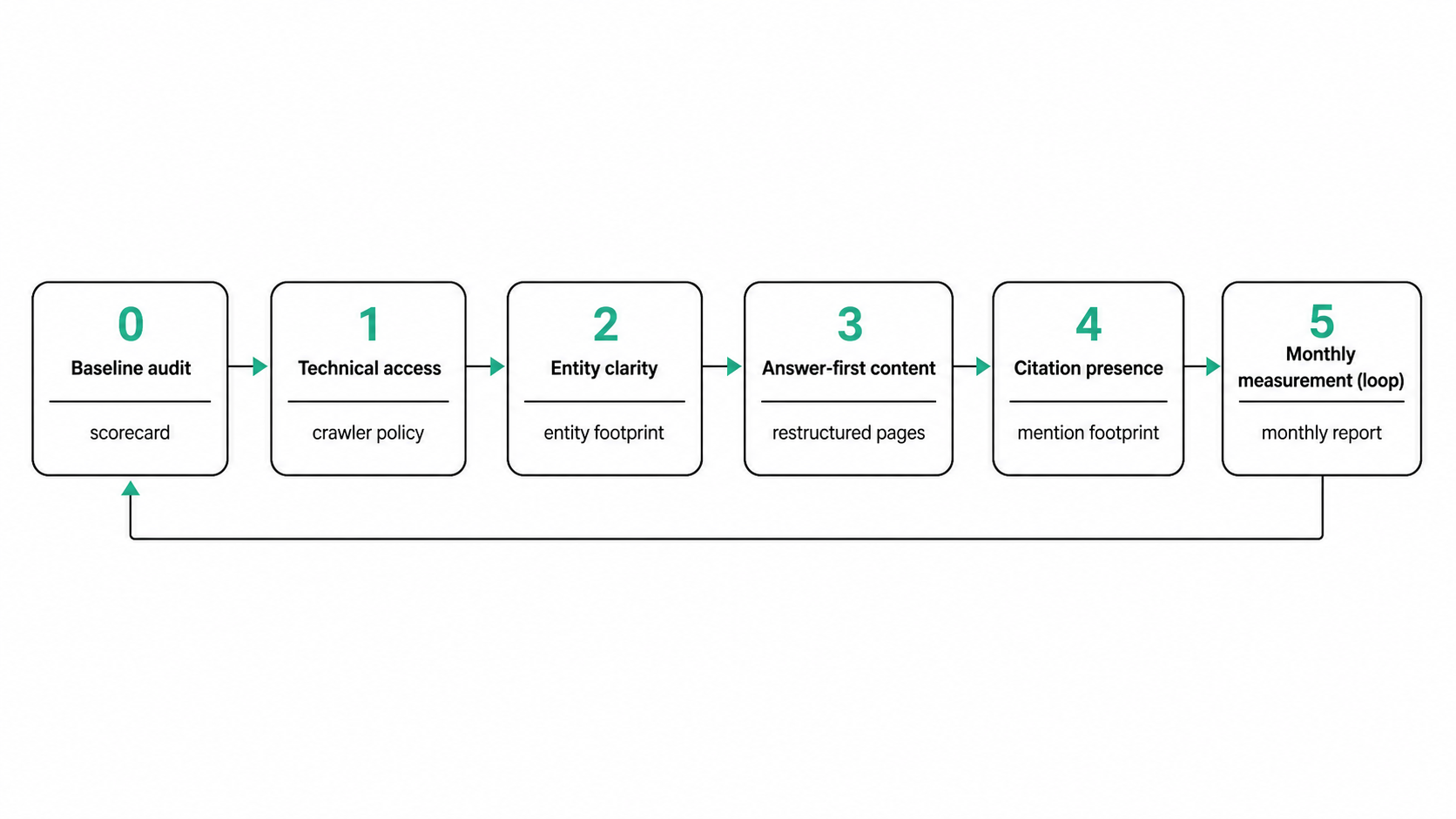
AI search optimization is the practice of making a brand’s website, content, and entity signals easy for AI systems — ChatGPT, Gemini, Google AI Overviews — to understand, trust, and cite in generated answers. This guide walks through the full working sequence: audit, technical access, entity fixes, answer-first content, citation building, and monthly measurement. For a medical practice, this sequence decides whether an AI assistant names your business — or a competitor’s — when a patient asks for a recommendation.
TL;DR
- AI search optimization is measured by citation rate — the share of a fixed set of buyer-intent prompts on which AI surfaces mention or cite your brand — not by rankings or traffic.
- Per Pew Research Center (March 2025 data), about 18% of Google searches produced an AI summary, and users clicked a result on only 8% of those searches versus 15% without one.
- The Princeton GEO benchmark study (arXiv:2311.09735, KDD 2024) reports visibility gains of up to 40% from source-citing, quotation, and statistics-focused edits.
- Google’s position: no special files or markup are required for AI Overviews or AI Mode — eligibility rides on standard indexability and structured data.
- Our pilot (Perplexity, August 3, 2026): category queries pull listicles and directories, definitional queries pull authority heavyweights, Reddit was the second-most-cited source type — which changes where you invest first.
What is AI search optimization?
AI search optimization is the discipline of earning brand citations inside AI-generated answers. The industry also calls it generative engine optimization (GEO) — the same practice, named from the technology side rather than the search-behavior side. For a medical practice, it applies when a patient asks ChatGPT about a procedure or compares providers in Gemini.
Generative engine optimization (GEO) is the practice of making a brand’s website, content, and entity signals easy for AI systems — ChatGPT, Gemini, Google AI Overviews — to understand, trust, and cite in generated answers.
For the atomic definition of the term, see our page on what AI search optimization is. This guide focuses on the working sequence — what to do, in what order, with what checks.
Why does AI search optimization matter now?
Because a growing share of search sessions now ends inside an AI answer, and the brands named there capture the decision before a click happens. Roughly one in five Google searches in March 2025 produced an AI summary, and users who saw one clicked through about half as often — 8% versus 15% (Pew, July 2025). Clicks on links inside the summaries: about 1% of visits.
Two more data points frame the opportunity honestly:
- Optimization is real, not folklore. The Princeton GEO paper (arXiv:2311.09735) benchmarked content-side changes — citing sources, adding quotations, adding statistics — and found visibility gains of up to 40% in generative answers, with effectiveness varying by domain. That caveat is why measurement (Step 5) is part of the discipline.
- The platforms don’t sell shortcuts. Google’s documentation on AI features states there are no additional requirements to appear in AI Overviews or AI Mode — no “AI text files,” no special markup. What is rewarded is the foundation: crawlable, indexable, people-first content with valid structured data.
The practical conclusion: this is not a new bag of tricks — it is a sequence of verifiable operations on the SEO foundation, measured by whether AI answers name you.
What does the implementation roadmap look like?
Six phases, each with a concrete deliverable and a success check. Phase 0 is a measurement every later phase is judged against. Technical access and entity clarity come before content work: an AI system cannot cite a page it cannot crawl or a brand it cannot confidently identify.
| Phase | Core actions | Deliverable | Success check |
|---|---|---|---|
| 0. Baseline audit (week 1) | Fixed battery of buyer-intent prompts across AIO, ChatGPT, Gemini, Perplexity; log mentions, citations, competitors | Baseline scorecard: citation rate per surface + who gets cited instead | Every prompt logged under identical conditions; source patterns documented |
| 1. Technical access (weeks 2–3) | Review robots.txt for AI crawlers (OAI-SearchBot, GPTBot), confirm indexation, fix render/login blockers | Explicit crawler-access policy + clean indexation | No unintended crawler blocks; priority pages indexed and fetchable |
| 2. Entity clarity (weeks 3–4) | Organization + specialty schema (MedicalClinic, Physician), consistent name/description across site and profiles | Consistent machine-readable entity footprint | Schema validates; same name and service scope everywhere you’re listed |
| 3. Answer-first content (weeks 4–8) | Question headings, 40–60-word direct answers, tables, FAQ blocks with FAQPage markup | Restructured priority pages | Each section quotable verbatim without surrounding context |
| 4. Citation presence (ongoing) | Verified directory profiles, community-thread contributions, review volume, inclusion in cited listicles | Third-party mention footprint | Your brand appears inside the pages AI answers actually cite |
| 5. Monthly measurement (ongoing) | Re-run the fixed battery; one hypothesis and one change per cycle | Monthly citation-rate report with trend | Movement attributable to specific changes across cycles |
Step 1 — Audit your current AI visibility
Start by measuring where you stand. Run a fixed set of buyer-intent prompts across Google AI Overviews, ChatGPT, Gemini, and Perplexity, and record whether your brand is mentioned, cited as a source, or absent. This baseline is the reference point for every change that follows.
AI visibility is the degree to which AI assistants and AI search features mention, cite, or recommend a brand in generated answers — measured by citation rate across a fixed set of prompts and platforms.
In practice, the audit is mechanical, and the discipline matters more than the tooling:
- Build the prompt battery once and freeze it. Cover the ways real buyers ask: category prompts ("best dental implant clinics in Austin"), task prompts, and offer prompts. Ours is 16 prompts — 4 themes × 4 phrasings.
- Clean session per surface. Logged out or incognito, fixed region, each prompt verbatim, no follow-up dialogue.
- Log three things per prompt: brand mentioned, brand linked as a source, and — critically — who got named or cited instead, capturing the sources tab where available.
- Expect zero and don’t panic. A practice or firm new to this work typically starts at or near 0. The baseline’s value is the pattern data: who is being cited and from where — that pattern prioritizes everything below.
Operational note: Perplexity runs in a clean browser session; ChatGPT and Gemini require logged-in manual runs; AI Overviews block automated querying — plan for a human executing the battery.
What do the three AI surfaces actually reward?
Each surface tests a different thing and pays a different currency, so a single “optimize for AI” effort wastes budget. The table combines what each surface evaluates with who actually gets cited — our data: Perplexity web, anonymous session, August 3, 2026, four buyer-intent prompts from our fixed battery.
| Surface | What is being tested | How to measure it | Who gets cited (observed patterns) |
|---|---|---|---|
| Google AI Overviews / AI Mode | Standard indexability, passage quality, snippet eligibility — no special markup required | Search Console “Web” report (includes AI-feature traffic) + manual prompt runs; automated querying is blocked | Sources largely overlap organic winners; passage-level answers and structured pages surface in the link panel |
| ChatGPT (search) + Gemini | Crawler access (OAI-SearchBot for ChatGPT search eligibility), entity confidence, third-party corroboration | Manual monthly runs in logged-in clean sessions; log mentions and cited links per prompt | Recommendation prompts lean on retrieved web sources — directories, reviews, pages that state plainly who serves whom |
| Perplexity | Live-web retrieval with a visible sources tab — the most transparent surface to study | Automatable clean-session runs; record answer + full sources list | Our Aug 3, 2026 pilot: category queries cited only listicles and directories (Clutch category page, DesignRush, agency “top-N” posts); an offer query cited Reddit three times — second-most-frequent source in the run; the definitional query cited only heavyweights (Semrush, Wikipedia, Coursera) |
Three practical conclusions we now build into every roadmap, drawn from that pilot:
- Category queries are won through lists, not homepages. Perplexity relayed third-party “top-N” pages and directory categories, not brands’ own sites. Being inside the cited lists moves citation rate faster than another homepage rewrite — Phase 4 belongs higher on the priority list than most guides admit.
- Reddit is a first-class source, not a side channel. With community threads cited multiple times in a four-prompt pilot, credible presence where buyers ask questions is both a demand channel and a citability asset — patient communities for a clinic, practice-area forums for a firm.
- Definitional queries are for authority, not citations. “What is…” answers cited only established heavyweights. Educational pages build topical authority, but aim citation expectations at category and offer prompts first.
Honest frame: this is a pilot — one surface, four prompts, a European IP (structure conclusions valid; US citation rates to be confirmed on the first full manual run). We publish the method so the numbers can be re-run.
Which technical checks make your site citable?
Before any content work, verify that AI systems can reach, parse, and attribute your pages. OpenAI publishes its crawler list — OAI-SearchBot surfaces sites in ChatGPT’s search results, GPTBot collects training data, ChatGPT-User handles user-initiated visits — each controlled independently via robots.txt. Many medical sites block these bots unintentionally through blanket firewall rules, then wonder why ChatGPT never cites them.
| Layer | What to check | How to verify |
|---|---|---|
| Crawlability | robots.txt not blocking Googlebot, OAI-SearchBot, or PerplexityBot on pages you want cited; GPTBot a deliberate policy decision, not an accident; no login walls on key pages; content renders without JS dependence | Fetch pages as each user agent; check server logs for 403s to AI crawlers; robots.txt tester |
| Entities | Organization schema plus specialty type (MedicalClinic / Physician); consistent name, address, description; sameAs links to verified profiles | Schema validator / Rich Results test; side-by-side sweep of every listing |
| Content | Question-form headings; self-contained 40–60-word answer opening each section; comparison tables; FAQPage markup; named author; dateModified that changes on update | Read each section out of context — if it needs the page around it, it is not extractable |
| Sources | Brand present in the directories, review platforms, and community threads AI answers in your category actually cite | Run your buyer prompts, open every cited source, check whether the cited pages include you — or could |
The Google side is unexciting by design: existing controls (nosnippet, max-snippet, noindex) govern AI-feature appearance, and AI-feature traffic reports in Search Console under “Web”. There is no separate “AI SEO” toggle.
Step 2 — Fix entity clarity
AI systems cite brands they can identify with confidence. Entity clarity means your organization is described consistently across your site and the web: Organization schema, the same name and description everywhere, and pages that state plainly who you serve and where.
An entity, in this context, is the machine-readable identity of your business — the thing an AI system resolves your brand name to. The checks:
- Structured data that matches reality. Organization schema plus the specialty type: MedicalClinic and Physician profiles for a clinic.
- One name, one description. “Smith Dental Implant Center” on the site, “Smith Dental” on Google Business Profile, and “Smith DDS PLLC” on a directory are three weak entities instead of one strong one.
- Plain-language service pages. “We do dental implant placement for patients in Austin, Texas” gives a retrieval system the who/what/where triple it needs to match a buyer’s prompt.
Entity fixes rarely produce a visible jump on their own — they remove the ambiguity that blocks citation. Do them once, and move on.
Step 3 — Restructure content answer-first
AI answers are assembled from passages, not pages. Each section of your content should open with a direct, self-contained answer of 40–60 words that an AI system can quote verbatim without surrounding context — definitions, steps, comparisons, and FAQs.
The working rules:
- Headings are questions buyers actually ask (“How much does a dental implant cost in Texas?”, “How long do I have to file a personal injury claim in Illinois?”) — retrieval matches prompts to passages, and a question heading is half the match.
- The first 40–60 words after the heading answer it completely. No throat-clearing; lifted out alone, the paragraph should still be true and useful.
- Put key comparisons in tables. Extraction systems take tabular structure more readily than prose — in our pilot, Perplexity returned a table-formatted comparison for the definitional query. Fee ranges, treatment options, filing deadlines: table them.
- FAQ blocks with FAQPage markup for the long tail of real patient and client questions, phrased the way people phrase them.
- Visible freshness. A named author, and published/modified dates that change when the content changes.
This page is written to the same standard — every section opens with a quotable answer, and the tables duplicate the key comparisons in extractable form.
Step 4 — Build citation presence
AI assistants lean on third-party sources when choosing which brands to name. Citation presence means your brand shows up where models already look: industry publications, directories, community threads, and review platforms. In our client work, consistent third-party mentions move citation rate faster than on-page edits alone.
Our pilot makes this concrete: on category prompts, Perplexity cited directory category pages and third-party listicles — not company sites. One agency’s own ranked listicle of “best healthcare SEO agencies,” with itself at №1, was relayed essentially verbatim. We don’t recommend inventing flattering rankings — but the lesson stands: ranked, comparative, methodology-backed pages get cited on category queries, and the honest version of that play is available to any practice or firm.
Priorities, in the order our data supports:
- Verified directories in your category. For an agency that means platforms like Clutch — where Rotgar holds a 5.0 rating across 26 verified reviews — because those category pages are exactly what got cited in our run. For a medical practice, the analog is the major provider directories.
- Community threads. Reddit was the second-most-frequently cited source type in our pilot (three citations on one offer query, July–August 2026 observation), and ranks top 3 organically across this cluster’s informational queries. Useful, disclosed, non-promotional answers are both a channel and a citability source.
- Reviews with volume and recency. Recommendation prompts pull from review corpora; a steady cadence beats a one-time push.
- Citable third-party mentions. Local press, professional associations, speaking pages — sources that are themselves cited lend citability downstream, and LLMs prefer sources that cite their own sources.
Step 5 — Measure monthly and iterate
The original published protocol specifies a fixed set of 16 buyer-intent prompts tested monthly across Google AI Overviews, ChatGPT, Gemini, and Perplexity, scored by citation rate. Keep the prompt set fixed between measurements, change one variable at a time, and re-measure.
The loop is deliberately boring: measure, form one hypothesis (“adding the practice to the two directories cited in March will lift category-prompt citations”), make that one change, re-measure a month later. Change five things at once and a movement teaches you nothing. Log the same three fields every cycle and keep dated screenshots, because surfaces change their answers.
Citation rate is the primary KPI; rankings and traffic are secondary signals here. What to change between cycles and in which order is a strategy question — we cover prioritization in our GEO strategy guide.
Which tools can monitor AI visibility?
Every tool below does a version of what this guide describes manually: running prompts against AI surfaces and logging brand mentions and citations. Choose by the surfaces and reporting depth you need — and keep a manual spot-check in the protocol, because automated access to some surfaces is restricted.
| Tool | What it does | Fits when |
|---|---|---|
| SE Ranking (AI tracking) | Tracks brand presence in AI Overviews and AI answers alongside classic rank tracking | You already run classic SEO reporting and want one stack |
| Semrush AI Toolkit | Brand mention and share-of-voice tracking across AI platforms, with competitor comparison | You need competitor benchmarking |
| Profound | Dedicated answer-engine monitoring: prompt-level citation tracking across AI assistants | AI visibility is a primary KPI and you want prompt-level diagnostics |
| Otterly.AI | Monitors brand mentions, links, and sentiment in AI search responses on a schedule | You want lightweight monitoring without an enterprise contract |
A fixed manual battery (Step 1) plus one tool is a reasonable setup: the tool provides the trend line, the manual runs provide screenshots and source-level detail.
What AI search optimization will NOT do
- It will not replace classic SEO. AI answers are assembled from the same sources SEO builds — this is an overlay, not a substitute, and Google says as much in its documentation.
- It will not guarantee citation. Nobody controls what ChatGPT or Gemini answers; platforms change models and source mixes without notice. Anyone selling “guaranteed citations” is selling weather.
- It is not paid placement. There is no ad slot inside an organic AI answer to buy.
- It is not a one-time setup. It is a measured cycle — audit, change, re-measure — assessed over months.
- It is not prompt-spam or “selling to ChatGPT.” The work is your site’s signals, your entity, and your external mentions — the same assets that serve human buyers.
Key takeaways
- AI search optimization is a sequence of verifiable operations — audit, technical access, entity clarity, answer-first content, citation presence, monthly measurement — scored by citation rate on a fixed prompt set.
- The shift is documented: ~18% of Google searches triggered AI summaries in March 2025, with click-through roughly halved (8% vs 15%) when one appeared (Pew Research Center).
- Optimization has measured upside — up to 40% visibility gains in the Princeton GEO benchmark — but efficacy varies by domain, so you measure instead of assume.
- Platform requirements are mundane: Google needs standard indexability and structured data; OpenAI’s crawlers are controlled via robots.txt — check you aren’t blocking them by accident.
- Our pilot (Perplexity, Aug 3, 2026): category queries are won inside cited listicles and directories, Reddit is a top-tier cited source, definitional queries cite only heavyweights — directory presence and community credibility outrank another blog post.
- Structure beats prose for extraction: question headings, 40–60-word self-contained answers, tables for key comparisons, FAQPage markup.
- One variable per monthly cycle. The prompt battery stays frozen; the changes rotate; the screenshots get dated.
FAQ
Is AI search optimization the same as SEO?
No. AI search optimization sits on top of the SEO foundation — crawlable, indexable content, E-E-A-T signals, clear entities — and adds what AI surfaces specifically reward: answer-first passages, structured data, citation presence, and measurement by citation rate instead of rankings.
Is AI search optimization the same as GEO?
In practice they name the same discipline from different angles: GEO from the technology (generative engines), AI search optimization from the user behavior. A buyer searching either term is looking for the same work — earning citations in AI-generated answers.
How long does AI search optimization take?
Honest answer: months, not weeks. Measurement cycles run monthly, and citation-rate movement is assessed across several cycles. Entity fixes and content restructuring can show early effects; durable citation presence is built over time. Anyone promising guaranteed timelines is guessing.
Can I do AI search optimization myself, or do I need an agency?
The steps in this guide are doable in-house — the sequence is deliberately operational. The hard part is discipline: a fixed monthly prompt audit, correct interpretation of citation-rate movement, consistent execution. As a managed service, that is what our AI search optimization services for medical practices are built around.
How do I know if AI search optimization is working?
By citation rate on a fixed prompt set, month over month. If the share of buyer-intent prompts where your brand is mentioned or cited is rising — and the movement ties to specific changes — the work is compounding. Rankings and traffic are secondary; the primary KPI is whether AI answers name you.
Should I block GPTBot in robots.txt?
It’s a policy decision, not a technical default. Blocking GPTBot opts your content out of OpenAI’s model training but does not affect ChatGPT search visibility — that is governed separately by OAI-SearchBot, per OpenAI’s crawler documentation. Practices and firms seeking AI visibility should allow OAI-SearchBot; the GPTBot decision is about training consent.