
TL;DR
- AI search optimization is the umbrella term for making a brand visible in AI-generated answers; GEO, AEO, LLM SEO, AIO, and LLMO label the same work from different angles.
- No consensus definition separating those terms existed in the academic literature as of early 2026, and practitioners use them interchangeably — so define one label, do not buy four services.
- It is an overlay on SEO, not a replacement: Google states there are “no additional requirements to appear in AI Overviews or AI Mode,” only that a page be indexed and snippet-eligible.
- The surfaces need different work: Semrush’s 2026 AI Visibility Index (126 million U.S. prompts) found ChatGPT cites about 15 sources per response while Gemini cites about 3.
- The stakes are click-side: Pew Research found AI summaries on ~18% of Google searches studied, with a traditional-result click in 8% of those searches versus 15% without one.
AI search optimization is the umbrella term for the practice of making a brand visible in answers generated by AI systems — the same discipline the industry also calls generative engine optimization (GEO), answer engine optimization (AEO), or LLM SEO. The terms overlap but are not identical: the differences are in emphasis, not in the substance of the work. For a medical practice, the umbrella covers one question: when a patient asks ChatGPT for a clinic recommendation, does the assistant name your business — or a competitor’s?
This page is the map: it fixes the vocabulary, shows which surface rewards what, and routes to the page answering each next question. The full working process lives in our AI search optimization guide.
How does AI search optimization map to SEO, GEO, AEO, and LLM SEO?
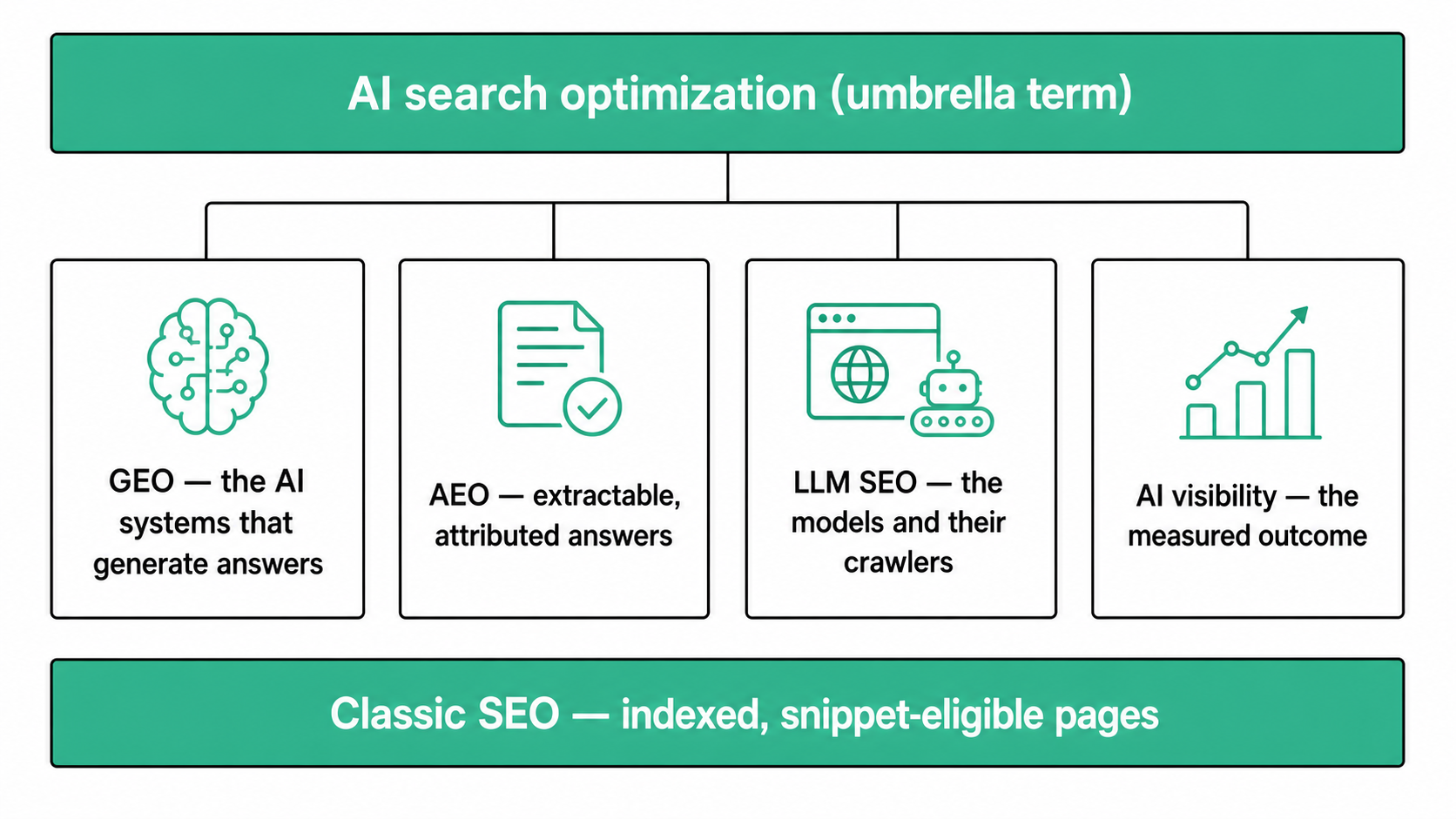
AI search optimization is the umbrella term; GEO, AEO, and LLM SEO name the same work from different angles — the systems optimized for (generative engines), the content structure (answer engines), or the underlying technology (large language models). Classic SEO sits underneath all of them as the foundation. The definitions below are the fixed canonical ones.
| Term | Canonical definition | What it covers in practice |
|---|---|---|
| Classic SEO | The practice of making a site findable and rankable in traditional search results — crawlability, indexation, relevance, authority. | The foundation: indexed, snippet-eligible pages AI systems can retrieve |
| Generative engine optimization (GEO) | Generative engine optimization (GEO) is the practice of making a brand’s website, content, and entity signals easy for AI systems — ChatGPT, Gemini, Google AI Overviews — to understand, trust, and cite in generated answers. | The systems generating answers: entity clarity, citable content, third-party corroboration |
| Answer engine optimization (AEO) | Answer engine optimization (AEO) is the practice of structuring content so answer engines — AI Overviews, voice assistants, chat-based search — can extract a direct, self-contained answer and attribute it to your brand. | Extractable answers: question-shaped headings, 40–60-word direct answers, tables, schema |
| LLM SEO | LLM SEO names the same discipline after the technology behind it — large language models. | The models: AI crawler access, presence in the sources models retrieve from |
| AI visibility | AI visibility is the degree to which AI assistants and AI search features mention, cite, or recommend a brand in generated answers — measured by citation rate across a fixed set of prompts and platforms. | The measurable outcome, not the practice — what you report monthly |
These are not four disciplines but one discipline with four labels — and that is documented, not just our opinion. Wikipedia’s entry on generative engine optimization notes that no consensus definition distinguishing the terms had been established in the academic literature as of early 2026, that they are used interchangeably by practitioners alongside AIO (artificial intelligence optimization) and LLMO (large language model optimization), and cites a Forrester analyst arguing the acronyms differ only slightly from traditional SEO, with vendors using distinct terms for market differentiation.
The consequence for a buyer: do not purchase “GEO” and “AEO” as two line items. Ask which surfaces are targeted, which signals change, and how the result is measured. For one deep dive, take generative engine optimization (GEO); if the AEO-versus-GEO boundary is the confusing part, see AEO vs GEO.
Which AI surfaces does AI search optimization cover?
As of August 2026, four surfaces matter: Google AI Overviews (and AI Mode), ChatGPT, Gemini, and Perplexity. They differ in how content gets in, how many sources they cite, and what you can measure — which is why one generic “AI optimization” package rarely fits all four. The citation counts below come from Semrush’s 2026 AI Visibility Index, built on 126 million U.S. AI search prompts from January to April 2026.
| Surface | How content gets in | Answer and citation format | What to measure |
|---|---|---|---|
| Google AI Overviews / AI Mode | Indexed, snippet-eligible pages from Google’s index; no special markup or AI-specific files | Summary block above results with a few inline source links | Presence in the AI block per prompt; Search Console clicks (reported under “Web”) |
| ChatGPT (with search) | Live-web retrieval via OAI-SearchBot, which must be allowed in robots.txt, plus model knowledge | Conversational answer citing ~15 sources, leaning on community and reference sites like Reddit and Wikipedia | Whether the brand is named; whether your domain is in the cited set |
| Gemini | Google’s ecosystem and index; a separate surface from AI Overviews | Conversational answer citing ~3 sources per response — a much narrower pool | Brand mention rate; mentions and citations diverge here (Semrush: overlap as low as 30%) |
| Perplexity | Live retrieval with an explicit sources tab on every answer | Answer with numbered, visible source links | Easiest surface to audit: read the sources list, log who is cited |
Two terms worth fixing, because the rest of the discipline depends on them. A citation is an attributed reference — the AI names or links your brand as a source inside its answer. An entity is the machine-readable identity of your business — what an AI system resolves your brand name to.
The access layer is where umbrella-level thinking pays off first. OpenAI’s crawler documentation separates OAI-SearchBot (surfacing sites in ChatGPT’s search features) from GPTBot (crawling for model training) and ChatGPT-User (user-triggered actions), each controlled independently in robots.txt. A blanket “block the AI bots” rule — common on clinic sites hardened by a cautious developer — quietly removes you from ChatGPT search results, when the training opt-out you wanted needed only the GPTBot line.
Is AI search optimization different from classic SEO?
AI search optimization does not replace SEO — it builds on it. AI answers are assembled from the same sources classic SEO optimizes: crawlable content, clear entities, trusted third-party mentions. Google Search Central confirms the framing: there are no additional requirements to appear in AI Overviews or AI Mode, no special schema or machine-readable files — a page must be indexed and eligible to be shown with a snippet, and the existing snippet controls (nosnippet, data-nosnippet, max-snippet) still apply.
The overlay adds what is specific to AI surfaces: passages written to be quoted verbatim, measurement by prompt sets instead of keyword rankings, entity data consistent enough for a model to resolve, and presence in the third-party sources models draw from. As a managed service, that is our AI search optimization work for medical practices.
The reason to add the layer now is click economics. Pew Research Center (2025) analyzed 68,879 Google searches from 900 U.S. adults in March 2025: about 18% produced an AI summary; users clicked a traditional result in 8% of those searches versus 15% without one, and clicked a link inside the summary only 1% of the time. Question-shaped queries — how patients and clients actually describe problems — triggered summaries 60% of the time, versus 8% for one-to-two-word searches.
What does our own measurement show about the umbrella?
The labels overlap, but the work does not: different query types are answered from entirely different source pools. In our baseline run (Rotgar, 2026-08-03: four prompts from our fixed battery, Perplexity, clean anonymous session, English, European IP), citation rate was 0/4 — the expected zero point for a site with no published AI hub — and the source patterns were the useful part.
| Prompt type | Example from our battery | What the answer was built from | Which layer of the umbrella that implies |
|---|---|---|---|
| Category / “who provides X” | Who provides generative engine optimization services? | No brands named directly; synthesized from third-party listicles and directories (Clutch’s GEO category, DesignRush, agency roundups) | Off-site citation presence — the entity and mention layer, not on-page work |
| Offer / “where can I get X” | Where can I get an AI visibility audit? | Named tools plus Reddit threads cited three times | Community presence and a self-serve offer page |
| Category with a ranked list | Best healthcare SEO agencies | Eight agencies in a table; the top-cited source was one agency’s own listicle placing itself first | Self-published comparison content with a transparent method |
| Definitional | What is generative engine optimization? | Semrush, Wikipedia, Coursera, Mailchimp, Seer Interactive | Topical authority — definitional pages rarely beat heavyweights for citations |
Honest frame: a four-prompt pilot on one surface from a non-US IP is directional, not a market study; our full protocol runs 16 buyer-intent prompts monthly across four surfaces. The reading still holds for choosing work: a dermatology clinic that wants to be named for “best dermatology practice in Miami” must exist in the directories and review platforms the engine cites.
What AI search optimization is NOT
- Not a replacement for classic SEO. It is an overlay on the same foundation — Google’s own documentation makes the index and snippet eligibility the prerequisite.
- Not paid placement. There is no ad slot inside an AI-generated answer to buy (August 2026).
- Not a guarantee of citation. Nobody controls what an AI assistant answers; the work controls the signals, not the output. “Guaranteed citations” sell something the platforms do not offer.
- Not a one-time setup. Models, retrieval behavior, and answer surfaces change monthly, so measurement and iteration are part of the discipline.
- Not a “ChatGPT trick.” The work happens at the level of content, entities, and third-party mentions — not platform hacks or prompt spam.
- Not four services. GEO, AEO, LLM SEO, and AIO are labels, not separate scopes; paying four times for one discipline is how this market overcharges.
Where should you go next?
Each question below has a page that answers it in full, so this one stays a map rather than a duplicate.
| If your question is… | Go to | What you get there |
|---|---|---|
| What does the most established term mean? | What is generative engine optimization? | The GEO definition, its academic origin, the four layers of work |
| How do I structure content so an AI can lift the answer? | What is answer engine optimization? | Answer-first passages, chunking, structured data |
| How do models pick sources? | What is LLM SEO? | Training data versus retrieval, and AI crawler control |
| How do I measure any of this? | What is AI visibility? and AI visibility score | The metric definition and the manual citation-rate formula |
| What separates AEO from GEO? | AEO vs GEO | A dimension-by-dimension comparison, and when each label fits |
| What do I actually do, in order? | AI search optimization guide | Audit, technical access, entities, content, citations, measurement |
Key takeaways
- AI search optimization is the umbrella term for making a brand visible in answers generated by AI systems; GEO, AEO, LLM SEO, AIO, and LLMO label the same discipline from different angles.
- The interchangeability is documented, not folklore — no consensus academic distinction as of early 2026, and analysts read the acronym spread as vendor differentiation.
- Classic SEO is the foundation, not a competing option: Google requires nothing special for AI Overviews or AI Mode beyond an indexed, snippet-eligible page.
- The surfaces are not one market. ChatGPT cites ~15 sources per answer against Gemini’s ~3 (Semrush, 126M prompts), and Perplexity exposes its sources — tactics and audits differ per surface.
- Crawler control is a lever with a failure mode: OAI-SearchBot governs ChatGPT search eligibility separately from GPTBot’s training crawl, so blanket AI blocks erase you from ChatGPT answers.
- The commercial case is click displacement: AI summaries on ~18% of searches studied by Pew, an 8% versus 15% click gap, and only 1% clicking inside the summary.
- Our pilot shows the work is query-shaped: category and offer queries are answered from listicles, directories, and Reddit; definitional queries from heavyweights — spend where your answers are sourced.
FAQ
Is AI search optimization the same as SEO?
No. It sits on the classic SEO foundation — crawlable content, E-E-A-T, clear entities — and adds what AI surfaces reward: extractable answer-first passages, structured data, third-party citation presence, and prompt-based measurement. Google confirms AI features use the same index and eligibility rules, so it extends SEO rather than replacing it.
Is AI search optimization the same as GEO?
AI search optimization is the umbrella term; GEO is the most established name for the same discipline. The work is identical — the difference is which aspect the label emphasizes. See generative engine optimization (GEO) for the term’s own definition page.
Is AI search optimization the same as LLM SEO?
They are overlapping labels for one discipline. LLM SEO names it after the underlying technology; AI search optimization names it after the user behavior. Either buyer is looking for the same work: entity signals, citable content, third-party presence, measurement.
Which AI platforms should a small business optimize for first?
Start with the surface you can measure. Perplexity shows its sources on every answer, making it the cheapest place to audit who gets cited for your money questions. Then check ChatGPT: it cites the widest source pool — about 15 per response — and rewards presence in directories and community threads.
Where do I start with AI search optimization?
Measure where you stand: run the buyer-intent questions your patients or clients ask AI assistants and record whether your brand is named, cited, or absent. The full sequence — audit, entity fixes, answer-first content, citations, measurement — is in our AI search optimization guide.
How do you measure AI search optimization results?
By citation rate on a fixed prompt set, re-measured on a schedule. The original published protocol specifies a fixed set of 16 buyer-intent prompts tested monthly across Google AI Overviews, ChatGPT, Gemini, and Perplexity, scored by citation rate.