
TL;DR
- LLM SEO is the practice of optimizing a brand’s website, content, and entity signals so large language models — ChatGPT, Gemini, Perplexity — understand, trust, and cite the brand in generated answers.
- The label is younger than the discipline: it names the same work practitioners call generative engine optimization (GEO), aimed specifically at chat surfaces. Wikipedia’s entry on the discipline notes the competing terms “are frequently used interchangeably in trade and practitioner contexts.”
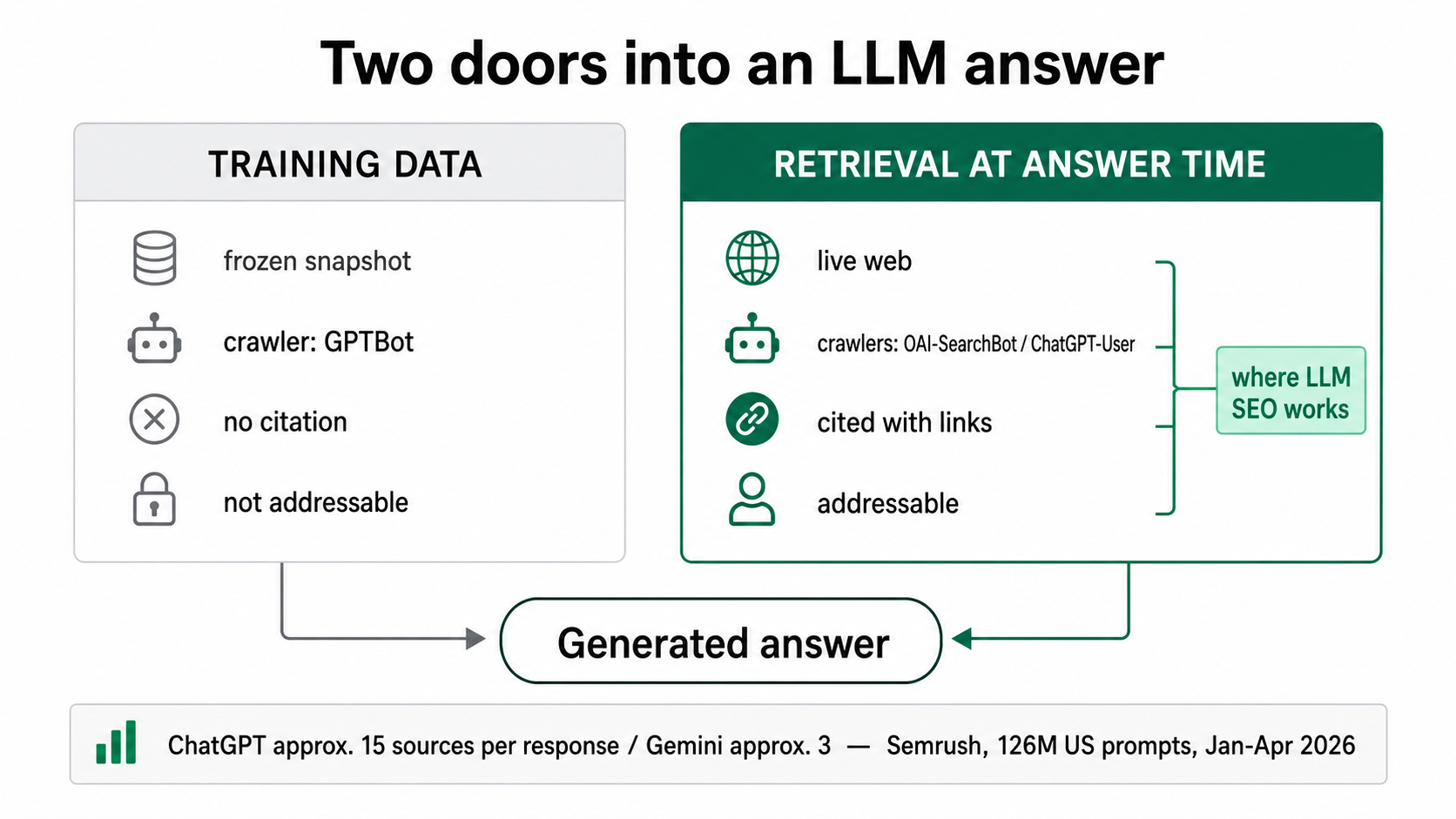
- Language models get your content through two different doors — training data (frozen, unaddressable) and retrieval at answer time (live, addressable). Almost everything you can actually influence sits behind the retrieval door.
- The most expensive technical mistake is a robots.txt line: OAI-SearchBot surfaces sites in ChatGPT’s search features while GPTBot crawls training content, and OpenAI states each setting “is independent of the others.”
- Surfaces are not equal gates. Semrush’s 2026 AI Visibility Index (126 million US prompts, January–April 2026) reports ChatGPT cites an average of 15 sources per response and Gemini about 3.
LLM SEO is the practice of optimizing a brand’s website, content, and entity signals so large language models — ChatGPT, Gemini, Perplexity — understand, trust, and cite the brand in generated answers. In current practice, LLM SEO is a younger label for the discipline most practitioners call generative engine optimization (GEO) — with its aim narrowed to LLM chat surfaces specifically (SERP observation, July 2026). For a medical practice, LLM SEO decides whether a chatbot names your business — or a competitor’s — when a patient asks for a clinic recommendation.
Is LLM SEO the same as generative engine optimization?
In practice, yes — LLM SEO and GEO describe the same discipline: making a brand easy for AI systems to cite. The difference is scope, not method: LLM SEO names the work when the target is specifically LLM chat surfaces, while GEO covers all generative answer engines, including Google AI Overviews.
For the fuller frame: Generative engine optimization (GEO) is the practice of making a brand’s website, content, and entity signals easy for AI systems — ChatGPT, Gemini, Google AI Overviews — to understand, trust, and cite in generated answers. The term has its own page: generative engine optimization (GEO).
The terminology is genuinely unsettled, and that is not our opinion. Wikipedia’s article on generative engine optimization lists answer engine optimization (AEO), large language model optimization (LLMO), artificial intelligence optimization (AIO), and AI SEO as alternative names for the same practice, and states the terms “are frequently used interchangeably in trade and practitioner contexts.” LLM SEO belongs to that family — the model-type label for the same body of work.
Each label emphasizes a different thing about the same practice: LLM SEO names the system type, GEO the outcome, AEO the content shape, and AI search optimization is the umbrella buyers actually use. Honesty about the label: the term LLM SEO arrived after the discipline itself, and as of July 2026 the search results for “LLM SEO” largely reproduce GEO content without a separate methodology (SERP observation, July 2026). What is real is the work, not the label — and this page defines the work. Where the terms genuinely diverge in emphasis, we break it down in AEO vs GEO.
How do large language models actually get your content?
Through two separate channels, and only one is worth optimizing. Training data is a frozen snapshot baked into the model months before you read this — you cannot edit it, target it, or measure it. Retrieval happens at answer time: the assistant runs a search, fetches live pages, and cites them. LLM SEO is retrieval work.
| Training data (pre-training / fine-tuning) | Retrieval and search (answer time) | |
|---|---|---|
| When your content enters | Before the model was built; a fixed cutoff | While the user’s question is being answered |
| Crawler involved (OpenAI example) | GPTBot — “used to crawl content that may be used in training” | OAI-SearchBot — “used to surface websites in search results in ChatGPT’s search features”; ChatGPT-User for user-initiated fetches |
| Can a new page reach it? | No — the snapshot is closed | Yes, as soon as it is crawlable and indexed |
| Does it produce a clickable citation? | No — the model reproduces knowledge without attribution | Yes — inline links and a named source list |
| What you can optimize | Broad entity presence across the corpus: consistent name, third-party mentions, long-lived reference pages | Crawler access, indexation, answer-first passages, tables, schema, third-party corroboration |
| How you measure it | Indirectly, via brand-name prompts asked without search | Directly: citation rate across a fixed prompt set, per surface |
| Practical verdict | Background effect, no lever with a deadline | The entire working surface of LLM SEO |
The distinction has one blunt consequence: a new page can be cited by ChatGPT this week and still be invisible to the model’s training knowledge for a year or more. Confusing the two channels is the most common technical error we find in audits.
Surfaces also differ in how much room they give you. Per Semrush’s 2026 AI Visibility Index — built on 126 million US AI search prompts from January through April 2026 — ChatGPT cites an average of 15 sources per response while Gemini cites about 3. Fifteen slots is a wide gate; three is a podium. The same index found only 36 brands held visibility across every platform in every month of the period — per-surface optimization is the norm, not the exception.
Which AI crawlers must you allow, and which are a policy choice?
Two of OpenAI’s crawlers govern visibility and one governs training consent. OpenAI’s crawler documentation states that “each setting is independent of the others — for example, a webmaster can allow OAI-SearchBot in order to appear in search results while disallowing GPTBot.” Blocking GPTBot does not remove you from ChatGPT search. Blocking OAI-SearchBot does.
| User agent (OpenAI) | Documented job | Effect if you block it | Sensible default |
|---|---|---|---|
| OAI-SearchBot | Surfaces websites in search results in ChatGPT’s search features | You lose eligibility to be cited in ChatGPT search answers | Allow |
| ChatGPT-User | Used for certain user actions in ChatGPT and Custom GPTs | A user who asks ChatGPT to open your page gets nothing back | Allow |
| GPTBot | Crawls content that may be used in training foundation models | Your content is excluded from training; search visibility is unaffected | Deliberate policy choice, not an accident |
| OAI-AdsBot | Validates the safety of pages submitted as ads on ChatGPT | Ad-related checks fail | Relevant only if you advertise |
# Visible in ChatGPT search, opted out of training
User-agent: OAI-SearchBot
Allow: /

User-agent: ChatGPT-User
Allow: /

User-agent: GPTBot
Disallow: /
The failure we see in practice is never a considered policy. It is a blanket bot rule at the CDN or firewall level, written for scrapers years ago, that catches every unfamiliar user agent — including the ones that decide whether an assistant can cite you. Check robots.txt and your edge rules before commissioning content; the deeper walkthrough is in our ChatGPT SEO guide.
How does LLM SEO differ from classic SEO?
LLM SEO builds on the same foundation as SEO: crawlable content, clear entities, trusted third-party mentions. LLM answers are assembled from sources that classic SEO work creates — LLM SEO adds passage-level citability and prompt-based measurement on top. It is an overlay, not a replacement.
| Dimension | Classic SEO | LLM SEO |
|---|---|---|
| What competes | A page in a ranked list | A passage inside one generated answer |
| Primary metric | Position and organic clicks | Citation rate across a fixed prompt set |
| Query unit | Keywords with search volume | Prompts — long, conversational, often multi-part |
| Winning content shape | Keyword-targeted pages with topical depth | Self-contained passages, tables, dated statistics, quoted sources |
| Off-site currency | Backlinks and domain authority | Presence in the sources engines retrieve: directories, listicles, reviews, community threads |
| Ranking dependency | Top 3 is the prize | Semrush found ChatGPT cites pages ranking 21 or lower almost 90% of the time |
| Technical gate | Googlebot access and indexation | The same, plus per-model crawler policy (OAI-SearchBot, GPTBot, PerplexityBot) |
| Failure mode | You rank on page two | You are absent from the answer; the user never sees a list to scroll |
That ranking row reverses an old assumption. Semrush’s AI search traffic study (July 2025, 500+ topics) found ChatGPT cites webpages ranking in position 21 or lower almost 90% of the time, and that the average AI search visitor is 4.4 times as valuable as a traditional organic visitor by conversion rate. A page that never cracked the top ten can still be quoted — and the visitor it sends is worth more.
What LLM SEO adds concretely: answer-first passages a model can quote verbatim, tables that survive extraction intact, measurement by citation rate instead of rank tracking, and deliberate presence in the sources models retrieve. The academic backing is the paper that named the discipline — GEO: Generative Engine Optimization (Aggarwal et al., KDD 2024), which reported visibility gains in generative responses of up to 40% from structural tactics. The service layer of this work is our LLM SEO services for medical practices.
The measure across all of it is AI visibility. AI visibility is the degree to which AI assistants and AI search features mention, cite, or recommend a brand in generated answers — measured by citation rate across a fixed set of prompts and platforms. The levels of visibility are on what is AI visibility.
What does our own measurement say about where LLM answers come from?
That the sources are rarely the vendors themselves. In our baseline pilot (Rotgar, 2026-08-03: four prompts from our fixed 16-prompt battery, run in Perplexity, clean anonymous session, English, European IP), we scored 0/4 — the expected zero point for a site that has not yet published this hub. The useful finding was the shape of the source lists.
| Prompt tested | What the answer named | What it actually cited |
|---|---|---|
| “Who provides generative engine optimization services?” | No individual brands — general categories only | Third-party listicles and directories: Clutch’s GEO category, DesignRush, agency roundups |
| “Where can I get an AI visibility audit?” | Named tools and self-serve checkers | A vendor blog, Reddit threads (cited three times), YouTube |
| “Best healthcare SEO agencies” | A ranked table of eight agencies | Two agencies’ own self-published listicles — the #1-ranked firm was citing itself |
| “What is generative engine optimization?” | A definition plus a comparison table | Heavyweights only: Semrush, Wikipedia, Coursera, Mailchimp |
Three readings for LLM SEO specifically. Retrieval favors aggregators: asked to name providers, a model reaches for lists of providers, so being in the lists is the work — not polishing a services page nobody retrieves. Community content is a first-class source, not a nice-to-have; Reddit outranked every individual vendor site on the audit-intent prompt. And head definitions are already owned — a small site should publish definitional pages for topical authority and internal linking, then expect its citations to come from narrower prompts.
Honest frame: this was a four-prompt pilot on one surface from a non-US IP, not a market study. Our full protocol runs all 16 prompts monthly across four surfaces, and we treat the pilot as directional about source structure rather than US market share.
What LLM SEO is NOT
- Not a separate discipline with its own methodology. In practice it is GEO aimed at LLM surfaces (SERP observation, July 2026).
- Not a replacement for SEO. It is an overlay: if a model’s retrieval layer cannot crawl and parse you, nothing downstream matters.
- Not a guarantee of citation. Nobody controls what ChatGPT or Gemini answers. Any vendor promising guaranteed citations is selling something the platforms do not offer.
- Not prompt-spam or “training the model on yourself.” Training data closed months ago; the work is your site’s signals, your entity, and your external mentions.
- Not paid placement. As of August 2026 there is no way to buy a mention inside a generated answer.
- Not a one-time setup. Platforms change monthly; measurement and iteration are part of the discipline.
LLM SEO is also not answer engine optimization (AEO) — AEO is about structuring content so answer engines can extract a direct, attributed answer.
Key takeaways
- LLM SEO is the practice of optimizing a brand’s website, content, and entity signals so large language models understand, trust, and cite the brand in generated answers — the same work sold as GEO, aimed at chat surfaces.
- The industry treats LLM SEO, GEO, AEO, LLMO, and AI SEO as largely interchangeable; judge providers by method, not vocabulary.
- Models reach your content two ways — frozen training data and live retrieval — and only retrieval is addressable.
- OpenAI’s crawlers are independently controlled: OAI-SearchBot governs ChatGPT search visibility, GPTBot governs training consent. Blocking the wrong one silently removes you from answers.
- Surfaces are unequal gates: ChatGPT cites roughly 15 sources per response, Gemini about 3 (Semrush, 126M US prompts, January–April 2026) — one generic “AI search” plan serves neither.
- Ranking is not the entry ticket it used to be — ChatGPT cites pages at position 21 or lower almost 90% of the time, and AI-referred visitors convert at 4.4x the rate of organic ones (Semrush, 2025).
- Our own pilot (Perplexity, 2026-08-03, 0/4) shows where citations come from: directories, listicles, and Reddit for provider questions; established publishers for head definitions.
FAQ
Is LLM SEO the same as GEO?
In practice, yes — the same body of work. The difference is aim: LLM SEO targets chat-surface LLMs specifically, while generative engine optimization (GEO) covers all generative answer engines, including AI Overviews. Wikipedia’s entry notes the trade terms are frequently used interchangeably.
Is LLM SEO the same as AEO?
No. AEO is about structuring content so answer engines can extract a direct, attributed answer — a different aim, much shared work. See answer engine optimization.
Is LLM SEO a real discipline or a buzzword?
The label is younger than the discipline. What is real is the work: prompt-set measurement, citable passages, entity signals, and crawler policy. Judge any provider — including us — by whether they can show those four, not by the term they use.
Should I block GPTBot in robots.txt?
That is a training-consent decision, not a visibility one. Per OpenAI’s documentation, each crawler setting is independent: you can disallow GPTBot to keep content out of model training while allowing OAI-SearchBot so ChatGPT search can still cite you. Blocking OAI-SearchBot is what costs visibility.
How do you measure LLM SEO results?
By citation rate across a fixed prompt set. The original published protocol specifies a fixed set of 16 buyer-intent prompts tested monthly across Google AI Overviews, ChatGPT, Gemini, and Perplexity, scored by citation rate.
Does LLM SEO work for medical practices?
Yes — under stricter rules. Healthcare is a YMYL category, so brands pass a double trust gate: search quality standards plus the model's caution with health topics. Entity clarity and licensed authorship — a named physician — decide more than keyword coverage.