
ChatGPT SEO is the practice of making a brand’s website and content easy for ChatGPT to find, understand, and cite in its answers — the ChatGPT-focused part of generative engine optimization (GEO). Generative engine optimization (GEO) is the practice of making a brand’s website, content, and entity signals easy for AI systems — ChatGPT, Gemini, Google AI Overviews — to understand, trust, and cite in generated answers. For a clinic, it decides whether ChatGPT names your practice or a competitor’s when a patient asks for a recommendation.
TL;DR
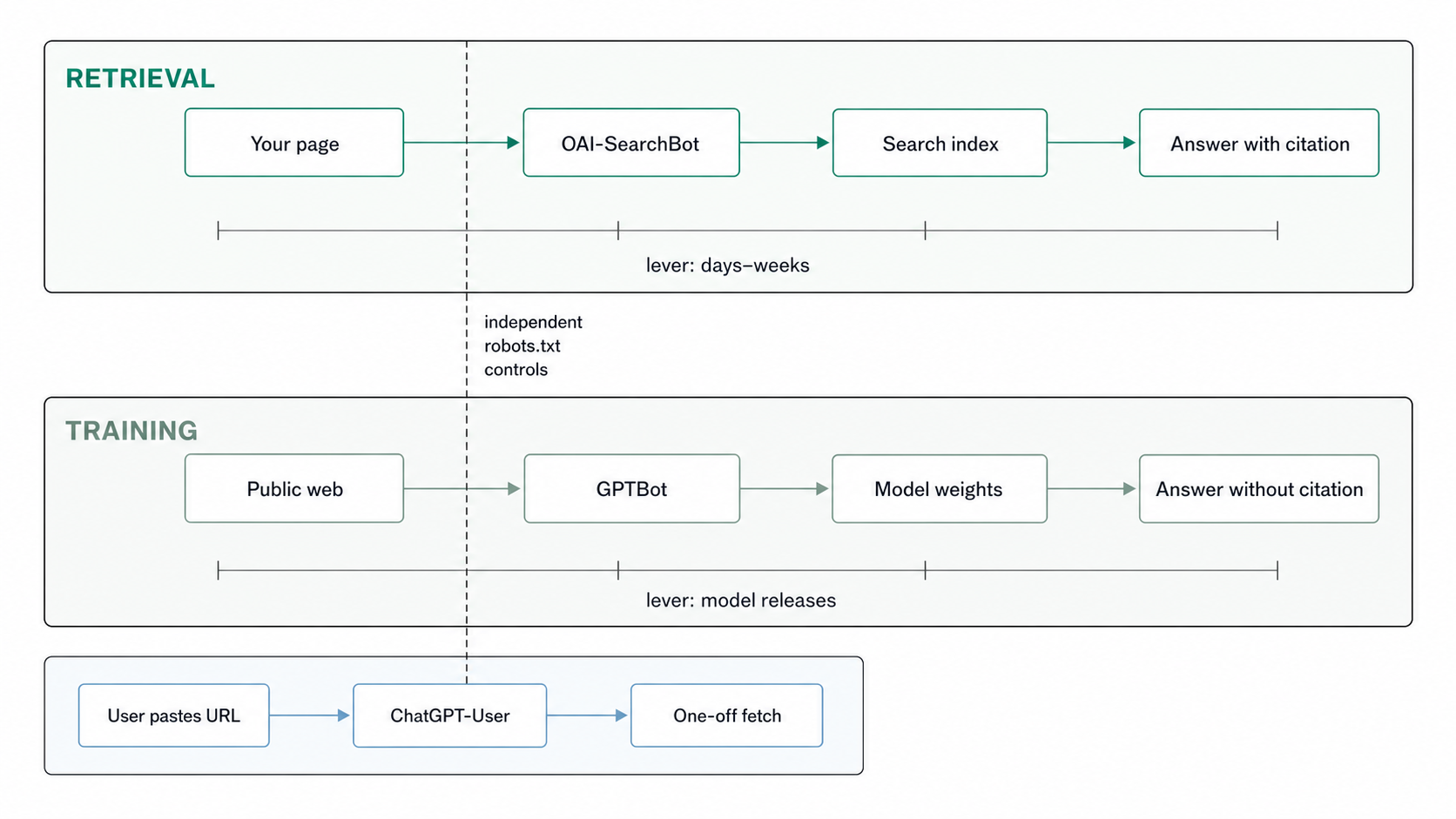
- ChatGPT reaches your content on two paths — live retrieval (ChatGPT search) and model knowledge fixed at training time. Only retrieval responds to changes you make this month, and one crawler governs it: OAI-SearchBot.
- Per OpenAI’s crawler documentation, “Sites that are opted out of OAI-SearchBot will not be shown in ChatGPT search answers,” while disallowing GPTBot only signals content “should not be used in training generative AI foundation models.” The settings are independent.
- ChatGPT is citation-hungry: Semrush’s 2026 AI Visibility Index, built on 126 million US prompts from January–April 2026, reports ChatGPT cites an average of 15 sources per response versus 3 for Gemini — five times more slots to compete for.
- The Princeton-led GEO paper (arXiv:2311.09735, KDD 2024) reports optimizations that “boost visibility by up to 40% in generative engine responses,” with the strongest gains from adding citations, quotations, and statistics — and none from keyword stuffing.
- Our pilot (Perplexity, 4 prompts, August 3, 2026, citation rate 0/4): category questions were answered from third-party listicles and directories, never from a company’s own homepage. On category prompts the work is off-site, not on-page.
What is ChatGPT SEO, and how does it differ from classic SEO?
ChatGPT SEO is classic SEO plus a citation layer. The foundation is unchanged — crawlable pages, clear entities, real expertise — because ChatGPT search is grounded in web content it can fetch and read. Added on top: passage-level extractability, third-party citation presence, and a different scoreboard — citation rate instead of rankings.
The practical difference is what you optimize the page for. Classic SEO optimizes a page to be chosen and clicked; ChatGPT SEO optimizes a passage to be quoted. A page can rank on page one of Google and never be cited, because the model could not lift a clean, self-contained answer out of it — while a modest page with one perfectly extractable definition gets cited repeatedly.
The second difference is the unit of competition. In Google, one blue link is one slot. In ChatGPT, an answer assembles many sources at once — an average of 15 per response in Semrush’s 126-million-prompt dataset — so the surface is less winner-take-all. That is good news for a small practice or a two-partner firm: you need not outrank a national directory, only be one of the sources the model can justify naming.
The same discipline applied across every AI surface at once is covered in our AI search optimization guide. This page stays on ChatGPT.
How does ChatGPT actually get your content?
Your brand reaches a ChatGPT answer along three distinct paths, each with a different lever and a very different feedback speed. Confusing them is the most common mistake in ChatGPT SEO — most advice about “training the model on your brand” targets the path you can least influence.
| Path | How your content enters the answer | What you actually control | How fast changes show up |
|---|---|---|---|
| Retrieval — ChatGPT search | ChatGPT searches, fetches candidate pages, cites the ones it can extract an answer from | Crawlability for OAI-SearchBot, page extractability, freshness, third-party sources retrieved alongside you | Days to weeks — the working lever |
| Model knowledge — training data | Facts absorbed into model weights at training time; surfaced with no live fetch and no citation | Only indirectly: how widely and consistently your brand is described across the public web. GPTBot access is a consent decision, not a ranking lever | Model releases — months, never guaranteed |
| User-initiated fetch — ChatGPT-User | A user pastes your URL or asks ChatGPT to open your page mid-conversation | That the page renders without JavaScript-only content or a hard paywall | Immediate, one user at a time |
Two consequences. You cannot push facts into a model’s weights, but you can make sure that every time ChatGPT searches, your page is retrievable and quotable. And unlinked model knowledge is not measurable visibility — a mention with no citation cannot be attributed or audited. The retrieval path is where the measurable work lives.
Which ChatGPT surfaces expose a brand?
As of August 2026, ChatGPT exposes brands on three surfaces: ChatGPT search (web-grounded answers with cited sources), ChatGPT shopping (product-style results, including Instant Checkout), and ChatGPT agent (multi-step tasks in which the assistant browses and acts on the web). Each surface reads overlapping but different signals.
| Surface | What it does | What you optimize for it | Relevance for a practice or firm |
|---|---|---|---|
| ChatGPT search | Answers grounded in fetched web content, with cited sources | OAI-SearchBot access, answer-first passages, entity clarity, third-party citations | Primary — recommendation questions are answered here |
| ChatGPT shopping | Product-style results and comparisons, including Instant Checkout | Product structured data, accurate pricing and availability | Low for services; matters if you sell physical products |
| ChatGPT agent | Multi-step tasks: comparing providers, filling forms, booking | Machine-readable service pages, working non-JS forms, visible scheduling paths | Rising — an agent that cannot use your booking form uses a competitor’s |
Surface names and mechanics reflect OpenAI’s public documentation as of August 2026 and change quickly — re-verify at each content refresh.
Which OpenAI crawlers control your ChatGPT visibility?
OpenAI documents four crawlers with separate jobs and independent robots.txt controls. The one that decides ChatGPT search visibility is OAI-SearchBot: per OpenAI’s documentation, “Sites that are opted out of OAI-SearchBot will not be shown in ChatGPT search answers.” GPTBot governs training-data collection only, and the documentation is explicit that “Each setting is independent of the others.”
| User-agent | Job | What blocking it does | Recommendation |
|---|---|---|---|
| OAI-SearchBot | Surfaces websites in ChatGPT search results | Removes you from ChatGPT search answers | Allow — this is the visibility switch |
| GPTBot | Collects data for training generative AI foundation models | Signals content should not be used in training; no effect on ChatGPT search | Content-rights decision, not an SEO one |
| ChatGPT-User | User-initiated actions in ChatGPT and Custom GPTs; “not used for crawling the web in an automatic fashion” | Because actions are user-initiated, “robots.txt rules may not apply” | Allow, and check the page renders on a plain fetch |
| OAI-AdsBot | Validates safety of submitted ad landing pages; its data “is not used to train generative AI foundation models” | Only relevant if you run OpenAI ads | Irrelevant to organic citation work |
A baseline robots.txt pattern for a practice or firm that wants ChatGPT search citations but not training use:
User-agent: OAI-SearchBot
Allow: /

User-agent: ChatGPT-User
Allow: /

User-agent: GPTBot
Disallow: /
Two caveats. Robots.txt directives are requests to compliant crawlers, not enforcement — OpenAI publishes IP ranges per crawler, so verify real visits against those ranges in your logs. And blanket template rules do damage: a User-agent: * / Disallow: / left over from staging blocks OAI-SearchBot along with everything else, and we have found exactly that on live sites during audits. Check this before any content work — one misplaced disallow line undoes every other item on this page.
What does the ChatGPT optimization roadmap look like?
Six steps, in order, each with a deliverable you can point at and a check that passes or fails. The sequence is front-loaded with access and entity work, because content edits on a site ChatGPT cannot fetch — or a brand it cannot resolve — return nothing.
| # | Step | Work | Deliverable | How to verify |
|---|---|---|---|---|
| 1 | Baseline measurement | Run a fixed prompt battery in ChatGPT; log mentions, citations, competitors named | Dated scorecard: citation rate plus screenshots | Re-running the same prompts next month yields a comparable number |
| 2 | Crawler access | Audit robots.txt, CDN and WAF rules, server logs for OAI-SearchBot | One-line crawler policy plus log evidence | OAI-SearchBot appears in logs with 200 responses |
| 3 | Entity clarity | Organization schema; one consistent name and description everywhere; plain service and practice-area pages | Entity footprint: same name and description across site and directories | Ask ChatGPT “what is [brand]” — the answer is correct and specific |
| 4 | Answer-first restructuring | Question headings; 40–60-word self-contained answer under each; tables; FAQPage markup | Restructured priority pages with visible author and dateModified | Any section lifted out still reads as a complete answer |
| 5 | Citation presence | Get listed where your buyer prompts are already sourced from: directories, review platforms, community threads, trade press | Mention footprint mapped to the sources cited in step 1 | Re-run the prompts; your name appears inside sources ChatGPT already trusts |
| 6 | Monthly re-measurement | Same battery, same wording, one variable changed per cycle | Monthly report: citation rate by surface, plus change log | Movement ties to one change, not to five at once |
Steps 1 and 6 are the same operation at two ends of a loop, and skipping them turns ChatGPT SEO into superstition: without a dated zero point, no one can tell whether a citation appeared because of your schema or because OpenAI shipped a new model that week.
“Entity clarity” in step 3 means the machine-readable identity of your business. A clinic listed as “Smith Dental Implant Center” on its site, “Smith Dental” on Google Business Profile, and “Smith DDS PLLC” in a directory is three weak entities instead of one strong one.
The condensed version of this sequence is on our page on how to rank in ChatGPT answers; the retrieval mechanics behind step 2 go deeper in what LLM SEO is.
What makes a page quotable by ChatGPT?
A quotable page is one where any single section survives being lifted out of it. ChatGPT assembles answers from passages, so the unit of optimization is the passage, not the page: a question-shaped heading, a direct 40–60-word answer beneath it, and enough context that the paragraph stays true and useful with the rest of the page removed.
What makes a passage extractable:
- Answer-first ledes. State the answer, then explain it. A section that opens with background is one a model must summarize rather than quote — and summaries lose attribution.
- Facts with numbers, sources, and dates. The GEO paper’s tested edits — adding citations, quotations, and statistics — produced the largest visibility gains, up to 40%, while keyword stuffing scored below the unmodified baseline. Pages that cite their own sources get cited more.
- Tables for anything comparative. Prices, options, timelines, procedure comparisons, filing deadlines. Extraction systems take tabular structure readily; in our pilot the definitional prompt produced an answer built around a comparison table.
- Entity-anchored language. "We place dental implants for patients in Austin, Texas" gives a retrieval system the who/what/where triple that matches a prompt. “Comprehensive solutions for your needs” gives it nothing.
- Visible freshness and authorship. A named author with real credentials, and a dateModified that changes when the content does.
A self-test for any page you care about: paste one section into a blank document and ask whether a stranger could act on it. If they need the page around it, ChatGPT does too.
Where does ChatGPT find third-party evidence about your brand?
Mostly not on your website. On category and recommendation questions — “best X in Y,” “who provides Z” — answers are assembled from third-party listicles, directories, review platforms, and community threads. Your pages establish what you do; other people’s pages decide whether you make the shortlist.
Our own data (pilot, August 3, 2026). We ran 4 prompts from our fixed 16-prompt battery on Perplexity, in an anonymous browser session on a European IP. Citation rate: 0/4 — the expected zero point for a low-authority site with a just-launched hub. The useful part was not the zero but the structure of what got cited instead:
| Prompt type | What the answer contained | What it cited |
|---|---|---|
| Category (“who provides GEO services”) | No brand names at all — generic categories | Directory category pages and third-party listicles (Clutch, DesignRush, agency roundups) |
| Offer (“where can I get an AI visibility audit”) | Named tools, plus advice to find an agency | Vendor pages, three separate Reddit threads, YouTube |
| Category, healthcare (“best healthcare SEO agencies”) | A ranked table of eight agencies | Two agencies’ own ranking posts — one places itself at №1 and quotes its own invented “AI Visibility Score 4.9/5” |
| Definitional (“what is generative engine optimization”) | Definition plus a comparison table | Heavyweights only: Semrush, Wikipedia, Coursera, Mailchimp |
Honest framing: this is a pilot, not a study — 4 prompts, one surface, one session, one date. It establishes no rates. It does show source types, and those held across all four answers.
Three things follow. Category prompts are won inside other people’s lists, so directory and listicle presence outranks another blog post. Community threads are a real citation channel — Reddit was the second-most-frequent source type in our run, and useful, disclosed, non-promotional participation is the only version of that play that survives a moderator. Definitional prompts are not worth chasing; their value is topical authority.
The pattern matches the largest public correlation study on the subject: Ahrefs’ analysis of 75,000 brands and AI Overview mentions found branded web mentions correlating at 0.664 against 0.218 for number of backlinks. That study measures Google’s surface, not ChatGPT, and its authors state plainly that “correlation ≠ causation” — but it points the same direction our run did: toward being talked about rather than merely linked to.
How do you measure ChatGPT visibility?
By citation rate on a fixed prompt set, re-run on a schedule: the share of buyer-intent prompts where ChatGPT mentions or cites your brand. Ten to twenty prompts phrased the way buyers actually phrase them, run in a clean session, logged with screenshots, repeated monthly with the wording frozen between runs.
One warning from our own protocol work: ChatGPT is the hardest major surface to measure automatically, because anonymous sessions hit a login wall. That is why our August pilot ran on Perplexity — the one surface we could automate cleanly. Plan ChatGPT measurement as a manual, logged-in, screenshot-based routine on a fixed date, and ask any vendor claiming frictionless automated ChatGPT tracking how it works.
Log four fields per prompt: was the brand named, was it linked, which competitors appeared, which sources the answer cited. The fourth generates the work — a literal list of pages you need to be mentioned on. Turning that log into a single number is covered on our page about the AI visibility score.
What to do and what to skip
The table separates practices with a documented or measured basis from the ones circulating on confidence alone. As of August 2026 no major platform requires a special AI file: Google’s documentation states that “You don’t need to create new machine readable files, AI text files, or markup to appear in these features,” and OpenAI documents control through robots.txt only.
| Don’t | Do instead | Why |
|---|---|---|
Block or ignore OAI-SearchBot, or copy a blanket Disallow: / from a template |
Explicitly allow OAI-SearchBot; verify fetches in server logs | Opting out of OAI-SearchBot removes you from ChatGPT search answers (OpenAI documentation) |
| Treat allowing GPTBot as an SEO tactic | Decide GPTBot on content-rights grounds alone | GPTBot governs training, not search; the settings are independent |
| Add an llms.txt file and call the job done | Fix crawler access, schema, and passage structure | No major platform documents such a file as a requirement |
| Stuff pages with “ChatGPT,” “AI search,” and target phrases | Add citations, statistics, and quotable specifics | Keyword stuffing scored below the unmodified baseline in the GEO benchmark; citations and statistics scored highest |
| Publish a flattering self-ranking with an invented proprietary score | Publish comparative content with a disclosed method and honest limits | Self-listicles get cited — and are the fastest way to lose credibility when the method is examined |
| Chase definitional queries for citations | Chase category, comparison, and offer queries | Definitional answers cite encyclopedic heavyweights; buying decisions happen on category prompts |
| Re-measure with reworded prompts | Freeze prompt wording between cycles | Changed wording is a different question; the comparison becomes meaningless |
What ChatGPT SEO will NOT do
- It will not guarantee citation. OpenAI publishes no ranking rules for which sources an answer names. Anyone selling guaranteed ChatGPT citations is selling weather.
- It is not paid placement. As of August 2026 there is no ad product that buys a brand into the organic body of a ChatGPT answer.
- It does not replace classic SEO. Retrieval runs on the same crawlable, indexable, trustworthy web that SEO builds. This is an overlay.
- It is not a one-time robots.txt fix. Surfaces, crawlers, and model behavior change on OpenAI’s schedule, not yours; the work is a measured cycle.
- It will not fix thin third-party evidence. With few reviews, no directory presence, and no external mentions, no amount of on-page structure makes a model confident enough to recommend you.
- It does not cover Gemini or AI Overviews. Those surfaces read overlapping but distinct signals and are measured separately.
Key takeaways
- ChatGPT reaches your content by retrieval and by training knowledge; only retrieval responds to work done this quarter, and OAI-SearchBot is its single access gate.
- The crawler controls are independent: blocking GPTBot is a content-rights decision with no effect on ChatGPT search, while blocking OAI-SearchBot removes you from ChatGPT search answers entirely.
- ChatGPT cites an average of 15 sources per response against Gemini’s 3 (Semrush, 126M US prompts) — more slots, lower barrier per slot, and a reason to aim for the considered set rather than first place.
- The roadmap is six ordered steps: baseline, crawler access, entity clarity, answer-first restructuring, citation presence, monthly re-measurement — each with a deliverable that either exists or does not.
- Extractability is the on-page discipline: question headings, 40–60-word self-contained answers, tables, named author, real dateModified. The GEO benchmark gained up to 40% from citations and statistics; keyword stuffing lost ground.
- Category and recommendation prompts are answered from third parties. Our pilot (Perplexity, August 3, 2026, 0/4) saw directories, listicles, and Reddit cited — never a company homepage.
- Measure ChatGPT manually, on a frozen prompt set, with dated screenshots. Citation rate is the number that matters.
FAQ
Is ChatGPT SEO the same as GEO?
ChatGPT SEO is the platform-specific part of GEO: the same discipline of earning AI citations, scoped to ChatGPT’s surfaces and crawlers. GEO covers every generative answer engine — ChatGPT, Gemini, Perplexity, Google AI Overviews. ChatGPT SEO is the slice aimed at one platform, with one crawler policy.
Does robots.txt affect ChatGPT visibility?
Yes, decisively. OpenAI’s documentation states that sites opted out of OAI-SearchBot will not be shown in ChatGPT search answers, while disallowing GPTBot only signals that content should not be used for training. Check robots.txt, plus CDN and WAF rules, before any content work.
Should I block GPTBot?
That is a content-rights decision, not an SEO one. Blocking GPTBot opts your content out of training generative AI foundation models and has no effect on whether ChatGPT search cites you — the controls are documented as independent.
Can I pay to appear in ChatGPT answers?
No. As of August 2026 there is no ad product that places a brand into the body of an organic ChatGPT answer. Visibility comes from crawler access, extractable content, entity clarity, and presence in the sources the model retrieves.
How do you measure ChatGPT visibility?
The original published protocol specifies a fixed set of 16 buyer-intent prompts tested monthly across Google AI Overviews, ChatGPT, Gemini, and Perplexity, scored by citation rate. For ChatGPT the run is manual and logged-in — anonymous automated sessions hit a login wall — with dated screenshots for every prompt.
Does ChatGPT SEO work for medical practices?
Yes, with a higher evidence bar. Health questions are YMYL topics, so models are more cautious before naming a provider. The work is identical in kind — access, entity, structure, citations — executed with verifiable credentials, real reviews, and named authors. It never involves giving medical or legal advice through the assistant.