
AI visibility is the degree to which AI assistants and AI search features mention, cite, or recommend a brand in generated answers — measured by citation rate across a fixed set of prompts and platforms. An AI visibility score turns that measurement into a single number: the percentage of a fixed prompt set where your brand appears in the AI’s answer. For a clinic, the score answers one question: when patients ask ChatGPT for a recommendation, how often is your practice named? (The underlying concept is explained in our guide to AI visibility.)
TL;DR
- An AI visibility score is the percentage of a fixed prompt set where a brand is mentioned or cited in AI-generated answers. Formula: prompts with a mention ÷ total prompts × 100.
- No AI platform — ChatGPT, Gemini, or Google — publishes an official visibility score. Every score on the market is either a vendor’s proprietary model or your own measurement (August 2026).
- We measured our own score publicly: in a pilot run on August 3, 2026, Rotgar appeared in 0 of 4 buyer-intent prompts on Perplexity. The answers cited listicles, directories, and Reddit threads instead — a normal zero point, and a map of where to show up.
- Semrush’s 2026 AI Visibility Index, built on 126 million US prompts, found that 45% of marketing leaders cannot accurately measure their brand’s visibility in AI answers, and only 9% have tools that track all relevant metrics.
- The Princeton-led GEO research paper showed content-side optimizations can boost visibility in generative engine responses by up to 40% — but you can only capture a gain you are able to measure.
How is an AI visibility score calculated?
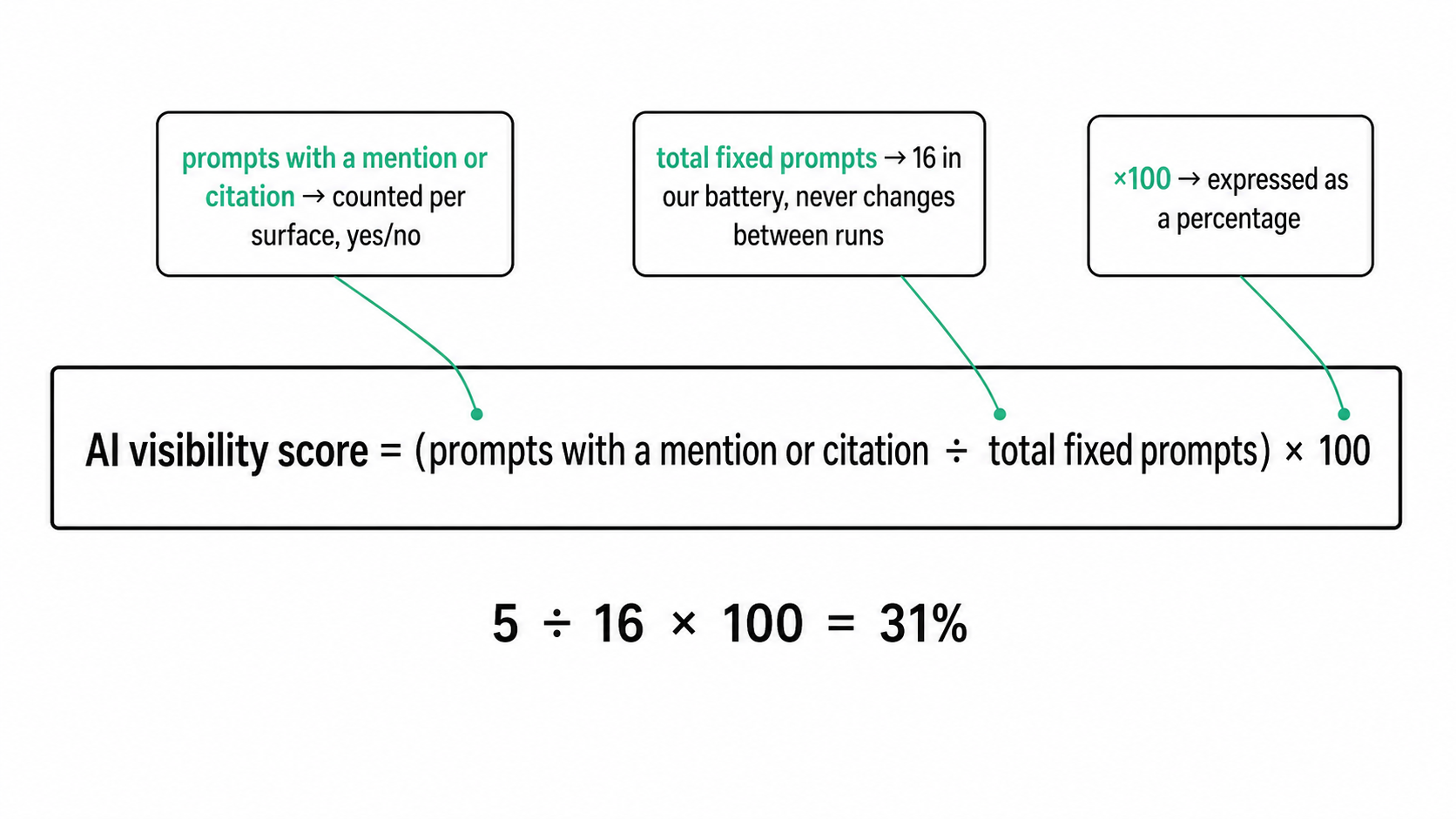
The manual way to calculate an AI visibility score is citation rate: run a fixed set of buyer-intent prompts on each AI platform, count how many answers mention or cite your brand, and divide by the total number of prompts. Score = prompts with a mention ÷ total prompts × 100.
AI visibility score = (prompts where the brand is mentioned or cited ÷ total fixed prompts) × 100
The manual protocol has four steps:
- Fix the prompt battery. In our methodology, 16 buyer-intent prompts covering four intent types: general category queries (“best healthcare SEO agencies”), local-market queries, niche-service queries, and offer queries (“who offers a free audit for clinics”). The battery does not change between measurements — otherwise the numbers stop being comparable.
- Run each prompt verbatim in a clean session (logged out or incognito, fixed region) on each surface: ChatGPT, Gemini, Google AI Overviews, Perplexity.
- Mark the result for each prompt: your brand named or linked — yes or no. Also record who was named instead of you; the competitor column is often more useful than your own score.
- Compute the score: mentions ÷ 16 × 100, per surface and in total.
The original published protocol specifies a fixed set of 16 buyer-intent prompts tested monthly across Google AI Overviews, ChatGPT, Gemini, and Perplexity, scored by citation rate. This is the same protocol behind our ChatGPT and Gemini visibility service for medical practices — the score you get in an audit is produced by the method on this page, not by a black-box tool.
A worked example: calculating the score manually
A hypothetical example — not a client case. A practice runs its fixed 16 prompts on one surface and is named in 5 answers: 5 ÷ 16 × 100 = 31%. On a second surface it appears in 2 of 16: 13%. The combined score across both surfaces: 7 ÷ 32 × 100 ≈ 22%. The third row below is not hypothetical — it is our own first measurement, discussed in the next section.
| Surface | Prompts with a mention | Score | Status |
|---|---|---|---|
| ChatGPT (hypothetical practice) | 5 of 16 | 31% | Illustration of the arithmetic |
| Gemini (hypothetical practice) | 2 of 16 | 13% | Illustration of the arithmetic |
| Combined (hypothetical practice) | 7 of 32 | ≈22% | Illustration of the arithmetic |
| Perplexity (Rotgar, real pilot, 2026-08-03) | 0 of 4 | 0% | Real measurement — baseline zero point |
The same arithmetic applies to a clinic running a fixed set of patient-intent prompts. The absolute number matters less than the trend: re-measured monthly on the same battery, the score shows whether the work is compounding. A 0% starting point is normal for a site with no AI optimization — it is a baseline, not a verdict.
What does a real zero score look like? Our measurement, August 2026
A real zero score looks like this: on August 3, 2026, we ran 4 prompts from our fixed 16-prompt battery on Perplexity in a clean anonymous session, and Rotgar appeared in 0 of 4 answers — citation rate 0%. We are publishing the result because a measurement methodology you only apply to clients is not a methodology; it is marketing.
| Prompt (verbatim) | Rotgar mentioned / linked | Who Perplexity cited instead |
|---|---|---|
| “Who provides generative engine optimization services?” | No / No | Listicles and directories: Clutch’s GEO category, DesignRush, agency blog listicles (SEOProfy, SEOTuners, Concurate and others) |
| “Where can I get an AI visibility audit?” | No / No | SE Ranking, Reddit threads (cited 3 times), YouTube, tool vendors with free-audit landing pages |
| “Best healthcare SEO agencies” | No / No | First Page Sage’s own listicle (ranking itself #1), Intrepy’s own listicle |
| “What is generative engine optimization?” | No / No | Heavyweights only: Semrush, Wikipedia, Coursera, Mailchimp |
Three findings matter more than the zero:
- Category prompts are won by third-party lists, not brand sites. Perplexity did not name agencies on its own authority — it reproduced existing “top N companies” listicles and directories. This matches Ahrefs’ study of 75,000 brands, which found branded web mentions correlate with AI Overview brand visibility at 0.664 (Spearman) versus 0.218 for backlinks — roughly a 3× gap. Being talked about across the web beats being linked to.
- Agencies publish their own scores — and get cited for them. The top answer for “best healthcare SEO agencies” reproduced First Page Sage’s own listicle, which ranks First Page Sage #1 and assigns each listed agency an “AI Visibility Score” of the author’s own devising (First Page Sage’s: 4.9/5). Perplexity relayed those numbers as if they were data. Our conclusion is not “invent a flattering score” — it is that a transparent, reproducible methodology is worth more than a pretty number, because sooner or later someone reruns the prompts.
- Reddit is a first-class source. In the audit-intent prompt, Reddit threads were the second most cited source type. Community answers feed AI answers directly.
Honest caveats: this was a 4-prompt pilot on one surface from a European IP; the full 16-prompt, 4-surface, US-region run is the monthly protocol, and ChatGPT, Gemini, and AI Overviews require logged-in manual runs. The structural finding — who gets cited and why — holds regardless. The clinic-focused implementation follows the same principle: earn presence in the sources AI engines already trust, then re-measure on the same battery.
Which metrics feed an AI visibility score?
Four metrics show up in AI visibility measurement, and they answer different questions: mention rate (are you named?), citation rate (are you linked as a source?), recommendation rate (are you actively advised?), and sentiment (how are you described?). A manual score is usually built on mention-or-citation rate; vendor scores may blend all four with proprietary weights.
| Metric | Question it answers | How it is counted | Caveat |
|---|---|---|---|
| Mention rate | Is the brand named in the answer text? | Prompts with a name-check ÷ total prompts | A mention can be neutral or even negative |
| Citation rate | Is the brand’s site linked as a source? | Prompts where your URL appears in sources ÷ total prompts | Strictest signal; platforms differ — Semrush’s 2026 index found ChatGPT cites ~15 sources per response, Gemini ~3 |
| Recommendation rate | Does the AI actively advise choosing you? | Prompts with an explicit recommendation ÷ total prompts | Closest to revenue; rarest and most volatile |
| Sentiment | How is the brand characterized when it appears? | Manual or model-assisted rating of each mention | Meaningless until mention rate is above zero |
For a simple, repeatable score, count a prompt as a “yes” when the brand is either named or linked — that is the definition we use in the formula above. Track the stricter metrics separately once you are consistently visible.
What do AI visibility scores from tools actually measure?
Scores from AI visibility tools are proprietary models: each vendor picks its own prompt sets, platforms, and weighting, so the same brand can get different scores in different tools. No AI platform — ChatGPT, Gemini, or Google — publishes an official visibility score (August 2026). Google’s own documentation on AI features states there are no special requirements or markup for appearing in AI Overviews or AI Mode — and offers no visibility metric beyond standard Search Console reporting, where AI Overviews traffic is folded into the “Web” search type.
| Tool-generated score | Manual citation-rate score | |
|---|---|---|
| Prompt set | Vendor-chosen, often undisclosed | Your own fixed battery, published |
| Transparency | Weighting usually proprietary | Full formula: mentions ÷ prompts × 100 |
| Comparability | Only within the same tool | Only within your own battery — but you control it |
| Scale | Hundreds to millions of prompts (Semrush’s index: 126M) | 16 prompts × 4 surfaces, monthly |
| Cost | Freemium to enterprise | Time only |
| Best use | Market-level benchmarks, competitor sweeps | Tracking one brand’s trend, month over month |
The measurement gap is real: in Semrush’s 2026 AI Visibility Index research, 45% of marketing leaders said they cannot accurately measure brand visibility in AI-generated answers, and only 9% have tools tracking all relevant metrics. Free checkers answer the curiosity (“give me a number for my domain”), but a one-off snapshot is not visibility: AI answers are stochastic and change between runs, so only measurements taken under one fixed methodology are comparable. An automated checker on this site is a separate product decision; the manual method above gives you a real first reading today.
What an AI visibility score will NOT tell you
- It will not tell you how much revenue a citation brought. Patient attribution is a separate analytics task.
- It does not replace classic SEO metrics. Rankings, traffic, and conversions remain; the score is an additional layer. Google’s guidance is explicit that standard SEO fundamentals are what feed its AI features — there is no separate “AI ranking” to chase.
- It is not comparable across methodologies. 40% in one tool and 15% in another is not a contradiction — they are different models.
- It does not guarantee future visibility. AI answers are stochastic; a score is a trend snapshot, not a forecast (August 2026).
- It is not an official rating of any AI platform. No such rating exists — including the “AI Visibility Scores” some agencies assign themselves in their own listicles.
Key takeaways
- An AI visibility score is citation rate over a fixed prompt battery: prompts with a mention or citation ÷ total prompts × 100. Anyone can compute it manually in an afternoon.
- Fix the battery, run clean sessions, never change the prompts between runs — comparability is the entire value of the number.
- Zero is a normal starting point. Our own first public reading was 0/4 on Perplexity (August 3, 2026); the useful output was the list of sources cited instead of us.
- What wins category prompts is third-party presence — listicles, directories, Reddit, YouTube. Ahrefs’ 75,000-brand study puts branded web mentions at ~3× the correlation of backlinks with AI visibility.
- Vendor scores are legitimate but proprietary; they benchmark markets, not your month-over-month trend. Manual scores do the opposite. Use each for what it is.
- A transparent methodology beats a flattering number: self-published scores are already being relayed verbatim by AI engines, and reproducibility is the only durable defense.
- Measurement precedes optimization: the Princeton GEO research showed up to 40% visibility gains from content optimization — gains you cannot verify without a baseline score.
FAQ
What is a good AI visibility score?
There is no universal “good” score — the number is relative to the methodology that produced it. The working frame: growth against your own baseline and against competitors measured on the same prompts. A score moving from 0% to 20% on a fixed battery is real progress, whatever the absolute value.
How can I check my AI visibility score for free?
Use the manual protocol on this page: a fixed prompt list, a clean session per platform, and a count of mentions. Vendor free checkers exist, but they give a one-off snapshot under their own proprietary method (August 2026) — fine for curiosity, not for tracking a trend.
Is an AI visibility score the same as Google rankings?
No. Rankings are positions of URLs in search results; the score is the share of prompts where a brand is mentioned inside a generated answer. They measure different systems — and a rank tracker cannot tell you what AI visibility is doing month over month.
How often should I recalculate my AI visibility score?
Monthly, on the same battery — that is our protocol. Recalculate more often only when you are actively shipping content changes and want faster feedback. Never change the prompt battery between measurements, or the numbers stop being comparable.
Do AI platforms publish official visibility scores?
No (August 2026). Every score in the market is either a vendor’s proprietary model, an agency’s self-published rating, or your own measurement. There is no official ChatGPT, Gemini, or Google visibility rating to check against — Google’s AI-features documentation offers no such metric.
What is the difference between an AI visibility score and citation rate?
Citation rate is the metric itself — mentions divided by prompts. The score is its numeric expression as a percentage over a fixed battery. Vendor scores may add weighting on top of citation rate; a manual score usually is the citation rate.