
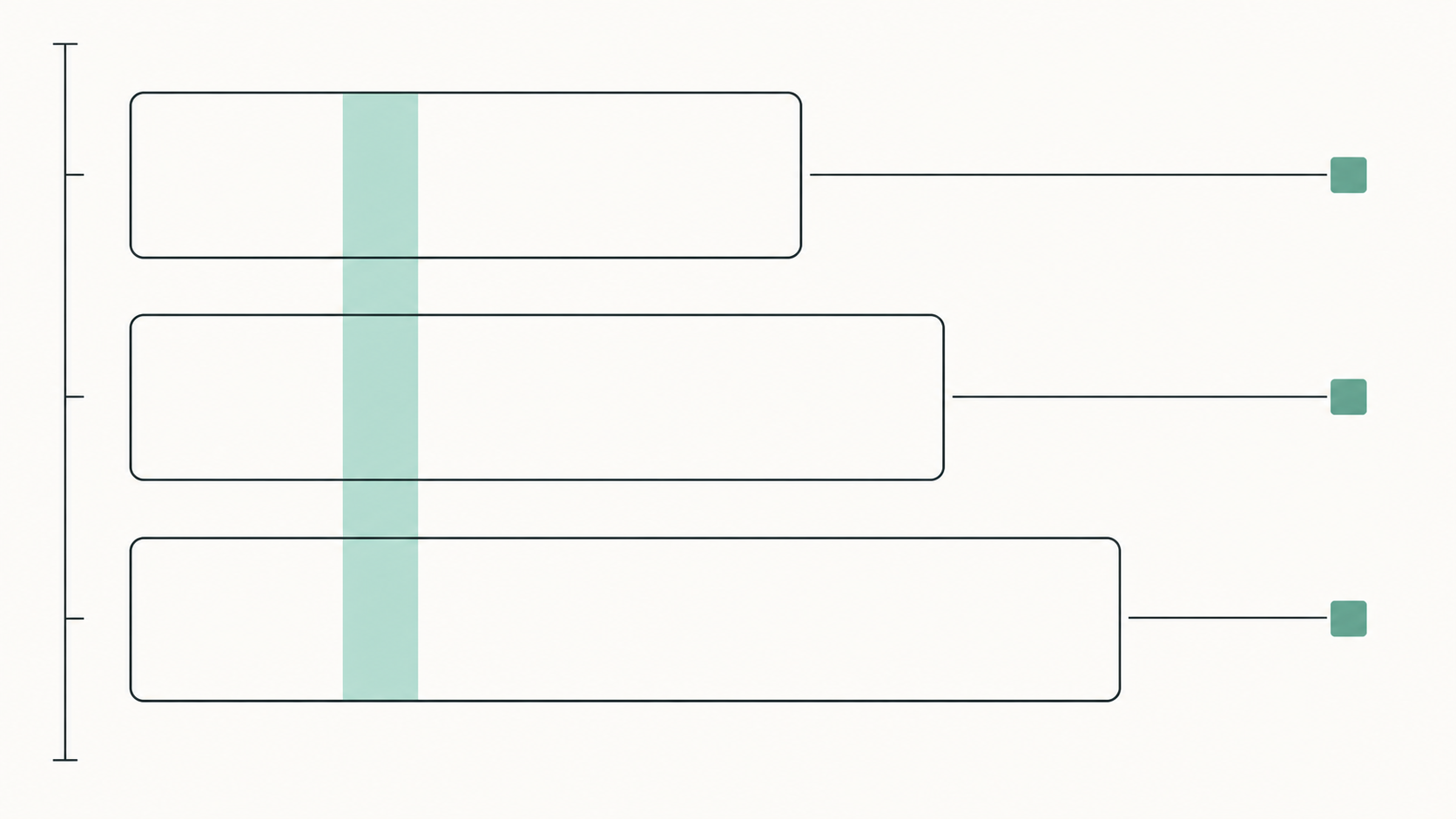
AI visibility is the degree to which AI assistants and AI search features mention, cite, or recommend a brand in generated answers — measured by citation rate across a fixed set of prompts and platforms. Mention, citation, and recommendation are three distinct levels of visibility — most tools and guides report them as one number. For a clinic, AI visibility decides whether ChatGPT or Gemini names your practice when a patient asks for a recommendation.
TL;DR
- AI visibility has three levels, not one: a mention (the AI names you), a citation (the AI links your page as a source), and a recommendation (the AI advises choosing you). Sentiment cuts across all three. Most dashboards collapse them into a single figure.
- It is measured as citation rate — the share of a fixed prompt set where the brand appears — recorded per surface and per level. Change the prompts and the numbers stop being comparable.
- Visibility is not traffic. Pew Research found that when an AI summary appeared, users clicked a traditional result in 8% of visits versus 15% without one, and a link inside the summary in just 1%.
- Surfaces differ: Semrush’s 2026 AI Visibility Index, built on 126 million US prompts, found ChatGPT cites ~15 sources per response against Gemini’s 3.
- Our own zero point, published: on August 3, 2026, Rotgar reached none of the three levels in 4 of 4 buyer-intent prompts on Perplexity. The useful output was who occupied those slots instead.
What are the three levels of AI visibility?
AI visibility comes in three levels. A mention means the AI names the brand. A citation means it links to the brand’s site as a source. A recommendation means it actively suggests the brand as a choice. Each level carries different weight — and each is recorded differently in a measurement, which is why collapsing them into one score loses information.
| Level | What the AI does | Clinic example | How it is recorded | What it is worth |
|---|---|---|---|---|
| Mention | Names the brand in the answer text | “Clinics like X offer same-day implants” / “Firms such as Y handle construction disputes” | Yes/no per prompt: name present in the answer body | Awareness; no click path |
| Citation | Links the brand’s page as a source | Your page appears in the source list under the answer | Yes/no per prompt: your domain in the sources panel | Click path plus entity trust; strictest signal |
| Recommendation | Presents the brand as the answer to a choice prompt | “For dental implants in Boston, consider X” / “For a personal injury claim in Texas, Y is a common choice” | Yes/no per prompt: explicit advice to choose you | Closest to acquisition; rarest and most volatile |
| Sentiment (cuts across all three) | Characterizes the brand when it appears | “Affordable, but reported as hard to book” | Manual or model-assisted rating per appearance | Meaningless until mentions are above zero |
The levels are not a funnel you climb in order. An engine can cite your page as a source while recommending a competitor by name — the citation earns you a click, the recommendation earns the client. The reverse also happens: assistants recommend brands they never link to, because the recommendation came from a third-party listicle rather than your own site.
Most tools and guides aggregate these into a single visibility number (SERP observation, August 2026). Convenient for reporting, but it hides the difference between being named and being recommended — and only the third level is directly tied to acquiring patients or clients.
How is AI visibility measured?
By citation rate: the share of a fixed prompt set where the brand appears in the AI answer, recorded on fixed surfaces at fixed intervals and classified by level. The original published protocol specifies a fixed set of 16 buyer-intent prompts tested monthly across Google AI Overviews, ChatGPT, Gemini, and Perplexity, scored by citation rate.
Four properties make a measurement usable:
- The prompt set stays fixed. Prompts are buyer-intent questions — “best implant dentist in Boston”, “who handles wrongful termination in Texas” — and they do not change between runs. Rewrite the battery and you have a new metric, not a new reading.
- Sessions are clean and the region is fixed. Logged out or incognito, one region, prompts entered verbatim with no follow-up turns. Personalization and conversation history are the fastest ways to fake a good number.
- Every appearance is classified by level. Mention, citation, recommendation — recorded separately, so the rate can be reported per level rather than as one blended figure.
- The competitor column is filled in. Who was named instead of you is usually more actionable than your own zero.
The arithmetic that turns those records into a single percentage lives on the paired page: see AI visibility score for the formula and a worked example. The full protocol is documented in our AI visibility measurement methodology.
One thing measurement cannot come from: your own analytics. Google states that sites appearing in AI features are folded into overall Search Console traffic under the “Web” search type, so there is no AI Overviews line to read off a dashboard (Google Search Central). Visibility is observed by running prompts, not by filtering reports.
Which AI surfaces count toward AI visibility, and how do they differ?
As of August 2026, four surfaces carry buyer-intent answers: Google AI Overviews, ChatGPT, Gemini, and Perplexity. They differ in how content gets in, how an appearance looks, and how much room there is to be cited — which is why one blended number across surfaces is close to meaningless.
| Surface | How content gets in | What an appearance looks like | Practical difference |
|---|---|---|---|
| Google AI Overviews | Standard Google indexing. Google documents no additional requirements, no AI-specific files, and no special schema.org markup for AI Overviews or AI Mode | Your page cited inside the generated block above the results | Snippet controls (nosnippet, data-nosnippet, max-snippet, noindex) are the only levers on what is shown; traffic is not separated in Search Console |
| ChatGPT (with search) | The OAI-SearchBot crawler. Per OpenAI’s bot documentation, sites opted out of OAI-SearchBot “will not be shown in ChatGPT search answers, though can still appear as navigational links” | Inline citations attached to statements in the answer | GPTBot (training) and ChatGPT-User (user-initiated fetches) are controlled separately in robots.txt — blocking training need not cost search visibility |
| Gemini | Google’s web index; same no-special-markup guidance as AI Overviews | A short answer with a compact set of supporting links | Semrush’s 2026 index measured ~3 cited sources per response — the narrowest slot of the four |
| Perplexity | Its own crawl and retrieval, with explicit sources on every response | A numbered source list beside or beneath the answer | Easiest surface to record objectively, and the only one runnable in a clean anonymous session without a login wall or captcha |
Two consequences follow. The citation slot is not the same size everywhere — Semrush’s index put ChatGPT at roughly 15 sources per response against Gemini’s 3, so identical content competes for very different amounts of room. And the entry mechanics differ: an AI Overviews problem is usually an indexing or snippet-control problem, while a ChatGPT problem can be a single robots.txt line.
What does zero AI visibility actually look like? Our own measurement
Zero looks like this: on August 3, 2026, we ran 4 prompts from our fixed 16-prompt battery on Perplexity in a clean anonymous session, and Rotgar reached none of the three levels in 4 of 4 answers. We publish it because an agency selling AI visibility that never measures its own is selling a claim, not a method.
| Prompt (verbatim, 2026-08-03) | Highest level Rotgar reached | Who occupied the mention and citation slots |
|---|---|---|
| “Who provides generative engine optimization services?” | None | No brand recommended at all — the answer stayed at category level and cited listicles and directories (Clutch’s GEO category, DesignRush, agency roundups) |
| “Where can I get an AI visibility audit?” | None | Tool brands named (SE Ranking, Semrush, BrightEdge and others); Reddit threads cited three times |
| “Best healthcare SEO agencies” | None | Eight agencies named and ranked, First Page Sage first — sourced from First Page Sage’s own listicle, which carries a self-assigned “AI Visibility Score” |
| “What is generative engine optimization?” | None | Reference heavyweights only: Semrush, Wikipedia, Coursera, Mailchimp |
Read by level, the pattern is sharper than the zero. On the category prompt nobody reached the recommendation level — the engine described categories instead of choosing brands. On the “best agencies” prompt, the mention level was filled entirely by a third party’s ranked list, relayed as if it were data. On the definition prompt, the citation level was locked to reference-grade domains.
Ahrefs’ study of 75,000 brands points the same direction: branded web mentions correlated with AI Overview brand visibility at 0.664 (Spearman) against 0.218 for backlinks. The authors are explicit that this is correlation, not causation, and that the factors they measured range from moderate to very weak — but being talked about in the sources an engine trusts appears to do more than being linked from them.
Honest caveats: a 4-prompt pilot, one surface, one session, European IP. ChatGPT, Gemini, and AI Overviews were not measurable in that environment — login walls and captchas — so they run as manual logged-in checks, and the US citation rate is confirmed on the first full run. The structural finding holds. This is the same protocol behind AI visibility work for medical practices: measure, see who holds the slot, then earn presence where the answer is assembled.
Why does AI visibility matter if AI answers are zero-click?
Because the answer itself is now the destination for a meaningful share of queries. Pew Research’s analysis of 68,879 Google searches by 900 US adults (March 2025) found about 18% produced an AI summary; when one appeared, users clicked a traditional result in 8% of visits versus 15% without, and a link inside the summary in 1%.
Those numbers cut both ways: a page can hold its rankings and lose clicks, but the mention itself now carries value it did not carry before. If a prospective patient reads a three-sentence answer and never clicks, the only asset that survives the interaction is whether your name was in those three sentences. That is what AI visibility measures — and why it is tracked separately from rankings and traffic.
For regulated practices there is a second reason: when an assistant names three clinics and the reader treats that as a shortlist, the shortlist is the market. Visibility work here never involves giving medical or legal advice to end users — it is about whether your organization is named, and whether what the engine says about you is accurate.
What AI visibility is NOT
- Not rankings. Organic positions and presence in AI answers are different systems — a site can rank well and be invisible to AI.
- Not web brand mentions. Mentions in articles are an input signal, not the visibility itself; Ahrefs measured their correlation with visibility, not equivalence.
- Not traffic. AI answers are largely zero-click: 8% versus 15% click-through in Pew’s data, 1% inside the summary.
- Not a Search Console metric. Google folds AI-features traffic into the “Web” search type, so AI visibility cannot be read off a standard report.
- Not something you buy. As of August 2026 there is no paid placement in AI answers.
- Not a one-time state. Platform answers change without notice; one check is a snapshot, not a metric.
- Not a guaranteed quantity. Nobody can promise a fixed level of AI visibility, and no self-assigned score makes one real.
Improving AI visibility is the goal of generative engine optimization (GEO).
Key takeaways
- AI visibility is the degree to which AI assistants mention, cite, or recommend a brand in generated answers — three distinct levels, plus sentiment across them, not one blended number.
- Citation is the strictest level and recommendation the most valuable; they move independently, so record them separately or you cannot tell awareness from acquisition.
- Measurement means a fixed buyer-intent battery, clean sessions, fixed region and cadence. The battery never changes between runs — comparability is the whole point.
- Surfaces are not interchangeable: ~15 cited sources per ChatGPT response against ~3 for Gemini, and entry mechanics differ (indexing and snippet controls for AI Overviews, the OAI-SearchBot line in robots.txt for ChatGPT search).
- Google documents no special markup for AI features and no separate reporting — which is why visibility is observed by running prompts, not by filtering analytics.
- Zero is a normal starting point. Our first public reading was 0 of 4 on Perplexity (August 3, 2026); the actionable finding was that listicles, directories, Reddit, and reference sites held every slot.
- Visibility is not traffic and cannot be bought. It can be measured, tracked monthly, and moved by earning presence in the sources engines already cite.
FAQ
Is AI visibility the same as SEO rankings?
No. Rankings describe positions in classic search results; AI visibility describes presence inside generated answers. The two share a foundation — crawlable content, clear entities, trusted mentions — but a site can hold page-one rankings and still never be named by ChatGPT or Gemini.
What is an AI visibility score?
An AI visibility score is a single aggregated metric, usually expressed as a percentage, computed from citation-rate data across prompts and platforms. It is useful as a trend line but compresses the three visibility levels into one figure — see AI visibility score for the formula, a worked example, and where vendor scores mislead.
How do I check my AI visibility?
Run a fixed set of buyer-intent prompts — the questions patients or clients actually ask — across AI Overviews, ChatGPT, Gemini, and Perplexity in clean sessions, recording for each whether you were mentioned, cited, or recommended, plus who was named instead. Repeat monthly under identical conditions.
Does AI visibility matter for medical practices?
Yes. Patients increasingly ask assistants which practice to choose, and regulated topics face stricter trust standards in AI systems. The work never involves giving medical or legal advice; it is about whether your organization is the one named, and whether the description is accurate.
Can you pay for AI visibility?
No. As of August 2026, there is no paid placement inside AI-generated answers. Visibility is earned through the signals AI systems read: your site’s content and structure, your entity clarity, and your presence in the third-party sources those systems already cite — directories, roundups, and community threads.
How often does AI visibility change?
Constantly at the level of individual answers, meaningfully at the level of months. Answers are stochastic and platforms update models and source pools without notice, which is why the protocol re-measures a fixed battery monthly — capturing real movement without chasing daily noise.