
TL;DR
- Generative engine optimization (GEO) is the discipline of making a brand’s site, content, and entity signals easy for AI systems — ChatGPT, Gemini, Google AI Overviews, Perplexity — to understand, trust, and cite in generated answers.
- The term comes from a Princeton-led research paper (Aggarwal et al., KDD 2024, arXiv:2311.09735): structural tactics such as adding quotations, statistics, and cited sources boosted a source’s visibility in generative answers by up to 40% on their GEO-bench benchmark.
- Google states there are no special requirements or markup for AI Overviews or AI Mode — a page must simply be indexed and snippet-eligible, which is why GEO builds on SEO rather than replacing it.
- The stakes are measurable: per Pew Research (2025), users clicked a traditional result in only 8% of Google searches that showed an AI summary, versus 15% without one.
- Our own measurement (Perplexity, 2026-08-03): category queries like “who provides GEO services” are answered from third-party listicles and directories, while definitional queries cite established heavyweights.
Generative engine optimization (GEO) is the practice of making a brand’s website, content, and entity signals easy for AI systems — ChatGPT, Gemini, Google AI Overviews — to understand, trust, and cite in generated answers. It is the same discipline buyers also call AI search optimization or LLM SEO. For a medical practice, GEO decides whether an AI assistant names your business — or a competitor’s — when a patient asks for a clinic recommendation.
Where does the term “generative engine optimization” come from?
The term was introduced by a Princeton-led research team in the paper “GEO: Generative Engine Optimization” (Aggarwal et al., arXiv:2311.09735), presented at KDD 2024. The authors formalized “generative engines” — search systems that synthesize answers from multiple sources — and showed that content owners can systematically improve how often those engines surface their material.
Their experimental results are the closest thing GEO has to founding data. On GEO-bench — a large-scale benchmark of diverse user queries across multiple domains — the best-performing optimizations boosted a source’s visibility in generative responses by up to 40%. The tactics that worked were structural, not keyword-based:
- Adding quotations improved position-adjusted visibility by roughly 40%.
- Citing sources improved it by roughly 30%.
- Adding statistics improved it by roughly 30%.
- Keyword stuffing — the classic manipulative SEO tactic — offered little to no improvement.
One more finding matters for smaller brands. Lower-ranked sites gained the most: in the paper’s analysis, a website ranked fifth in the underlying search results saw a 115% visibility increase from citing sources, while top-ranked sites could actually lose share. Generative engines partially level a playing field that domain authority used to dominate — relevant to an independent clinic competing against national healthcare brands.
The paper studies on-page tactics in a controlled benchmark; GEO in practice is broader, covering the entity, off-site citation, and measurement layers described below.
How does generative engine optimization work?
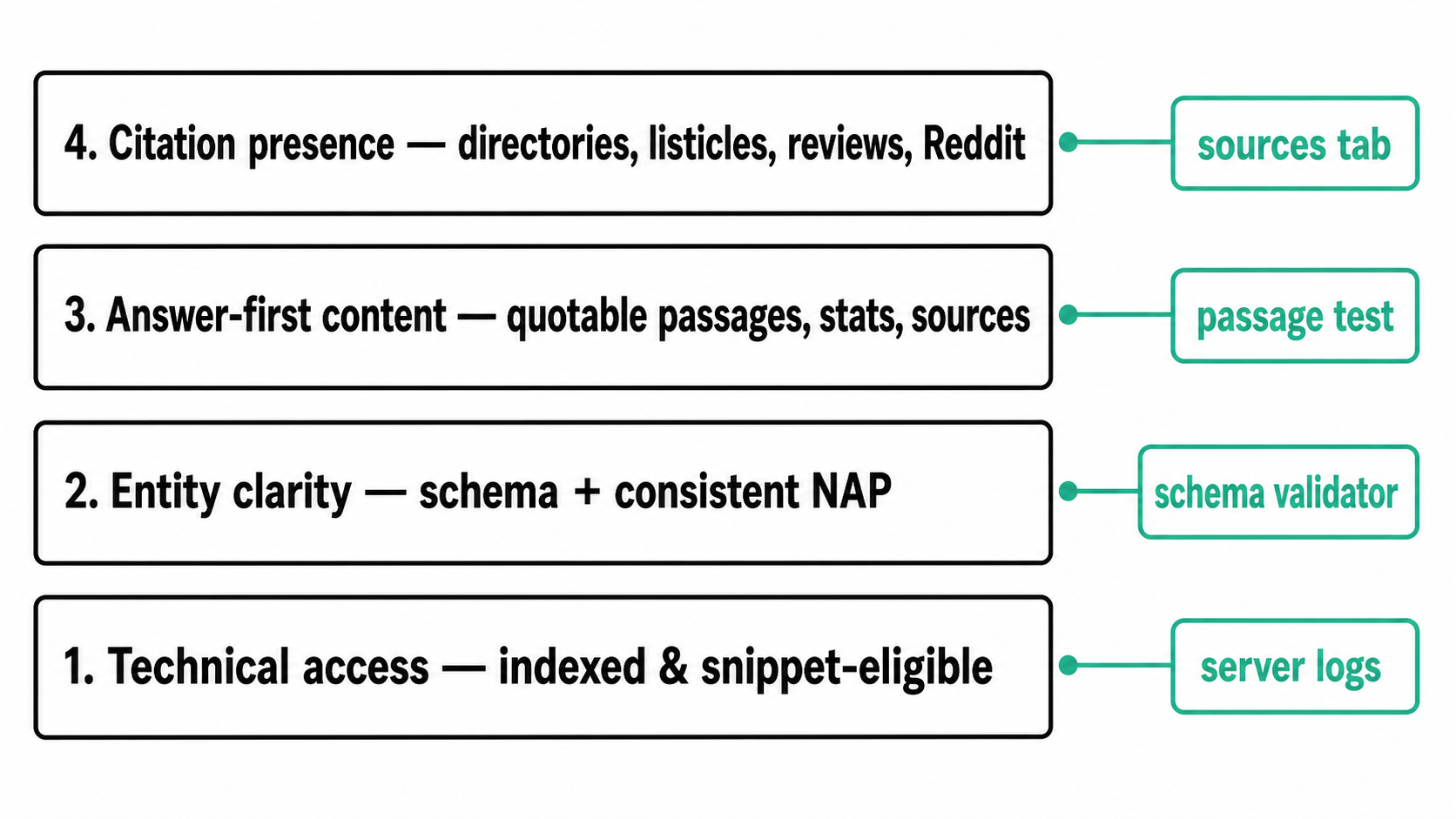
GEO works on four layers: technical access (AI systems can crawl and index you), entity clarity (machines know exactly who you are), answer-first content (pages an AI can quote verbatim), and citation presence (trusted third-party sources that AI models draw from). Each layer produces a distinct signal and has a distinct verification method.
| Layer | What the work is | Signal it produces | How to verify |
|---|---|---|---|
| 1. Technical access | Allow crawling for search and AI crawlers (robots.txt, CDN rules), keep pages indexed and snippet-eligible, fix rendering blockers | The page is available as raw material for retrieval | Search Console indexing report; crawler hits from GPTBot, Google-Extended, PerplexityBot in server logs |
| 2. Entity clarity | Organization/LocalBusiness/MedicalClinic/Physician schema, consistent name-address-phone everywhere, aligned profiles (Google Business Profile or medical directories) | A machine-readable answer to “who is this brand, where, doing what” | Schema validates; brand-name queries return a consistent knowledge panel and profile set |
| 3. Answer-first content | Question-shaped headings, direct answers in the first 40–60 words, tables, dated statistics, quoted sources (the tactics validated in the Princeton study) | Self-contained passages an AI can lift and attribute | Each H2 block reads as a complete answer out of context; AI answers begin reusing your phrasing or tables |
| 4. Citation presence | Reviews, directories (Clutch, Avvo, Healthgrades), industry listicles, Reddit and community threads, PR mentions | Third-party corroboration in the sources AI engines already trust | Sources cited in Perplexity/AI Overviews for your money queries include pages that mention you |
A concrete clinic example. For a dental clinic, layer 2 means a Dentist schema block whose name, address, and phone match Google Business Profile and Healthgrades character for character; layer 4 means presence in the “best implant dentists in [city]” listicles answer engines cite.
How is GEO different from traditional SEO?
GEO does not replace SEO — it builds on it. AI answers are assembled from the same sources classic SEO optimizes: crawlable content, clear entities, trusted mentions. What changes is the unit of competition (a cited passage instead of a ranked page), the metric (citation rate instead of position), and the shape content must take to be extractable.
| Dimension | Traditional SEO | GEO |
|---|---|---|
| Unit of competition | A ranked page in a list of ten blue links | A cited passage inside one synthesized answer |
| Primary metric | Rankings and organic clicks | Citation rate across a fixed set of prompts |
| Who evaluates you | Crawling + ranking algorithms | Retrieval + a large language model composing an answer |
| Content shape that wins | Keyword-targeted pages with topical depth | Self-contained, quotable passages with statistics, sources, and tables |
| Off-site currency | Backlinks and domain authority | Presence in the third-party sources AI engines cite: listicles, directories, reviews, Reddit |
| Tactic that stops working | Keyword density still correlates with relevance | Keyword stuffing shows little to no effect in generative engines (Aggarwal et al., 2024) |
| Failure mode | You rank on page two and get few clicks | You are absent from the answer entirely — the user never sees a list |
| Change cadence | Periodic algorithm updates | Models, retrieval, and answer surfaces shift monthly |
Google’s own documentation confirms the “builds on, not replaces” framing. Google Search Central states there are “no additional requirements to appear in AI Overviews or AI Mode,” no special files or schema to add — a page must be indexed and eligible to be shown with a snippet, and standard SEO best practices remain the relevant ones. In other words: a site that cannot get indexed and ranked has no raw material to offer a generative engine. That is why our generative engine optimization services for medical practices start from the search foundation, not around it.
The commercial reason to add the GEO layer is answer-share and traffic quality. Per Pew Research Center (2025), users clicked a traditional result in just 8% of searches with an AI summary, versus 15% without one — the answer increasingly absorbs the click. Meanwhile, Semrush’s research estimates the average AI search visitor is worth 4.4x more than a traditional organic visitor. Fewer clicks, higher intent — which rewards being the cited source rather than result number six.
Which AI surfaces does GEO cover?
As of August 2026, the main surfaces are four. ChatGPT — the conversational assistant patients question directly, with web search grounding. Gemini — Google’s assistant, tied to its search ecosystem. Google AI Overviews — AI-generated summaries inside Google Search itself, drawn from Google’s index. Perplexity — an answer engine that shows its sources with every response, which makes it the most transparent surface to measure.
The measure of success across all four is AI visibility. AI visibility is the degree to which AI assistants and AI search features mention, cite, or recommend a brand in generated answers — measured by citation rate across a fixed set of prompts and platforms. Rankings locate a page in a list; citation rate tells you whether the answer contains your name.
What does winning in generative search look like in practice?
Winning looks different by query type — and the fastest way to see that is to inspect what an answer engine actually cites. In our own baseline measurement (Rotgar, 2026-08-03: pilot run of our fixed prompt battery in Perplexity, clean anonymous session, English), the citation patterns split sharply by intent.
- Category queries are won by listicles and directories. For “Who provides generative engine optimization services?”, Perplexity named no individual brands on its own — it synthesized from third-party “top GEO companies” lists and catalogs (Clutch’s GEO category, DesignRush, agency roundups). The path into that answer is being present in the lists the engine cites, not just having a services page.
- Definitional queries cite heavyweights. For “What is generative engine optimization?”, the sources were Semrush, Wikipedia, Coursera, Mailchimp, and Seer Interactive. A small site rarely gets cited on head definitions; the role of definitional content is topical authority and internal linking, not citation capture.
- Self-published rankings get quoted verbatim. On “best healthcare SEO agencies,” Perplexity’s top-cited source was an agency’s own ranked listicle — with that agency at #1. Answer engines currently reward transparent (and sometimes not-so-transparent) self-published comparison content.
- Community threads are a first-class source. On the audit-intent query, Reddit threads were cited three times — more than any single vendor site.
Honest frame: this was a four-prompt pilot on one surface from a European IP; our full protocol runs 16 prompts monthly across four platforms, and we treat the pilot as directional for source structure, not US market share. The strategic reading still holds for any local-service brand: a clinic that wants to be named for “best dermatology practice in Miami” must exist in the directories and review platforms the engine cites.
What generative engine optimization is NOT
The term is hyped, so the boundaries matter as much as the definition:
- Not a replacement for SEO. It is an overlay on the classic foundation, not a substitute for it — Google’s documentation is explicit that AI features draw on the same index and the same eligibility rules.
- Not paid placement. There is no way to buy a mention inside ChatGPT, Gemini, or AI Overviews (as of August 2026); the generated answer itself is not for sale.
- Not a guarantee of citation. Nobody controls generated answers; the work controls the signals. Any vendor promising “guaranteed citations” is promising something the platforms do not sell.
- Not a one-time setup. Models, retrieval behavior, and answer surfaces change monthly; measurement and iteration are part of the discipline, not an add-on.
- Not prompt-spam. GEO works on your site’s signals and your brand’s entity — not on gaming individual conversations.
GEO is also not the same as answer engine optimization (AEO) — AEO is about structuring content so answer engines can extract a direct, attributed answer, while GEO emphasizes visibility across generative chat systems and the entity and citation work behind it. The two overlap heavily in practice; we break down the differences dimension by dimension in AEO vs GEO.
Key takeaways
- GEO is the practice of making a brand’s website, content, and entity signals easy for AI systems to understand, trust, and cite in generated answers — the same discipline sold as AI search optimization or LLM SEO.
- The term has an academic origin: Aggarwal et al. (KDD 2024) showed structural tactics — quotations, statistics, cited sources — lift visibility in generative answers by up to 40%, while keyword stuffing does almost nothing.
- The Princeton data favors underdogs: lower-ranked sources gained the most, which makes GEO disproportionately valuable for independent clinics and boutique firms.
- GEO is a four-layer discipline — technical access, entity clarity, answer-first content, citation presence — and each layer has its own verification method.
- Google requires nothing special for AI Overviews beyond an indexed, snippet-eligible page — the SEO foundation is a prerequisite, and GEO is the extraction-and-citation layer on top.
- The click economics justify the work: 8% of AI-summary searches produce a traditional click (Pew, 2025), while AI-referred visitors are worth roughly 4.4x more (Semrush).
- Citation data shows the playbook is query-dependent: category answers are built from listicles and directories, definitional answers from heavyweights — invest where the answers you need are sourced.
FAQ
Is generative engine optimization the same as SEO?
No. GEO builds on the SEO foundation — crawlable content, authority, entities — and adds passage structure for answer extraction, prompt-level measurement, and third-party citation building. Google confirms AI features use the same index and eligibility rules as classic search, so GEO is an extension of SEO, not a rename.
Is GEO the same as answer engine optimization?
They overlap but aim differently: GEO emphasizes generative chat systems like ChatGPT and Gemini plus the entity and citation work behind visibility, while answer engine optimization targets engines that extract direct answers, such as AI Overviews. In practice, most of the work is shared.
Is GEO the same as LLM SEO?
In practice, yes — LLM SEO is a younger label for the same discipline, with the aim stated by the model type (large language models) rather than the outcome. The work is identical: entity signals, citable content, third-party presence, measurement.
Do I need GEO if I already do SEO?
Yes, if being found through AI assistants matters to your business. SEO makes you rankable; GEO makes you citable. The sensible first step is a measured baseline — where AI assistants mention you today, and where they name competitors instead — before spending on optimization.
How do you measure generative engine optimization results?
By citation rate, not rankings. The original published protocol specifies a fixed set of 16 buyer-intent prompts tested monthly across Google AI Overviews, ChatGPT, Gemini, and Perplexity, scored by citation rate. The same battery, run every month, turns “are we visible in AI” into a trend line.
Does GEO work for medical practices?
Yes — with stricter rules. Healthcare is a YMYL category, so brands pass a double trust gate: Google's quality standards plus the answer engine's caution with health topics. Entity clarity, licensed authorship (physician), and verified reviews weigh more than content volume in healthcare.