
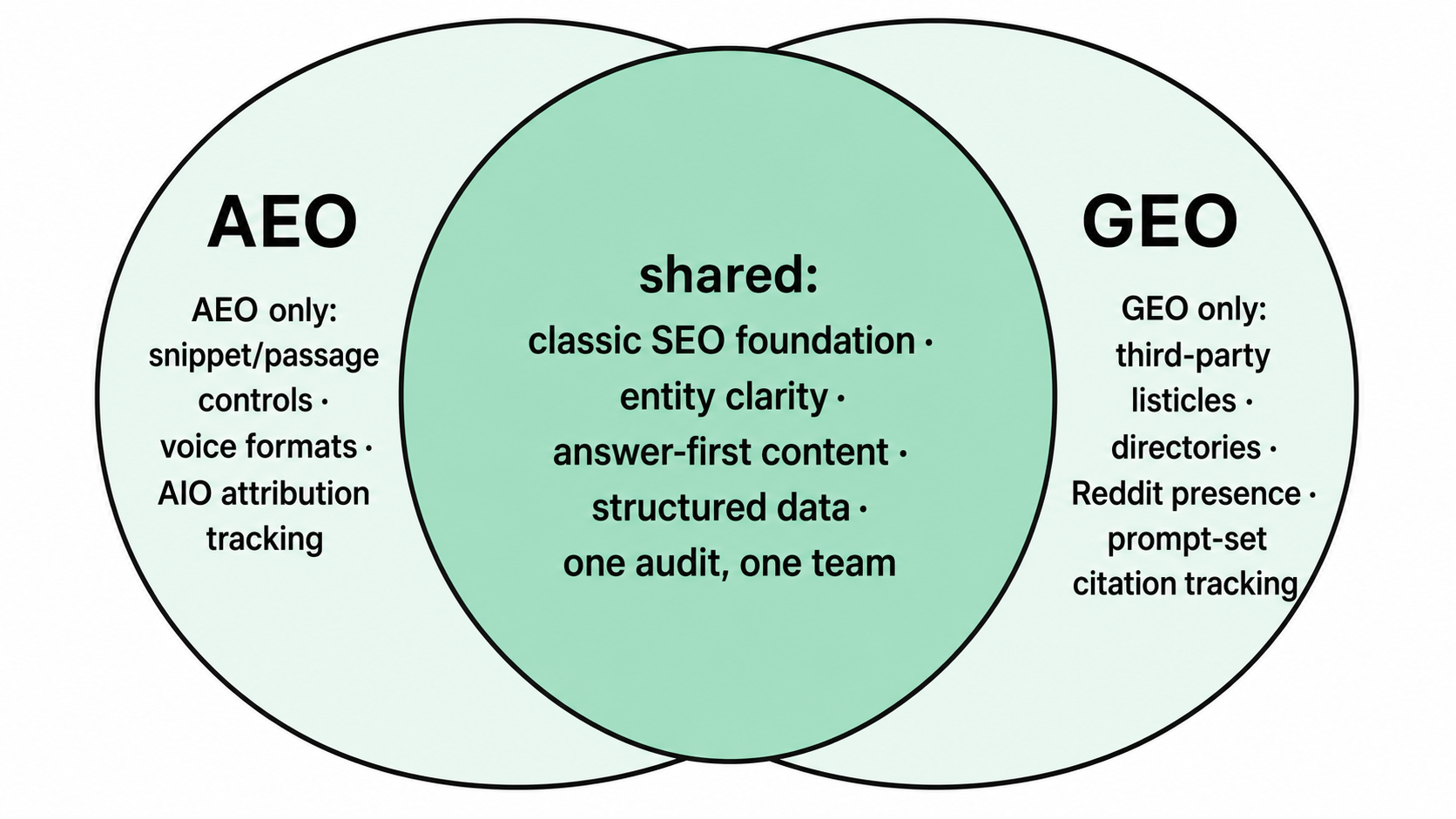
TL;DR
- AEO and GEO overlap heavily, but they describe different measurement contexts: AEO is about extractable answers on direct-answer surfaces — Google AI Overviews, answer boxes, voice — while GEO is about brand citations inside generated assistant answers in ChatGPT, Gemini, and Perplexity.
- The term GEO comes from the November 2023 paper “GEO: Generative Engine Optimization” (arXiv:2311.09735, KDD 2024), which reported up to 40% visibility gains in generative engine responses from content-side optimizations.
- The industry has not converged on one term: Wikipedia lists AEO, GEO, LLMO, and AIO as overlapping terms “frequently used interchangeably,” with no consensus definition in the academic literature as of early 2026.
- Google’s own documentation states there are no additional requirements to appear in AI Overviews or AI Mode beyond standard SEO best practices — evidence that the shared foundation is larger than the terminological split.
- Our own pilot measurement (Perplexity, August 3, 2026): definitional prompts cite heavyweight sources (Semrush, Wikipedia, Coursera), while category prompts cite listicles and directories — the prompt type, not the label you use, decides who gets cited.
AEO and GEO are two names for overlapping parts of the same discipline. Answer engine optimization targets direct-answer surfaces — AI Overviews, voice assistants. Generative engine optimization targets chat-based LLMs — ChatGPT, Gemini, Perplexity. In practice, the work is one job with two aims.
Answer engine optimization (AEO) is the practice of structuring content so answer engines — AI Overviews, voice assistants, chat-based search — can extract a direct, self-contained answer and attribute it to your brand.
Generative engine optimization (GEO) is the practice of making a brand’s website, content, and entity signals easy for AI systems — ChatGPT, Gemini, Google AI Overviews — to understand, trust, and cite in generated answers.
The full term pages: answer engine optimization (AEO) and generative engine optimization (GEO). For a medical practice, the practical question is not which term to pick, but whether AI surfaces name your organization — or a competitor’s — when patients ask.
What is the difference between AEO and GEO?
The difference is the measurement context. AEO optimizes for engines that extract and display one direct answer to a search query — Google AI Overviews, voice assistants, featured-answer formats. GEO optimizes for generative chat models — ChatGPT, Gemini, Perplexity — that take a conversational prompt, synthesize a multi-source answer, and cite brands inside it.
| Dimension | AEO | GEO |
|---|---|---|
| Target engine | AI Overviews, voice assistants, answer boxes | ChatGPT, Gemini, Perplexity |
| User input | Search query typed into a search engine | Conversational prompt to an assistant |
| Answer format | One extracted direct answer, attributed to a source | Synthesized multi-source answer with citations |
| Success metric | Presence and attribution in AI Overviews | Citation rate across a fixed prompt set |
| How to measure | Rank-tracking tools with AIO detection; manual SERP checks per query set | Repeated prompt runs per surface, logged mentions and linked sources |
| Typical work | Answer-first passages, structured data, snippet controls, concise extractable chunks | Entity clarity, third-party citations (listicles, directories, Reddit), answer-first content |
| Historical root | Evolution of featured-snippet and voice optimization | Coined in the 2023 Princeton-led research paper; spread with chat-based LLM search |
| Shared foundation | Classic SEO — crawlable content, entities, E-E-A-T (same for both) | Classic SEO — crawlable content, entities, E-E-A-T (same for both) |
This table is a working distinction for planning, not a border between two professions. People searching “answer engine optimization vs generative engine optimization” usually want one answer: are these two different jobs? They are not — the overlap below is larger than the difference. But the two measurement contexts are real, and they matter when you decide what to build and how to report on it.
The GEO column has the clearer birth certificate. The term entered the vocabulary through “GEO: Generative Engine Optimization” (Aggarwal et al., November 2023, KDD 2024) — the paper defined visibility metrics for generative engines, released the GEO-bench evaluation set, and showed content-side changes lifting visibility in generated responses by up to 40%, varying by domain. AEO has no single origin paper; it grew out of featured-snippet and voice-search practice and was re-purposed for the AI era.
Where do AEO and GEO overlap?
They overlap in the work itself. Both need the same foundation — classic SEO — and the same three signal layers: entity clarity, answer-first content, and trusted third-party citations. A page optimized to be cited by ChatGPT is the same page AI Overviews can extract an answer from.
Google’s documentation on AI features and your website states that standard SEO best practices remain the guidance for AI Overviews and AI Mode, with no additional or special optimizations required. Ahrefs’ comparison of SEO and GEO names the same four shared foundations — quality content, user intent, trust and reputation, technical health — while noting that GEO shifts weight toward third-party mentions and measures brand citations instead of rankings.
The audit is one audit. The measurement is one measurement. The team doing the work is one team. Buyers also call the whole discipline AI search optimization or LLM SEO — the labels multiply, the work does not (our AI search optimization guide maps the whole stack in one place). That is why this discipline is sold as one service with two aims: for the generative side, see our generative engine optimization services; for the extraction side, Google AI Overviews optimization.
Where the aims diverge is emphasis, not substance:
| Work item | Same or different? | Note |
|---|---|---|
| Entity signals (schema, consistent org data) | Same — built once | Both surfaces verify who you are the same way |
| Question-shaped headings + direct answers | Same — built once | Extractable for AIO, quotable for LLMs |
| Comparison tables and structured chunks | Same — built once | Both engine types lift tables preferentially |
| Snippet and passage controls (nosnippet, max-snippet) | AEO-weighted | Google’s documented controls apply to AI Overviews extraction |
| Third-party citations: listicles, directories, Reddit | GEO-weighted | Chat assistants lean on off-site sources for recommendations |
| Reporting metric | Different | AIO presence and attribution vs citation rate on a prompt set |
Who uses which term — AEO, GEO, LLMO, or AIO?
Nobody owns the vocabulary. Wikipedia treats generative engine optimization as “one of the names” for the practice and lists answer engine optimization, large language model optimization (LLMO), artificial intelligence optimization (AIO), and AI SEO as overlapping terms — frequently used interchangeably, with no consensus definition in the academic literature as of early 2026.
| Term | Stands for | Who tends to use it | Emphasis |
|---|---|---|---|
| AEO | Answer engine optimization | Practitioners from the snippet/voice tradition; vendors like Profound, who argue AEO is the clearer label | The user-facing answer surface: extraction and attribution |
| GEO | Generative engine optimization | Academia (the 2023 origin paper) and most SEO trade press | The generation side: being cited inside synthesized answers |
| LLMO | Large language model optimization | Occasional trade usage; least common of the four | The model layer rather than any one surface |
| AIO | Artificial intelligence optimization | Rare as a discipline name; collides with “AI Overviews,” which shares the abbreviation | Ambiguous — clarify on first use, or avoid |
Profound’s take is titled “AEO vs. GEO: why they’re the same thing” — the company argues both terms describe an identical strategy and prefers AEO only because it is clearer and easier to own. Ahrefs, writing from the other direction, notes in passing that GEO is “also known as AEO or LLMO.” When the vendors arguing for different labels agree the referent is the same, the debate is about naming, not method.
When should you say AEO, and when GEO?
Use AEO when the conversation is about Google AI Overviews, voice assistants, or direct-answer formats. Use GEO when it is about chat-based LLMs — ChatGPT, Gemini, Perplexity — and being cited inside generated answers. In a strategy document, pick one term, define it once, and stay consistent.
- Reporting about AI Overviews presence or voice-assistant answers → AEO.
- Reporting about chat-LLM citations and assistant recommendations → GEO.
- Talking to a client about the whole discipline → one chosen term with a one-line definition.
- Writing where the abbreviation AIO appears → say “AI Overviews” in full at least once; the same four letters also stand for “artificial intelligence optimization.”
- Terminology in this space ages fast — re-check usage at every page update.
The same rule holds in this clinic example. A clinic reporting “we appear in the AI Overview for ‘pediatric dentist near me’” is making an AEO claim. A clinic reporting "ChatGPT names us when someone asks for an implant dentist in Austin" is making a GEO claim. Both claims are produced by the same underlying work.
What does our own measurement show about the two contexts?
Our pilot run shows the split is real — but it runs along prompt types, not team structures. On August 3, 2026 we ran the first live slice of our fixed 16-prompt battery: 4 prompts on Perplexity (clean web session, English; European IP, so structural conclusions only — US citation rates get confirmed on the first full manual run).
What the four prompts returned:
- Definitional prompt (“What is generative engine optimization?”) — Perplexity produced a definition plus a GEO-vs-SEO table, and cited only heavyweight sources: Semrush, Wikipedia, Coursera, Mailchimp. This is the AEO-shaped context: one extractable answer, sourced from established authorities. On definition queries, newcomers do not get cited — the realistic goal of definitional pages is topical authority and internal traffic, not citations.
- Category prompt (“Who provides generative engine optimization services?”) — no brands named in the answer body; the citation list was listicles and directories: Clutch’s GEO category, DesignRush, SEOProfy, and others. This is the GEO-shaped context: recommendations assembled from third-party “top-N” sources, not from vendors’ own pages.
- Audit-offer prompt (“Where can I get an AI visibility audit?”) — named tools directly and cited Reddit three times, more than any single publisher. Community threads are a first-class citation source in recommendation contexts.
- Vertical category prompt (“Best healthcare SEO agencies”) — Perplexity reproduced a self-published agency listicle (First Page Sage, ranking itself #1) nearly verbatim. Self-authored ranked comparisons, with transparent methodology, are citable assets.
The connection to the terminology question: what people call AEO — being the extracted answer — is won on definitional and how-to prompts, where authority sites dominate. What people call GEO — being the brand cited in a recommendation — is won on category prompts, through listicles, directories, and community threads. Same team, same foundation, two different battlegrounds. Citation rate on the pilot was 0/4 for our own brand — the expected zero point for a site that had just published its AI-search content; the value of a baseline is the delta on re-measurement.
What does the AEO vs GEO debate get wrong?
- These are not two separate services. Selling them apart means selling the same work twice — the audit, content restructuring, and measurement are shared.
- Neither term replaces SEO. Both are overlays on the same foundation; Google’s documentation says AI Overviews inclusion requires nothing beyond standard SEO best practices.
- There is no “correct” term. The industry has not converged — Wikipedia lists four overlapping names used interchangeably, and the same publishers rank for both keywords (SERP observation, July 2026).
- The term choice changes nothing. Results change with signals: entities, answer-first content, third-party citations.
- No term comes with a guarantee. Neither AEO nor GEO can promise citations in AI answers; nobody controls generated output, the work controls the signals.
Key takeaways
- AEO and GEO are overlapping labels for one discipline, but they name two real measurement contexts: extractable answers on direct-answer surfaces (AEO) versus brand citations inside generated assistant answers (GEO).
- The operational split runs along prompt types: definitional prompts reward extractable authority content, category and recommendation prompts reward third-party citations — our August 2026 Perplexity pilot showed exactly this pattern.
- The shared foundation — classic SEO, entity clarity, answer-first structure, trusted citations — is built once and serves both aims; Google states no special optimizations exist for AI Overviews.
- GEO is the only term with an academic origin (arXiv:2311.09735, 2023; up to 40% visibility gains from content-side changes); AEO evolved from snippet and voice practice; LLMO and AIO are minority variants.
- Wikipedia classifies all four terms as overlapping and interchangeable, with no consensus definition as of early 2026 — pick one term per document and define it on first use.
- Use AEO when discussing AI Overviews and voice; use GEO when discussing ChatGPT, Gemini, and Perplexity citations; never build two separate strategies.
- Measure both aims the same way: a fixed prompt set, re-run on a schedule, scored by citation rate per surface.
FAQ
Is AEO the same as GEO?
No, but they overlap heavily. The distinction is the measurement context — direct-answer engines extracting one attributed answer versus generative chat models citing brands inside synthesized answers — as the table above shows. In day-to-day practice, the same audit, the same content work, and the same measurement serve both aims.
Which comes first, AEO or GEO?
Neither. The shared foundation — entity clarity, answer-first content, structured data — is built once and serves both. Prioritize the surface where your buyers actually ask questions; for clinics, that means both Google AI Overviews and chat assistants.
Is AEO just old SEO with a new name?
No. AEO adds what classic SEO never required: passages written to be extracted and quoted, FAQ structures mapped to real questions, and measurement by answer presence instead of rankings. But it stands on the SEO foundation — crawlable content, entities, E-E-A-T.
Do I need separate AEO and GEO strategies?
No. You need one strategy with two aims. Separate strategies duplicate the audit, the content restructuring, and the measurement — the differences between the two are surface-level tactics, not strategy.
How do you measure AEO and GEO results?
With citation rate on a fixed prompt set, re-measured on a schedule. The original published protocol specifies a fixed set of 16 buyer-intent prompts tested monthly across Google AI Overviews, ChatGPT, Gemini, and Perplexity, scored by citation rate.
Which term should a healthcare practice care about?
Both — as one discipline. Medical answers face double scrutiny on AI surfaces (YMYL topics get stricter trust evaluation), so the underlying signals matter more than the label. The goal is unchanged: when a patient asks an AI assistant, your practice is the one named.