
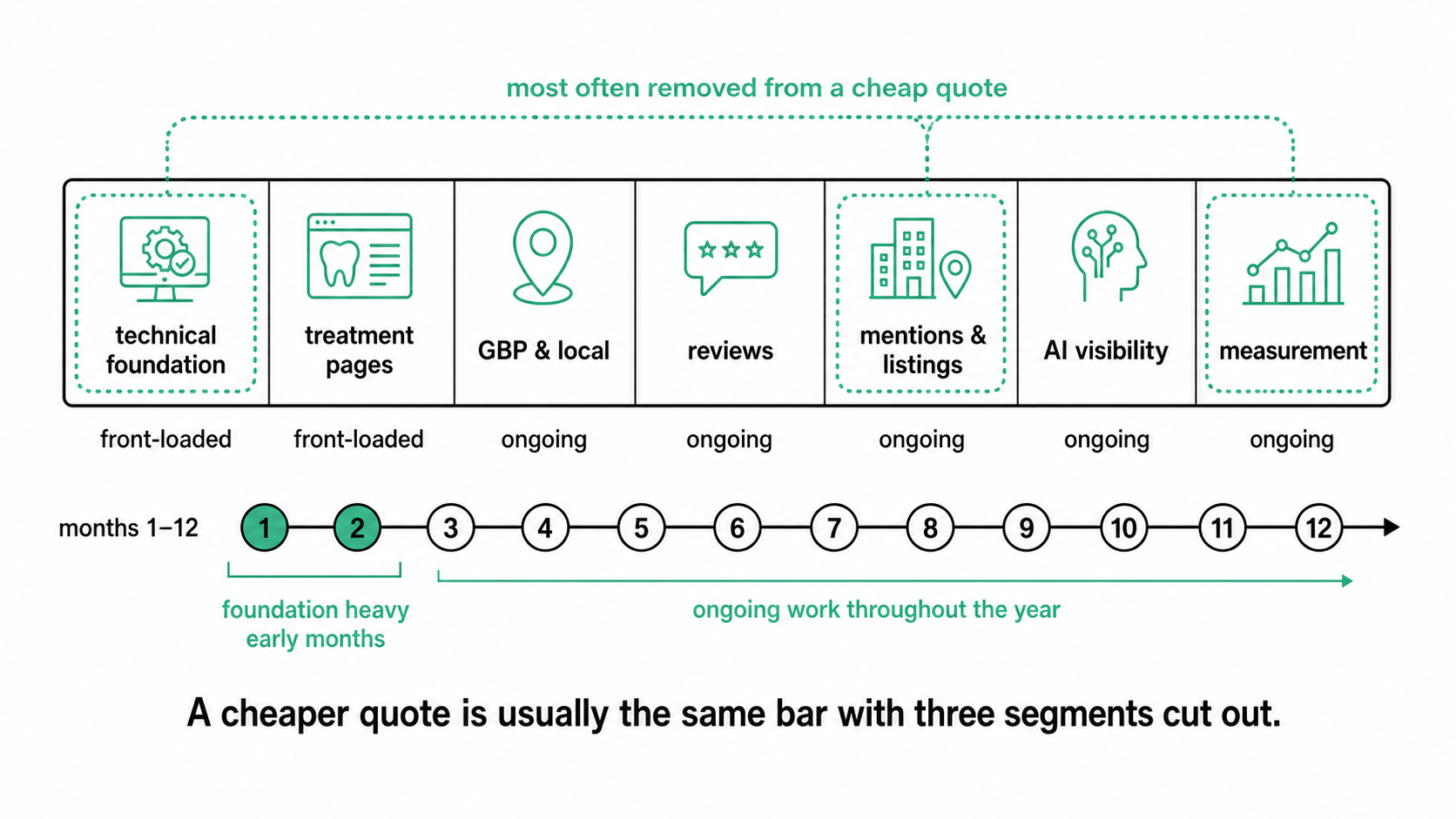
Dental SEO costs roughly $1,500 to $5,000 per month in the agency ranges we see in our client work, and Rotgar retainers start at $3,000 per month after a free audit. Five things set the number: market competition, the condition of your site, how many locations you run, the scope you buy, and how fast you want results.
TL;DR
- Rotgar retainers start at $3,000 per month, scope agreed after the audit. The $1,500–$5,000 span is what we see across agency proposals in our client work — not an industry average, and nobody publishes one worth citing.
- A dental SEO invoice is seven line items, not one service, and most of the cost is front-loaded into months one to four. Cheap month-one quotes usually mean the foundation work was quietly removed.
- Google states plainly: “No one can guarantee a #1 ranking on Google” (Google Search Central). A quote priced on a guarantee is priced on something the seller does not control.
- Break-even is division, not a benchmark. A $3,000 retainer needs $3,000 of monthly gross profit from new cases: six cases at $500 profit each, or roughly one implant-scale case.
- The AI layer is a line item, not an upsell — 44.1% of medical queries trigger AI Overviews (Ahrefs, 146M SERPs, September 2025), and when a summary appears, clicks to traditional links fall from 15% to 8% of visits (Pew Research Center, 68,879 searches, March 2025).
How much does dental SEO cost per month?
Between $1,500 and $5,000 per month in the agency ranges we see in our client work, with full-system retainers — search, Maps, reviews, content, AI visibility — starting around $3,000. Below roughly $1,500 you are buying reporting and a few hours of tasks; above $5,000 you are usually paying for multiple locations or a competitive metro, not a better method.
Dental SEO is the process of optimizing a dental practice’s website, Google Business Profile, and online reputation so the practice appears in Google Search, Maps, and AI answers when potential patients look for dental care. That is the product being priced. When two quotes differ by $2,000 a month, they are rarely selling the same volume of that work — they are selling different fractions of it, described with the same three words.
We publish our floor so you have a reference point: Rotgar engagements are retainer-based, starting at $3,000 per month, with scope agreed after the audit. Hold any proposal on your desk against it, including ours. What the retainer buys is described on our dental SEO page.
What drives the cost of dental SEO?
Five variables, and only two of them are about your practice’s ambition. The other three are conditions you already have: how contested your market is, what state your website is in, and how many locations carry your name. A quote that does not visibly price those three has not looked at them.
| Cost driver | Low end | High end | Why it moves the number |
|---|---|---|---|
| Market competition | Suburb, few optimized competitors | Metro with dozens already running SEO | More depth, more mentions, more months to overtake incumbents |
| Site condition | Modern, fast, crawlable | Slow, template-locked, thin service pages | A rebuild phase consumes months one to three before growth work starts |
| Locations | One office, one profile | Multi-site practice or DSO | Each location is its own local-pack contest, profile and review flow |
| Scope | Profile and Maps only | Search, Maps, reviews, content, AI visibility as one system | Line items are separable; each is real labor, not a checkbox |
| Speed | Steady quarterly cadence | Compressed build (new location, partner buy-in) | A year of work in two quarters raises monthly hours, not efficiency |
Distance is the one input nobody can price. Google states local results are based on “relevance, distance, and prominence” and that “distance refers to how far each business is from the customer who’s searching” (Google Business Profile Help). An agency can move relevance and prominence. Anyone charging you to move distance is selling geography.
What is actually inside a dental SEO retainer?
Seven line items. Read any proposal against this list and ask which ones were removed to hit the price. The cheapest quotes typically drop items 1, 5 and 7 — the technical foundation, the slow off-site work, and the reporting that would let you notice.
| Line item | What the work is | Load | What it is supposed to move |
|---|---|---|---|
| 1. Technical foundation | Speed, mobile usability, crawlability, indexation, structure | Front-loaded, months 1–3 | Whether anything else you pay for can rank at all |
| 2. Treatment pages | A page per procedure patients research — process, candidacy, recovery, pricing logic | Front-loaded, then extended | Rankings and conversions on high-value procedures |
| 3. Google Business Profile | Categories, services, hours, photos, Q&A, booking link, per location | Setup, then monthly | Local pack presence and map-driven calls |
| 4. Reviews and reputation | Ask routine, response workflow, monitoring | Ongoing | Prominence, and the choice between you and the practice two blocks away |
| 5. Mentions and listings | Directory consistency, local sponsorships, earned mentions | Ongoing, slow | Prominence in Search, eligibility in AI answers |
| 6. AI visibility | Prompt-set measurement, entity consistency, source-side presence | Ongoing | Whether assistants name and describe your practice correctly |
| 7. Measurement and account time | Call and booking attribution, reporting, strategy calls | Monthly | Whether you can tell if items 1–6 worked |
Item 7 is where cheap engagements hide. If a report shows sessions and rankings but never connects to calls, forms and booked appointments, you cannot audit your own spend — and neither can we. The full sequence of how these items are ordered across a year sits in our dental SEO strategy guide.
Which pricing model should a dental practice choose?
A monthly retainer for anything that needs to compound, a fixed project fee for anything with a finish line. Hourly billing misprices the work in both directions, and per-lead deals in healthcare tend to collapse into arguments about what counted as a lead.
| Model | How it works | Works well for | Watch out for |
|---|---|---|---|
| Monthly retainer | Fixed fee, defined ongoing scope | Visibility that compounds month over month | Scope vague enough to shrink quietly; get line items 1–7 into the contract |
| Fixed project | One-off fee for a defined build | Site rebuilds, a batch of treatment pages, a local cleanup | Nothing compounds after handover; results decay without upkeep |
| Hourly | Pay per hour worked | Advisory input alongside an in-house marketer | Unpredictable totals; the vendor owns hours, not outcomes |
| Per-lead / revenue share | Pay per lead or attributed case | Rare in healthcare; occasionally one high-ticket line | Lead-quality and attribution disputes; incentive to send volume, not patients |
In our client work retainers produce the strongest outcomes, because the asset compounds: month twelve is built on the pages, profile strength and mentions accumulated before it. Which is also why switching agency every quarter is the most expensive thing a practice can do at any price point — it restarts the clock while the invoice keeps running.
What questions should you ask before signing a quote?
Eight, and Google publishes half of them. Its own guidance on hiring an SEO tells business owners to ask for previous work and success stories, whether the provider follows the Google Search Essentials, what results to expect and in what timeframe, how success is measured, and what experience the provider has in your industry (Google Search Central). The four dental-specific ones are ours.
| Ask this | Why it matters | A weak answer sounds like |
|---|---|---|
| “Can you show me examples of your previous work and share some success stories?” (Google) | Separates practitioners from resellers | Logos with no described work |
| “Do you follow the Google Search Essentials?” (Google) | Rules out tactics that put your site and profile at risk | “We have proprietary methods” |
| “What kind of results do you expect to see, and in what timeframe? How do you measure your success?” (Google) | Forces a measurable promise | Traffic and impressions, no path to booked appointments |
| “What’s your experience in my industry?” (Google) | Dental has HIPAA constraints and review rules generalists learn on your budget | Case studies from unrelated verticals |
| Which of the seven line items is in the fee, and which is extra? | The commonest source of price confusion | “Full-service SEO package” |
| Will you work with a competing practice in my market? | Exclusivity is a legitimate ask | Evasion — which is itself the answer |
| How is a booked appointment tracked back to a channel? | Without it the retainer cannot be judged at renewal | Ranking screenshots |
| What do I keep if I leave? | Pages, content and profile access should be yours | Assets held on the agency’s platform |
How do you calculate dental marketing ROI?
Start from break-even and work backwards, because that number needs only one input you already have: gross profit per new case. Monthly fee ÷ gross profit per case = cases needed to break even. Everything above that line is return; everything below is a learning expense with an end date.
Worked example — break-even at a $3,000 retainer. This table is division, not a benchmark. The left column is your number, taken from your own practice management data, not an industry average.
| Average gross profit per new case | Cases per month to break even at $3,000 | Cases per month for a 3× return |
|---|---|---|
| $200 (hygiene and exam-led new patients) | 15 | 45 |
| $500 (mixed restorative) | 6 | 18 |
| $1,000 (crown and endo-weighted) | 3 | 9 |
| $2,500 (implant and full-arch scale) | 1.2 | 3.6 |
Two honest observations. High-ticket practices cross break-even on volumes so small that the real question is not whether it pays back but how quickly the flow starts — in our client work the first meaningful movement lands in a quarter, not a month. And the number that matters over a year is cost per acquired patient, which falls as the asset matures: the same $3,000 buys more patients in month twelve than in month three. Paid clicks do the opposite; their price is set by auction.
Then add lifetime value, where dentistry differs from most local businesses: a new implant patient is also a hygiene patient for years, and often a family. We model that with your case values during the audit instead of publishing invented averages. Which procedures to target first is a semantics question, handled on dental SEO keywords.
What does our own data say about dental SEO pricing?
Two datasets, both ours, both dated. The first is the demand behind this page — and its most useful finding is how few practice owners ask about price at all, which is part of why almost no agency publishes its prices.
| Query (US, asked by practice owners and marketers) | Monthly searches | CPC | What it tells you |
|---|---|---|---|
| dental seo pricing | 20 | — | The only pricing query in the vertical with meaningful volume |
| dental marketing cost | 10 | — | The whole US asks about price ~40 times a month |
| dental marketing roi | 10 | — | Owners search the tactic far more often than the price |
| dental marketing | 2 400 | $57.23 | Category head term — the market bidding for your attention |
| dental seo | 1 900 | $57.39 | Agency demand, not patient demand |
| dental seo services | 1 600 | $69.57 | Buying-intent query, priced accordingly |
| dental marketing company | 1 600 | $70.51 | What a “who should I hire” click costs an agency |
| dental marketing company near me | 90 | $93.80 | Highest CPC in our dental core |
Source: Rotgar semantic core, Ubersuggest, US, collected 2026-07-26. Read the last five rows as a pricing input rather than trivia: agencies pay $57 to $94 for a single click from a practice owner, and that acquisition cost sits inside the retainer you are quoted. An agency that earns its own visibility carries less of it. Fair question for a sales call.
What our AI-visibility pilot showed, honestly framed. On 2026-08-03 we ran four buyer-intent prompts from our fixed battery on Perplexity in a clean anonymous session; our own citation rate was 0/4, the published zero point. One pattern matters if you are comparing quotes: on “best healthcare SEO agencies” the assistant returned a ranked table of eight firms assembled from those firms’ own self-published listicles, one of them ranking itself first on a score it invented. So an AI shortlist of dental SEO companies is marketing collateral rendered as a recommendation, not evidence about price. The limit, stated plainly: our dental prompts (“Best dental SEO companies”, “Who offers a free SEO audit for dentists?”) were not run in this pilot — one surface, European IP — and dental figures come from the first full run.
Why is AI visibility a line item on a 2026 quote?
Because dental and medical queries trigger AI answers at roughly twice the average rate, and those answers change what a ranking is worth. Ahrefs found AI Overviews on 21% of keywords overall but 44.1% of medical queries, across 146 million SERPs in September 2025 (Ahrefs). Paying for rankings while ignoring the layer above them buys a diminishing asset.
The traffic effect is measured: Pew Research Center tracked 68,879 Google searches by 900 US adults in March 2025 and found that when an AI summary appeared, users clicked a traditional result in 8% of visits against 15% without one, and clicked the summary’s own source link in about 1% (Pew Research Center).
Addressing it costs less than most practices expect, because it is largely entity work rather than a new content program — consistent naming, services and location data, plus presence in the sources assistants cite. Ahrefs’ study of 75,000 brands found branded mentions correlate with AI Overview visibility at 0.664 against 0.218 for backlinks, noting correlation is not causation (Ahrefs). The mechanics are on what AI visibility is; on a quote, this line should read as measurement plus source-side work, with a stated prompt set and a monthly score — not as a separate product.
What are the red flags in dental marketing pricing?
Six, and each one is a pricing signal rather than a style complaint. A quote containing any of them is either mispriced or priced for a different product than the one you think you are buying.
| Red flag | Why it is a pricing problem |
|---|---|
| Guaranteed rankings | Google states “No one can guarantee a #1 ranking on Google” — you are paying for a promise the seller cannot fulfill |
| “Full service” at $500 a month | Seven line items cannot be staffed at that price; you are buying reports, not work |
| Long contracts with no exit clause | Confidence shows up as reasonable terms, not as lock-in |
| Reports about traffic only | If spend cannot be connected to calls and bookings, the renewal decision is guesswork |
| Scope described only as “SEO package” | Undefined scope is the mechanism by which retainers shrink after month three |
| Your competitor is also their client | Two practices in one market, one budget being split; ask about exclusivity directly |
One more, less obvious: a price quoted before anyone has looked at the site, the profile and the competitive set is not pricing — it is a rate card.
When is dental SEO the wrong spend for a practice?
When the constraint is not visibility. SEO adds demand; it fixes nothing downstream of the phone ringing. Four situations where a retainer is the wrong line on the budget this quarter, and we say so during the audit rather than after the invoice:
- No chair capacity. If the schedule is full six weeks out, more new patients means longer waits and cancellations. Fix capacity or case mix first.
- A reputation problem, not a visibility problem. At 3.2 stars, ranking higher only shows more people the rating.
- A rebrand, relocation or sale within six months. Foundation work paid for now is partly rebuilt afterwards. Wait, then start.
- Runway under six months. Compounding channels need quarters. If the budget must produce patients in three weeks, that is a paid-search question.
Client work, honestly framed: for Dentalia Krasovsky in Beverly Hills we did technical SEO, mobile usability, page speed and Google Search and Maps visibility; the client reported higher positions, month-over-month lead growth and positive ROI (client-reported case — exact figures are not published, and we do not invent them).
Key takeaways
- Dental SEO runs $1,500–$5,000 a month in the agency ranges we see in our client work; Rotgar retainers start at $3,000, scope agreed after a free audit.
- Five drivers set the price — competition, site condition, locations, scope, speed. Three are conditions you already have; a quote that has not priced them has not looked at your practice.
- A retainer is seven line items. Cheap quotes are cheap because the foundation, the mentions work and the reporting were removed, not because the same work costs less elsewhere.
- Break-even is division: monthly fee ÷ gross profit per case. At $3,000, six $500 cases or roughly one implant-scale case — your numbers, not an industry average.
- Cost per acquired patient falls as the asset matures; paid clicks move the other way, at $57–$94 per click in our dental keyword core (Ubersuggest, US, 2026-07-26).
- The AI layer belongs on the quote as measurement plus source-side work: 44.1% of medical queries trigger AI Overviews, and clicks to links fall from 15% to 8% when a summary appears.
- Guaranteed rankings are the definitive red flag — Google states no one can guarantee a #1 ranking, so any price attached to that promise is fiction.
FAQ
How much does dental SEO cost per month?
Roughly $1,500 to $5,000 per month in the agency ranges we see in our client work, driven by market competition, site condition, number of locations, scope and speed. Full-system retainers covering search, Maps, reviews, content and AI visibility start around $3,000; Rotgar’s own floor is $3,000 per month, with scope set after the audit.
Is dental SEO worth the money?
When the break-even math works, it is usually the highest-return marketing a practice runs, because the asset compounds while paid clicks reset every month. Divide the monthly fee by your gross profit per new case: at $3,000 and $500 profit per case you need six cases a month. High-ticket procedures reach that line fastest.
Why is dental SEO so expensive?
Because it is seven parallel disciplines delivered as ongoing skilled labor — technical work, content production, local optimization, review systems, mentions, AI visibility, and measurement — over quarters rather than weeks. Cheap SEO is not a discounted version of that product; it is a much smaller product sold under the same name.
Can I do dental SEO myself to save money?
The basics genuinely are DIY: completing the Google Business Profile, a review-request routine at checkout, consistent listings, answering your own profile Q&A. The compounding parts — technical work, treatment-page strategy, mentions and AI visibility — are where specialist time pays for itself. Read our dental SEO strategy guide first and judge honestly which half you have the hours for.
How long before dental SEO pays for itself?
Longer than paid search and shorter than most owners fear. In our client work the first meaningful movement shows within a quarter, and the payback point depends far more on your case mix than on the retainer size — a practice with implant-scale gross profit crosses break-even at roughly one case a month, while a hygiene-led practice needs volume and therefore more months.
Get a free audit — we will model these numbers with your case values and your market before anyone quotes you a retainer. The simplest free audit starts with one clinic or selected location, one priority market and one patient language. It shows current visibility across Google Search, Google Maps, Google AI Overviews, ChatGPT, and Gemini, plus competitor gaps and prioritized fixes.