
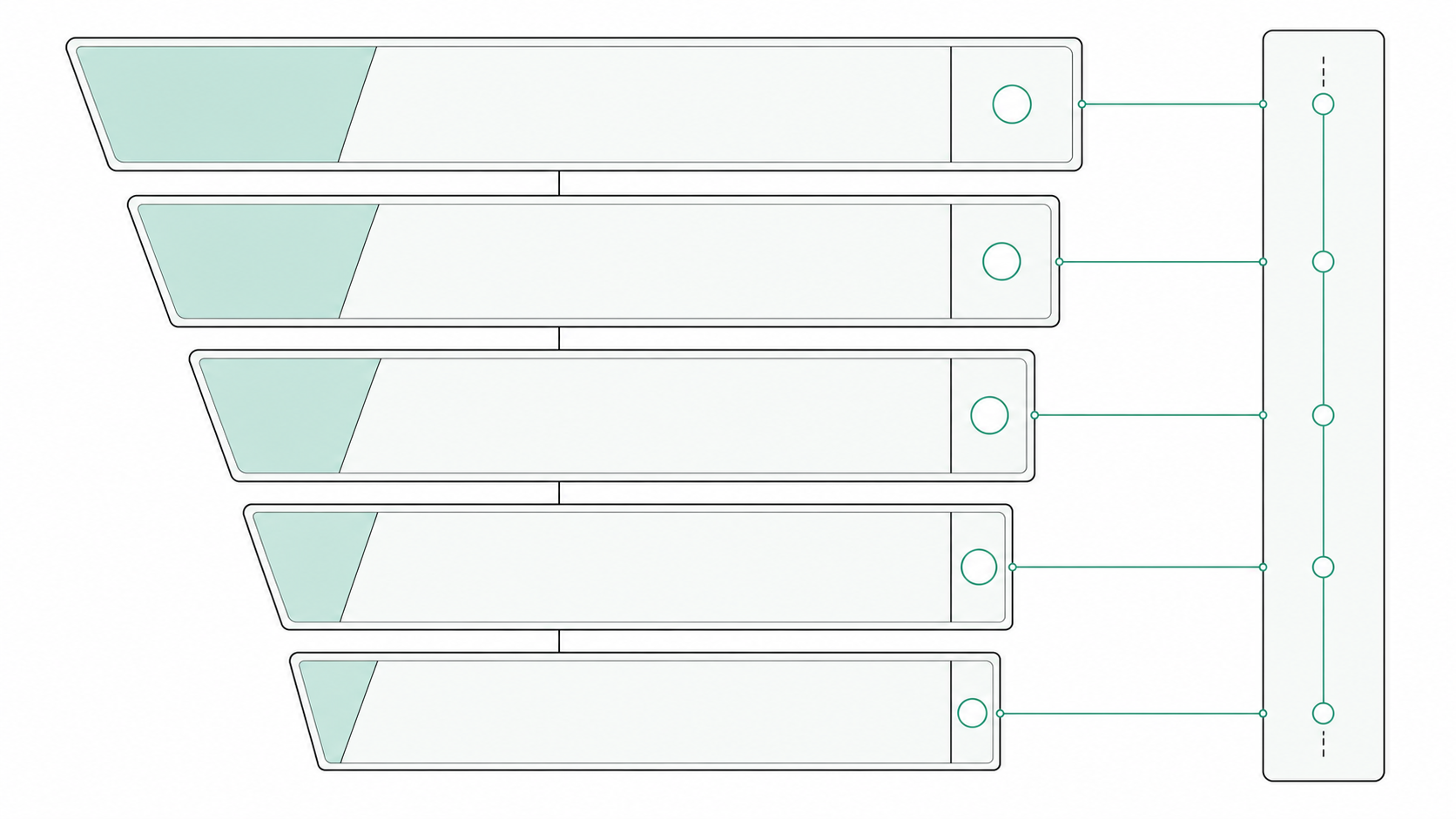
This generative engine optimization checklist is organized in five layers — technical access, entity, content, off-site sources, measurement — because sites fail to get cited at different points, and a flat list of tips hides which point is yours. Every item is pass/fail: run the check, mark it, fix what fails, re-run monthly. Generative engine optimization (GEO) is the practice of making a brand’s website, content, and entity signals easy for AI systems — ChatGPT, Gemini, Google AI Overviews — to understand, trust, and cite in generated answers. The same list is what buyers call answer engine optimization (AEO) best practices — one discipline, two labels.
TL;DR
- 27 items in 5 layers, each with the two columns that matter: how to check it and what counts as done. No scoring shades, no “create quality content.”
- No item requires special AI markup. Google states there are “no additional requirements to appear in AI Overviews or AI Mode” and no special schema.org data to add — a page must be indexed and snippet-eligible (Google Search Central).
- Layer 4 (off-site sources) is usually the binding constraint, not schema. In our pilot on August 3, 2026, Perplexity answered 4 buyer-intent prompts without naming Rotgar once — citing listicles, directories, and Reddit threads instead.
- The Princeton-led GEO paper (KDD 2024) found its top methods — adding citations, credible quotations, and relevant statistics — produced a 30–40% relative visibility gain, while keyword stuffing offered “little to no improvement.”
- A checklist verifies inputs; the outcome is a separate number — citation rate on a fixed prompt set, re-measured monthly. All boxes green with a flat citation rate is a real, diagnosable state (Layer 5).
How do you use this GEO checklist?
Work top-down and stop at the first layer that fails. Technical access gates everything above it; entity clarity gates content; content gates citation; nothing gates measurement, which you start immediately. Run each stated check on your own site and mark pass or fail. Re-run the full list monthly: AI platforms change how they select and cite sources.
| Layer | The question it answers | Items | Fix this layer first if… |
|---|---|---|---|
| 1. Technical access | Can AI systems reach and use the page? | 6 | Pages are not indexed, JS-only, snippet-blocked, or crawlers disallowed |
| 2. Entity | Do AI systems know who you are, unambiguously? | 5 | Your name, category, or location differs across site, schema, and profiles |
| 3. Content | Can an answer be lifted from the page cleanly? | 6 | Pages rank but never appear as a cited source |
| 4. Off-site sources | Do the sources AI engines read already name you? | 5 | You are invisible on category prompts (“best X firm”) |
| 5. Measurement | Do you know whether any of this moved? | 5 | You cannot state last month’s citation rate |
This checklist confirms the work was done; what to do first at the business level is decided on our GEO strategy page. For the same five layers as a process — sequencing and effort estimates instead of pass/fail rows — read the AI search optimization guide.
The original published protocol specifies a fixed set of 16 buyer-intent prompts tested monthly across Google AI Overviews, ChatGPT, Gemini, and Perplexity, scored by citation rate. That is why measurement is Layer 5, not a closing note.
Layer 1 — Which technical checks decide whether AI systems can use your pages?
Six checks, all of them ordinary search hygiene rather than AI-specific configuration. Google’s guidance is explicit: to be eligible as a supporting link in AI Overviews or AI Mode, a page must be indexed and eligible to be shown in Search with a snippet. The only genuinely new item is crawler policy, set separately per bot.
| # | Item | How to check | Done when |
|---|---|---|---|
| 1 | Key pages are indexed | URL Inspection in Search Console, per priority URL | “URL is on Google”, no coverage error, no noindex |
| 2 | Pages are snippet-eligible | Search the source for nosnippet, max-snippet:0, data-nosnippet |
No snippet control suppresses the text you want quoted (Google) |
| 3 | Answer text is in the initial HTML | View raw source, not the rendered DOM | The 40–60-word answer under each key heading is there without JavaScript |
| 4 | OAI-SearchBot is allowed |
Read the user-agent blocks in /robots.txt |
It is not disallowed for key sections — OpenAI documents it as the crawler that surfaces sites in ChatGPT search (OpenAI) |
| 5 | The GPTBot decision is deliberate |
Compare /robots.txt against a written, dated decision note |
Whoever asks gets one answer; the team knows GPTBot governs training use only |
| 6 | Canonicals and sitemap agree | Compare sitemap.xml against each canonical tag |
One canonical per topic, no redirect chains, sitemap lists live canonicals only |
Item 5 is where most sites make an unexamined choice. OpenAI documents its crawlers as independent settings: OAI-SearchBot for visibility in ChatGPT search, GPTBot for model training, ChatGPT-User for pages fetched at a user’s request. Blocking GPTBot is a defensible content-rights position; blocking OAI-SearchBot is opting out of ChatGPT visibility — which sites do by accident with one wildcard “AI bots” rule.
Layer 2 — Which entity signals have to match everywhere?
Five checks, all testing one thing: whether a machine reading your site, your profiles, and third-party pages concludes they describe the same organization. Entity ambiguity is silent — nothing breaks, you simply stop being the answer to “who does X.” Fix it before content work: content is attributed to an entity or to no one.
| # | Item | How to check | Done when |
|---|---|---|---|
| 7 | One primary name string | Put the name from your H1, Organization schema, Google Business Profile, and directory listings side by side |
All strings identical character for character — no abbreviations, suffixes, or “&”/“and” swaps |
| 8 | Organization schema with sameAs |
Run the homepage through a structured-data validator | Validates with zero errors; sameAs lists profiles you control |
| 9 | Name, address, phone, category agree | Compare site footer, schema, Google Business Profile, five external listings | All five state the same address, phone, and primary category |
| 10 | Author is a named person | Inspect article markup and the visible byline | author is a Person with a real bio, plus visible datePublished and dateModified |
| 11 | Positioning facts identical off-site | Compare services, markets, and languages on your site against profile descriptions | “Orthopedics, Boston, English/Spanish” — or “personal injury, Texas” — reads the same everywhere |
Items 7 and 9 sound clerical and are the highest-yield rows here: AI systems resolve entities by agreement across sources, so two spellings of your name are two weak entities instead of one strong one.
Layer 3 — How should content be structured so an answer can be lifted from it?
Six checks on extractability. The controlling evidence is the Princeton-led GEO study at KDD 2024: across nine content strategies, the top performers — Cite Sources, Quotation Addition, Statistics Addition — achieved a 30–40% relative visibility improvement, while keyword stuffing, in the authors’ words, offered “little to no improvement.” Structure and sourcing beat repetition.
| # | Item | How to check | Done when |
|---|---|---|---|
| 12 | Answer-first lede under every key heading | Cut one block out of the page and read it alone | It answers its own heading in 40–60 words, no pronoun pointing outside the block |
| 13 | One page, one intent | Read title, H1, URL, and first paragraph in sequence | All four name the same subject; no mixed terms (GEO in the title, “AI SEO” in the H1) |
| 14 | Comparisons rendered as real tables | Inspect the HTML | <table> markup, not screenshots or prose lists — tables are what AI answers reuse most readily |
| 15 | Claims are sourced or dated | Scan every sentence about platform behavior or market numbers | Each carries a source link or an explicit “as of August 2026”; unsourced statistics are removed |
| 16 | Statistics and quotations present, not just adjectives | Count figures and cited quotations per page | Key sections contain at least one — the strategies the KDD 2024 study ranked top |
| 17 | FAQ marked up with FAQPage |
Validate the page against the visible questions | Entities validate and match visible questions one-to-one, answers verbatim |
Layer 4 — Do the sources AI engines already read name you?
Five checks, and on category prompts this layer usually decides the outcome: AI assistants answering “best X agency” rarely nominate brands on their own authority, they relay existing lists. Ahrefs’ study of 75,000 brands found branded web mentions correlate with AI Overview brand visibility at 0.664 versus 0.218 for backlinks — a ~3× gap; the authors state plainly that correlation is not causation.
| # | Item | How to check | Done when |
|---|---|---|---|
| 18 | Present in the directories your category’s lists draw from | Run your category query, open the top listicles, note which directories they cite | You have a complete profile in each directory those lists pull from |
| 19 | Named in third-party roundups | Search your category term plus “best”/“top”, then your brand name | Name and a one-line description appear on at least three pages you do not own |
| 20 | Community presence under a consistent identity | Search your category term on Reddit and the forums your buyers read | Useful, non-promotional answers under one identity, brand named where relevant |
| 21 | Reviews use one brand string | Read the ten most recent reviews | Reviewers name the organization the way your schema does |
| 22 | You publish a citable asset with a transparent method | Ask what a third party could cite from your site as evidence | At least one page states a method others can reproduce — data, a scored comparison, a protocol |
What our own measurement says about which layer binds
On August 3, 2026 we ran 4 prompts from our fixed 16-prompt battery on Perplexity in a clean anonymous session and were named in 0 of 4 answers — citation rate 0%. The useful output was not the zero but the sources cited instead, and the layer each implicates.
| Prompt (verbatim, Perplexity, 2026-08-03) | Named / cited | What the answer cited instead | Layer that decided it |
|---|---|---|---|
| “Who provides generative engine optimization services?” | No / No | Directories and agency listicles: Clutch’s GEO category, DesignRush, SEOProfy, Concurate | Layer 4, items 18–19 |
| “Where can I get an AI visibility audit?” | No / No | Tool vendors with free-audit pages, Reddit threads (cited three times), YouTube | Layer 4, item 20 |
| “Best healthcare SEO agencies” | No / No | First Page Sage’s own listicle, ranking itself first with a self-assigned “AI Visibility Score”; Intrepy’s own listicle | Layer 4, item 22 — a self-published asset relayed as data |
| “What is generative engine optimization?” | No / No | Heavyweights only: Semrush, Wikipedia, Coursera, Mailchimp | None — definition prompts are won on domain authority |
Honest framing: a 4-prompt pilot on one surface from a European IP, not the full 16-prompt, four-surface US run — ChatGPT, Gemini, and AI Overviews need logged-in manual runs. The structural finding holds regardless of region: three of four answers were assembled from third-party pages. If Layers 1–3 are green and category prompts still return competitors, the checklist has done its job by pointing at rows 18–22 — the sequence we apply in AI visibility work for medical organizations.
Layer 5 — How do you check that any of this worked?
Five checks on the measurement setup itself, because an unmeasured checklist is a to-do list. Start this layer on day one, before fixing anything: without a baseline you cannot tell a real improvement from a stochastic one, since AI answers vary between runs.
| # | Item | How to check | Done when |
|---|---|---|---|
| 23 | The prompt battery is written down | Open the file — it should be a file, not a habit | A fixed list of buyer-intent prompts (16 in our protocol) that never changes between runs |
| 24 | Session protocol is documented | Read your own protocol note | Region, logged-out state, and surface list are specified and repeated each run |
| 25 | A fixed run date exists | Check the calendar entry | The battery runs the same day each month, on every surface you claim to track |
| 26 | The competitor column is recorded | Look at last month’s results table | For every prompt you record who was named instead of you |
| 27 | Citation rate is computed and stored | Recompute last month’s number from the raw table | Citation rate = mentions or citations ÷ total prompts, per surface and in total, kept month over month |
Row 26 is the one teams skip and later wish they had: it converts a zero into a map.
Measurement also sets traffic expectations. Pew Research Center found that around one-in-five Google searches in March 2025 produced an AI summary, and that users clicked a result link in 8% of visits with a summary present versus 15% without (Pew). Track being named inside the answer separately from clicks — clicks are what the summary absorbs.
What this GEO checklist will NOT fix
- It will not guarantee citation. Passing all 27 items improves the odds; no checklist can promise mentions in AI answers.
- It is not a substitute for measurement. The checklist verifies inputs; the result is citation rate on a fixed prompt set. Otherwise: all boxes green, and still nobody cites us.
- It is not a one-time procedure. Platforms change how they select and cite sources; a list run once goes stale (August 2026).
- It will not compensate for a weak search foundation. If pages are not indexed or the content is thin, Layer 3 and 4 items will not save them — GEO overlays search fundamentals, it does not replace them.
- It is not prompt manipulation or platform “hacks.” Every item here is a site, entity, or source signal — and the classical-SEO assumption that more keywords equal more visibility measured close to zero effect in the KDD 2024 research.
Key takeaways
- The checklist is 27 pass/fail items in five layers: technical access (6), entity (5), content (6), off-site sources (5), measurement (5). Work top-down; stop at the first failing layer.
- No item requires AI-specific markup — indexed and snippet-eligible is Google’s stated bar. But crawler policy is per-bot:
OAI-SearchBotgoverns visibility in ChatGPT search,GPTBotgoverns training use, and one wildcard “block AI bots” rule silently does both. - Entity items are clerical and high-yield: one name string, one address, one category, agreeing across site, schema, profiles, and reviews.
- Content items follow measured evidence: citations, quotations, and statistics produced a 30–40% relative visibility gain in the KDD 2024 GEO study; keyword stuffing produced little to none.
- Off-site sources usually bind on category prompts. Our August 3, 2026 pilot returned 0/4, with answers assembled from listicles, directories, and Reddit; Ahrefs puts branded mentions at ~3× the correlation of backlinks.
- Measurement is a layer, not an afterthought: fixed battery, fixed protocol, fixed date, competitor column, citation rate stored month over month.
FAQ
How often should I re-run a GEO checklist?
Monthly, on the same day you run your prompt battery — the two belong together. AI platforms change how they select and cite sources (August 2026), so a list run once goes stale. Layers 1 and 2 rarely move month to month; Layers 3 through 5 are where the monthly work lives.
Is a GEO checklist the same as an AEO checklist?
In practice, yes. The terms name overlapping parts of one discipline and the underlying items are the same signals; the emphasis differs in which surfaces you care about. For the full comparison, see AEO vs GEO.
Which layer should I fix first?
Whichever fails first, reading top-down — but the common real answer is Layer 4. Most professional-services sites pass the technical and content checks and still lose category prompts, because those answers are assembled from third-party lists, directories, and community threads rather than vendor sites.
Do I need special schema markup to appear in AI Overviews?
No. Google’s documentation states there are no additional requirements for AI Overviews or AI Mode, no AI-specific files, and no special schema.org structured data to add; a page needs to be indexed and eligible to be shown with a snippet. Schema on this list serves entity clarity and FAQ eligibility.
Can I do GEO myself with a checklist?
The on-site layers — yes. Layers 1 through 3 are checkable and fixable in-house by anyone comfortable with a CMS and Search Console. What needs a process rather than an afternoon is Layer 4, third-party presence, and Layer 5, running the same measurement monthly without drift.
Does this checklist work for healthcare?
Yes, with tighter scrutiny. Medical topics are held to higher trust standards, so named authorship, factual accuracy, and consistent entity data matter more, not less — Layers 2 and 3 carry extra weight. None of the 27 items involves giving medical or legal advice.