
Dental practice SEO adapts the same core work — website, Google Business Profile, reviews, content — to the practice’s size and model. A solo office, a group practice, and a multi-location DSO need different priorities, budgets, and timelines. The work does not change as a practice grows; ownership, architecture, and the order of operations do.
TL;DR
- One office, one profile. Google’s guidelines are explicit: “Do not create more than one page for each location of your business, either in a single account or multiple accounts” (Google Business Profile Help). Multi-location visibility is an architecture problem before it is a marketing problem.
- Individual dentists are separate entities. Google states that where several practitioners share a location, “The organization should create a Business Profile for this location, separate from that of the practitioner,” titled with only the practitioner’s name.
- Templated location pages are a documented spam pattern, not a shortcut: Google lists “having multiple domain names or pages targeted at specific regions or cities that funnel users to one page” as doorway abuse (Google Search Central).
- Practice-type buyers are a small, uneven cluster:
dental practice seoat 480/mo (difficulty 15, $39.82 CPC) againstseo for dental officesat 210/mo and difficulty 37 — the smaller query is the harder one (Rotgar semantic core, Ubersuggest, US, 2026-07-26). - The multi-location model keeps growing: ADA Health Policy Institute analysis of nearly 200,000 practicing dentists found “more than 1 in 4 dentists up to 10 years out of dental school were affiliated with a DSO” in 2024, where affiliation means an outside entity manages nonclinical functions “such as billing, marketing, human resources or more” (ADA News, November 2025).
What changes in dental SEO as a practice grows?
Three things: who owns the work, how many entities Google has to keep straight, and what breaks first. A solo office competes for one map pack with one profile. A group practice adds doctors as separate entities. A multi-location group adds a profile, a page, and a review stream per site — and the failure mode shifts from “invisible” to “competing with yourself.”
| Solo office | Group / multi-doctor practice | Multi-location group or DSO | |
|---|---|---|---|
| What decides visibility | The map pack for one address | The map pack plus provider-name searches | Per-location packs, each won separately |
| Profile footprint | 1 practice profile | 1 practice profile + practitioner profiles | 1 profile per location, plus practitioners |
| Site architecture | Flat: services + one location | Services + provider pages | Locations × services grid, one domain |
| First thing that breaks | Nothing is claimed or completed | Reviews and provider pages have no owner | Two of your own pages target one query |
| Where the work sits | Owner or office manager | Office manager + marketing help | Central marketing team + local staff |
| Realistic first 90 days | Profile, reviews, 3–5 treatment pages | Provider pages + a review routine per doctor | Audit every profile, then fix the worst location |
Read the last row as the actual plan. Practices of every size lose the same way — content before the profile and the architecture are right — but a group loses that way in parallel, across every office it operates.
SEO for a solo dental office: what comes first?
Google Business Profile, then reviews, then a handful of strong treatment pages — in that order, with nothing else funded until those three are solid. A solo office has one address and one budget, so concentration beats coverage, and a fast site with clear service pages outperforms a blog nobody maintains.
Most of a solo office’s new patients arrive through proximity search, which is why local SEO for dental practices is where the budget belongs first. Solo practices also hold one advantage larger organizations cannot copy: the doctor is the brand. Named reviews, the doctor’s own voice in treatment explanations, and a real photo of the person holding the drill cost nothing but discipline.
SEO for group practices: how do provider pages and reviews work?
Each doctor is a separate entity, and Google treats them that way. Google’s guidelines state that when multiple practitioners share a location, the organization keeps its own Business Profile and each practitioner may hold a separate one titled with only the practitioner’s name (Google Business Profile Help). Individual profiles are appropriate when the practitioner “operate[s] in a public-facing role” and “can be contacted directly at the verified location during stated hours.”
That produces two jobs a solo office never has. Provider pages: one page per doctor with credentials, specialties, treatment focus, and photo — these rank for name searches, the highest-intent queries a group receives, because the patient already has a referral and is checking the person. Review distribution: reviews pile onto the practice while patients choose a doctor, so the ask has to name the provider who delivered the treatment.
The third job is internal. Four doctors offering the same four treatments do not need sixteen pages: one page per treatment with providers listed on it keeps the signal in one place. Splitting by doctor is the group-practice version of the cannibalization problem multi-location groups hit later.
How do you structure a multi-location dental site (locations × services)?
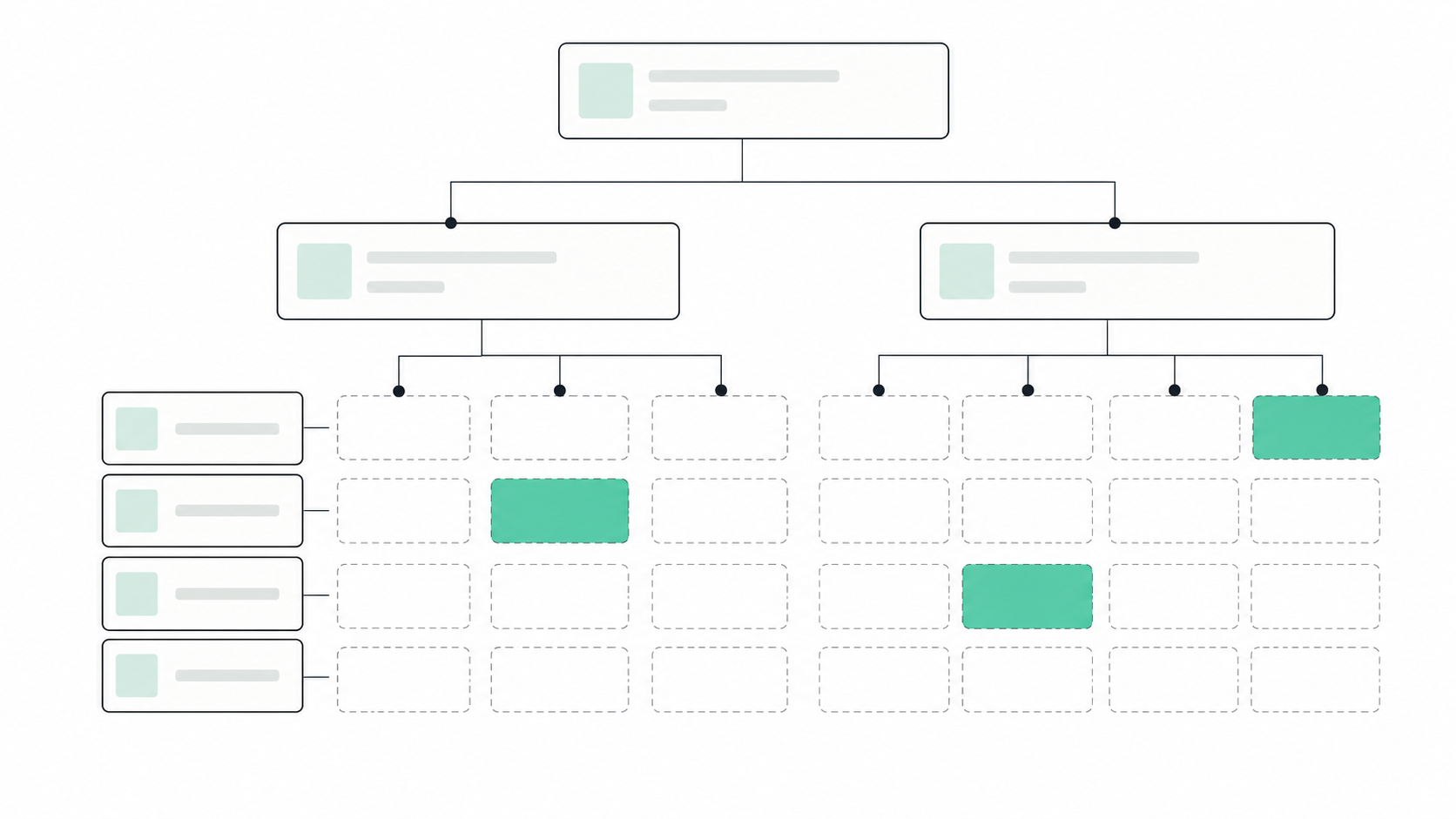
One domain, one page per location, one page per service, and combination pages only where there is something location-specific to say. A DSO (dental service organization) — a group that owns or manages multiple dental practices, typically handling nonclinical functions like billing, HR, and marketing — is running an architecture problem, not a visibility problem. The grid below is the decision, not the theory.
| Page type | URL pattern | What it targets | What earns it a page | Entity link |
|---|---|---|---|---|
| Location page | /locations/<office>/ |
The practice name plus proximity searches for that address | Address, hours, staff, photos, insurance, booking for that office — all unique | Matches exactly one Google Business Profile |
| Service page | /services/<treatment>/ |
Treatment demand across the whole group | Clinical explanation, cost drivers, recovery, FAQs — written once, well | Dentist / LocalBusiness markup on the parent entity |
| Location × service | /locations/<office>/<treatment>/ |
“Treatment + neighborhood” demand | A named provider, real pricing or financing, cases, or equipment only that office has | Location profile + provider entity |
| Provider page | /team/<doctor>/ |
Doctor-name searches | Credentials, specialties, offices worked, reviews naming the doctor | Practitioner Business Profile, if one exists |
Row three separates a real multi-location site from a penalized one. Google’s spam policies define doorway abuse as pages “created to rank for specific, similar search queries” that “lead users to intermediate pages that are not as useful as the final destination,” naming “having multiple domain names or pages targeted at specific regions or cities that funnel users to one page” as an example (Google Search Central). A generated grid of “Invisalign in [city]” pages differing by one noun is that pattern exactly.
Markup follows the same logic: each location page carries its own URL, which Google’s structured data guidance defines as “the fully-qualified URL of the specific business location” and requires to be a working link (Google Search Central). One page, one URL, one profile, one address — per office, never merged.
Worked example — sizing the grid before building it. A three-location group offering eight treatments could publish 3 × 8 = 24 combination pages. Applying the test above, only combinations with a location-specific asset survive: two offices have an in-house implant surgeon, one runs a Saturday emergency clinic. That is 3 combination pages, not 24. Add 3 location pages, 8 service pages, and 6 provider pages: 20 pages total. At two well-researched pages a month with clinical review, that is a ten-month build — which is why “which office is losing the most patients right now?” comes before the architecture diagram.
How do you keep locations from cannibalizing each other?
By assigning every keyword group exactly one owner page across the entire group, and enforcing it centrally. Two offices six miles apart will both try to rank for the same treatment query; if both have a near-identical page, Google picks one — often not the one you would choose.
Check three sources in this order: identical treatment copy replicated across location folders, two location pages whose service areas overlap with nothing to differentiate them, and legacy microsites from acquired practices still ranking on their own domains. The third is the most common finding in DSO audits and the most valuable to fix — the acquired domain usually carries reviews, links, and years of history that should be consolidated, not left to compete. The mapping method is on dental SEO keywords, which groups service × location × intent with one row per page.
Who owns what? Governance for a multi-location practice
Central marketing owns the system; local staff own what only local staff can do. Governance is the difference between a group with 12 offices and a group with 12 independent SEO outcomes — and the reason multi-location work is slower to set up but compounds harder: every template improvement replicates across every location.
| Asset | Central owner | Local owner | Cadence | What happens if nobody owns it |
|---|---|---|---|---|
| Business Profile data (categories, services, attributes) | Sets the standard, audits quarterly | Confirms hours, holidays, closures | Quarterly audit, immediate for hours | Profiles drift; one office lists three services, another lists twenty |
| Photos | Sets the shot list and specs | Takes and uploads them | Monthly | Stock images or none; the profile looks abandoned |
| Reviews — the ask | Provides the script and link | Asks at the chair, every time | Weekly | Review velocity is a spike, then silence |
| Reviews — the response | Writes the HIPAA-safe templates | Flags urgent ones same day | 48 hours | A staff member confirms a patient relationship in public |
| Website content | Owns templates, service pages, keyword map | Supplies local facts and provider details | Per launch | Location pages become copy-paste doorways |
| New location onboarding | Runs a fixed checklist | Verifies address and phone | Per acquisition | The acquired microsite competes with your own domain |
| Reporting | Per-location and rolled-up views | Reads their own numbers | Monthly | Leadership sees an average that hides two failing offices |
Two rows carry disproportionate weight. Review responses in dentistry are a compliance surface, not a customer-service one: a public reply acknowledging that someone was a patient is a mistake to design out with templates, not with training alone. And reporting has to exist at both levels — a rolled-up dashboard showing group growth will happily conceal a location that lost half its calls.
The bottleneck at scale is often not search at all: visibility work delivers calls into a central intake, and the answer rate there decides whether they become appointments. Before funding another quarter of content, count how many calls went unanswered last month.
How much demand is there for practice-type queries?
Enough to build one page around, not enough to build a strategy around. This is the real cluster from our own core, shown next to the head terms so the proportion is visible.
| Keyword (canonical) | Volume/mo | CPC | Difficulty | Note |
|---|---|---|---|---|
| dental marketing | 2 400 | $57.23 | 33 | Head term of the vertical |
| dental seo | 1 900 | $57.39 | 31 | Family max; absorbs seo for dentists, seo dentistry |
| local dental seo | 1 000 | $68.15 | 24 | Absorbs local seo for dentists |
| dental practice seo | 480 | $39.82 | 15 | Absorbs seo for dental practices, seo for dental practice |
| seo for dental offices | 210 | $42.50 | 37 | Absorbs dental office seo; hardest key in this table |
| dental website seo | 140 | $70.43 | 17 | Absorbs seo for dental websites; highest CPC here |
| seo for dental clinics | 50 | $31.06 | 11 | Thin, easy, and the closest match to DSO language |
Source: Rotgar semantic core v2 (Ubersuggest, US, pulled 2026-07-26; duplicate phrasings collapsed to one canonical key, volume = family maximum). Difficulty does not track volume here: seo for dental offices has less than half the volume of dental practice seo and more than twice the difficulty. Practice-type queries are a cluster to cover on one page, not a set of pages to spread across a site.
What changes for a multi-location practice in AI answers?
The inputs change more than the work does. Assistants assemble answers about dentists from third-party pages, directories, and review platforms as much as from a practice’s own site — so a group’s weakest location, the one with eight reviews and a half-filled profile, can become the version of the brand an assistant describes. Consistency across locations stops being a branding preference and becomes a data-quality requirement.
Our own measurement says to be careful with confident claims here. In our 2026-08-03 pilot run against Perplexity (clean anonymous session), category questions returned no brand answers the model composed itself — the responses were rebuilt from third-party listicles, self-published agency rankings, and Reddit threads. The dental prompts in our fixed 16-prompt battery were not run in that pilot, so those patterns come from adjacent healthcare and category prompts; dental-specific numbers land at our first full run. How the surfaces work is covered on AI visibility for a dental practice rather than repeated here.
What’s the same across all practice types
Whatever the size, five things decide the outcome:
- A complete, correctly categorized Google Business Profile — Google states that “Businesses with complete and accurate info are more likely to show up in local search results” and ranks local results “mainly” on relevance, distance, and prominence (Google Business Profile Help).
- A steady flow of fresh, specific reviews — “More reviews and positive ratings can help your business’s local ranking.”
- Treatment pages that answer cost, fear, and longevity questions.
- A fast, mobile-first website with a booking path that completes on a phone.
- Measurement in booked appointments, not traffic.
That core is what dental SEO actually is: Dental SEO is the process of optimizing a dental practice’s website, Google Business Profile, and online reputation so the practice appears in Google Search, Maps, and AI answers when potential patients look for dental care. The type of practice changes the priorities, the owners, and the sequence — not the definition. The full scope of the service sits on dental SEO.
What practice-type SEO will NOT fix
It will not make one location rank in another location’s neighborhood. Distance is the one local ranking factor no amount of work moves; a page targeting a suburb where you have no office is the doorway pattern with extra steps.
It will not standardize a patient experience that varies by office. Reviews are the public readout of front-desk behavior and chair-side communication; in a group, SEO makes the differences between locations visible faster — useful information, and occasionally an unwelcome surprise.
It will not fix an intake bottleneck. More calls into an unanswered phone or an untrained central intake team produce a worse cost per new patient, not a better one.
For the Beverly Hills practice Dentalia Krasovsky — a single-location office — we ran technical SEO, mobile usability, and speed work, then Google Search and Maps visibility; the client reported higher positions, month-over-month lead growth, and positive ROI (client-reported, no figures published). APPW Clinic in Boston engaged us for technical and local SEO against proximity-driven demand and reported a lift in keyword visibility and leads (client-reported, directional). Both are single-location engagements, and we say so: multi-location results should be judged per location, never on a group average.
If you are weighing the broader picture beyond search, the dental marketing system page maps every channel a practice can fund.
Key takeaways
- Practice type changes ownership, architecture, and sequence — not the work. The same five fundamentals decide the outcome for a solo office and a 40-location DSO.
- Solo offices win by concentration: profile, reviews, a few strong treatment pages, and the doctor as the brand. Everything else is a distraction until those are solid.
- Group practices add two jobs: provider pages that rank for doctor-name searches, and a review ask that names the provider. Do not split one treatment page across four doctors.
- Multi-location groups need one domain, one page and one Business Profile per location, and combination pages only where a location-specific asset exists — templated city pages are documented doorway abuse.
- Cannibalization has three usual sources: replicated treatment copy, overlapping service areas, and legacy microsites from acquired practices. The third is the highest-value fix and the most often missed.
- Governance is the multiplier. Central owns templates, keyword ownership, standards, and reporting; local owns hours, photos, and the review ask. Anything unowned drifts within a quarter.
- Practice-type queries are a real but small cluster —
dental practice seoat 480/mo,seo for dental clinicsat 50/mo (Rotgar core, Ubersuggest, US, 2026-07-26). Cover them on one page; spend the rest on patient-side demand.
FAQ
Is SEO different for a dental office vs. a clinic?
The mechanics are identical — profile, reviews, content, site. What differs is scale and ownership: a single office concentrates everything on one location and one map pack, while a clinic or group manages multiple providers or locations and has to decide centrally which page owns which query, so its own pages do not compete.
Do multi-location dental groups need separate websites?
No. Separate websites split authority and multiply maintenance. The working model is one domain with a dedicated page and its own Google Business Profile per location — Google’s guidelines say not to create more than one profile per location, and one page per location is the site-side equivalent. Acquired microsites should be consolidated with redirects, not left running.
Should each dentist in a group practice have their own Google Business Profile?
Only if the dentist is public-facing and reachable directly at the verified location during stated hours — that is Google’s stated condition. When they qualify, the practice keeps its own profile and each practitioner profile is titled with only the practitioner’s name. Provider pages on the website are worth building either way, because doctor-name searches carry the highest intent a group receives.
Which practice type sees SEO results fastest?
Solo offices in less competitive markets typically move first, because the work is concentrated on one profile and one site. Multi-location groups take longer to set up — every location needs its own audit, profile, and page — but then replicate each template improvement across all locations, which is where the model pays back.
Can SEO work for a brand-new dental practice or a newly acquired location?
Yes, with adjusted expectations. A new address has no reviews and no history, so the first months go into the profile, consistent listings, and foundational pages. For an acquired practice, the priority is different and usually faster: inherit rather than restart — consolidate the old domain, keep the review history attached to the right profile, and update the name only if the real-world signage changes.
How many location pages is too many?
There is no page count that is too many; there is content that is too thin. A location page earns its place with facts only that office has — address, hours, staff, photos, insurance accepted, its own booking path. If two location pages would read identically with the city name swapped, that is Google’s doorway example, and one strong page beats both.
Not sure which priorities fit your practice type?
Get a free audit — The simplest free audit starts with one clinic or selected location, one priority market and one patient language. It shows current visibility across Google Search, Google Maps, Google AI Overviews, ChatGPT, and Gemini, plus competitor gaps and prioritized fixes.