
TL;DR
- Dental marketing is one system with seven parts — search, Maps, reviews, AI answers, paid, social, website conversion — measured in booked appointments.
- Demand is search-led and expensive: in our US keyword core
dental marketingruns 2,400 searches/month,seo for dentists1,900, anddental marketing servicecarries a $193 CPC (Ubersuggest, US, 2026-07-26). - Google states local results are “mainly based on relevance, distance, and popularity” and that reviews and ratings can help local ranking.
- Dentistry sits where AI answers hit hardest: Ahrefs found AI Overviews on 20.5% of 146 million SERPs but on 44.1% of medical queries, and KFF reports 32% of US adults used AI chatbots for health information in the past year (n=1,343, February 2026).
- Nobody sells placement there: Google states there are “no additional requirements to appear in AI Overviews or AI Mode, nor other special optimizations necessary” — a guaranteed-citation promise is a disqualifier.
Dental marketing is the system a practice uses to attract, convert, and retain patients — across Google Search, Maps, social media, and increasingly AI assistants. The practices that win treat it as infrastructure: one strategy, measured in booked appointments.
Get a free audit — one clinic or selected location, one priority market and one patient language.
What does dental marketing actually cover?
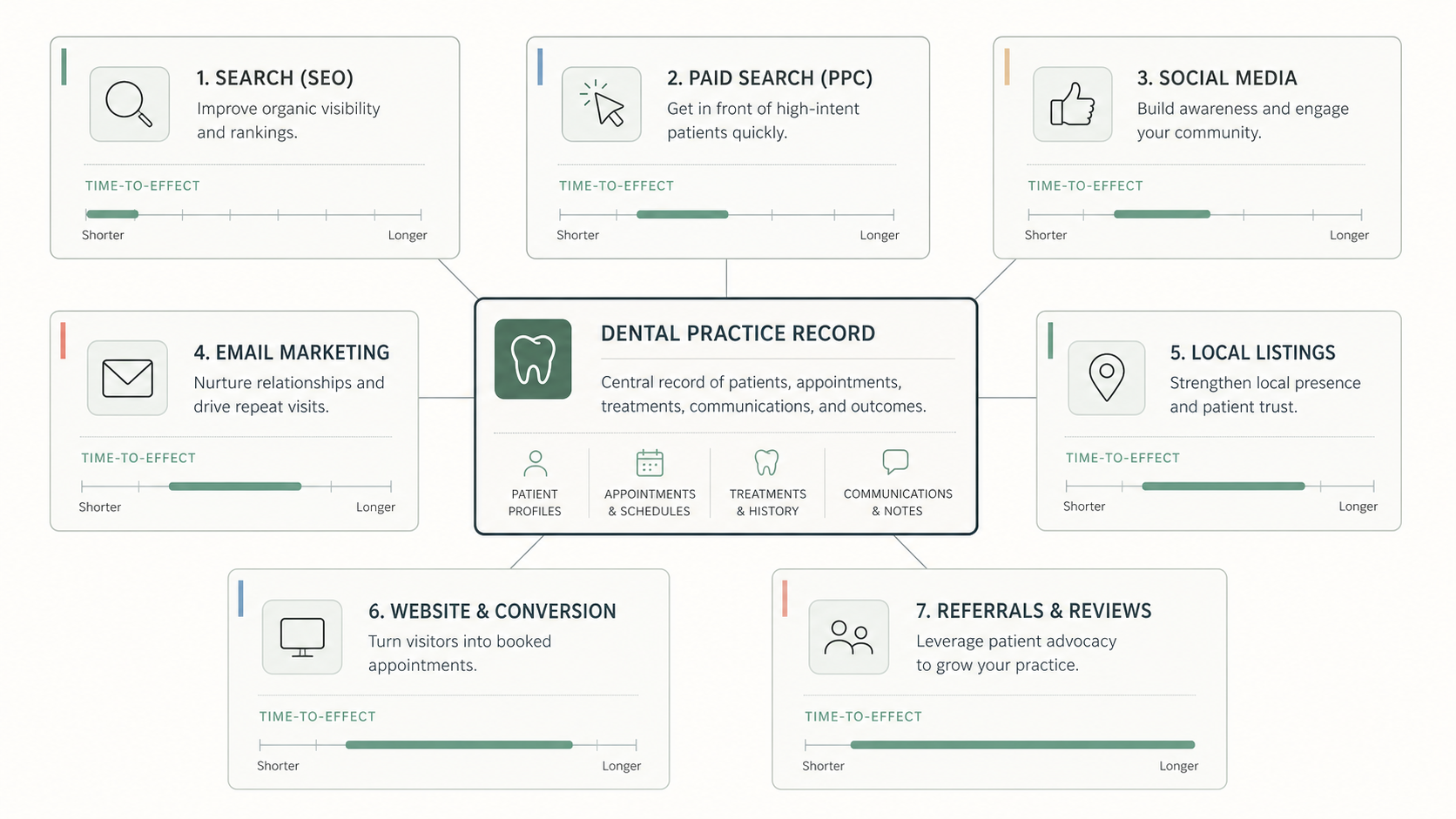
Dental marketing covers seven working parts: organic search, Google Maps and the local pack, reviews, AI answers, paid ads, social media and website conversion. Each has a different job, metric and time to effect — which is why comparing them on price produces the wrong budget.
| Channel | What it delivers | Metric to report | Time to effect |
|---|---|---|---|
| Organic search (SEO) | Treatment and question queries: implants, veneers, aligners | Non-branded sessions → calls | 3–6 months, compounding |
| Google Maps / local pack | Proximity demand: “dentist near me”, “emergency dentist” | Profile calls, directions, clicks | Weeks to months |
| Reviews | Ranking input and the patient’s last step before dialing | Velocity, rating, response rate | 1–2 months |
| AI answers | Presence when a patient asks ChatGPT, Gemini or AI Overviews | Citation rate per surface | Slow; follows search |
| Paid search | Rented visibility for high-value cases and new locations | Cost per booked appointment | Days; ends when paid |
| Social media | Familiarity and trust; best fit for aesthetic cases | Consult requests from social | Months; rarely primary |
| Website conversion | Turns the other six channels’ visits into calls | Call rate, form completion | Immediate |
Sold separately they are a bag of tactics; in a system they feed each other — reviews lift Maps ranking and ad conversion alike, and patient-question content feeds organic search and the sources AI assistants read.
The compounding core is search. Dental SEO is the process of optimizing a dental practice’s website, Google Business Profile, and online reputation so the practice appears in Google Search, Maps, and AI answers when potential patients look for dental care. It is covered in depth on our dental SEO page; the Maps half has its own breakdown in dental local SEO.
What do practice owners actually search for?
Vendors, in commercial language — company, agency, firms, services. The head of our own US keyword core for this cluster:
| Keyword | US volume/mo | What it signals |
|---|---|---|
dental marketing |
2,400 | Broad entry; no channel chosen yet |
seo for dentists |
1,900 | Channel chosen; comparison stage |
dental seo |
1,600 | Same intent, agency vocabulary |
dental marketing firms |
1,600 | Vendor shortlist |
online dental marketing |
720 | Broad, DIY-leaning |
dental marketing service |
480 (CPC $193) | Highest commercial pressure in the cluster |
lead generation for dentists |
90 | Bottom-funnel, performance framing |
Source: Rotgar semantic core, Ubersuggest, US, pulled 2026-07-26.
One caveat proposals rarely publish: raw exports inflate this market. Our dental vertical showed 46,730 monthly searches across 113 keywords — eleven of them wordings of one “dental seo” request. Deduplicated, unique dental demand is roughly 9,000–11,000 searches per month, not 46,700. A pitch quoting 46K quotes the export, not the market.
Agency, consultant, or in-house: which model fits a practice?
An agency fits when the whole system has to be built and run without hiring. A consultant fits when someone in-house already executes. An in-house hire starts to pay around five locations, when the workload is permanent.
| Agency | Consultant | In-house hire | |
|---|---|---|---|
| Cost | Retainer — ours from $3,000/mo, scoped after the audit | Lower fee, plus your execution time | Salary + tools + management |
| Speed to start | Weeks — the team exists | Fast advice, slow execution | Months to hire and ramp |
| Expertise depth | Full bench: SEO, local, content, AI | One person | One person |
| Main risk | Wrong agency choice | Strategy nobody executes | Single point of failure |
| Best fit | 1–4 locations needing the full system | Practices with a marketing coordinator | DSOs, 5+ locations |
Before you compare: results for “dental marketing agency” and “dental marketing company” are agency homepages, not editorial reviews — Wonderist Agency, Progressive Dental Marketing and Identity Dental Marketing ranked top ten when we sampled the cluster in July 2026, alongside self-published listicles. A neutral SERP observation, not a judgment on those firms — but you bring your own criteria.
What should a dental marketing company deliver — and what should you ask?
Eight deliverables, all inspectable. The label varies — online dental marketing, dental marketing services, dental practice marketing — the list should not: a strategy for your market and service mix; Google Business Profile and review work in scope; content, not just “optimization”; measurement in calls and bookings; a stated retainer with named exclusions; HIPAA-aware handling of reviews and photos; market exclusivity; AI visibility in scope. The last two are where most fall short.
Then judge the process — five questions for any candidate, including us.
| Ask this | A good answer sounds like | Red flag |
|---|---|---|
| “How will you report results?” | Calls, forms, profile actions, bookings — monthly, vs baseline | Impressions, “awareness”, a rankings PDF |
| “What happens in the first 90 days?” | A named sequence, with owners and dates | “We start with content and see” |
| “Who else do you work with in my market?” | A clear exclusivity answer, in writing | Evasion |
| “What do you do about AI answers?” | A fixed prompt set, measured per surface, no guarantees | Guaranteed ChatGPT citations — or silence |
| “How do you handle patient photos?” | Consent before publication, HIPAA-aware workflow | “Send whatever you have” |
How does lead generation for dentists actually work?
Lead generation for dentists is a chain that breaks at its weakest link: visibility (Search, Maps, AI) → click → page → call or form → booked appointment → chair.
Worked example in round numbers — illustrative arithmetic, not a benchmark. 1,000 monthly visits at a 3% call rate is 30 calls; miss 20% and 24 remain; at a 50% booking rate, 12 new patients. Answer every call and the same traffic produces 15 — a 25% lift with zero extra spend. Lift the page call rate to 4% instead: 40 calls, 16 booked.
Where practices leak: an incomplete Google Business Profile, a slow website and — most often — the phone. Marketing delivers the call; the front desk converts it. For the levers in order, how to get more dental patients; to turn them into a plan, a dental marketing strategy or a shortlist of dental marketing ideas.
How is AI search changing dental marketing?
Dentistry sits inside the zone AI answers hit hardest. Ahrefs’ analysis of 146 million SERPs found AI Overviews on 20.5% of results overall but 44.1% of medical queries. Pew Research found about 18% of Google searches produced an AI summary in March 2025, and users clicked a traditional result on 8% of those visits versus 15% without one (68,879 searches).
| What changes | What it means for a practice |
|---|---|
| Fewer clicks per impression | Ranking first no longer equals the same call volume |
| Answers assembled from sources | Being cited is a goal separate from being ranked |
| Third-party sources carry weight | Directories and threads feed the answer as much as your own site |
| No special markup exists | Google states no special optimizations apply here |
Our own measurement, honestly framed: on 2026-08-03 we ran a four-prompt pilot on Perplexity (clean anonymous session, EU IP) and scored our citation rate at 0/4. On the category prompt it named no brands — only directories and listicles. On “Best healthcare SEO agencies” it returned eight firms sourced from those firms’ own self-published rankings, one placing itself at #1. The dental prompts in our battery were not run in this pilot; that measurement lands with our first full run. The read for a practice: AI visibility is won largely off your own website.
Mechanics live elsewhere: what AI visibility is, the practice-level dental AI visibility, and AI search optimization.
Where does social media fit in dental marketing?
As a supporting channel. Search and Maps capture patients looking now; social builds the familiarity that decides who they choose when they do. For aesthetic cases it earns its keep — before-and-after content, with consent and HIPAA-aware handling first. Otherwise it rarely drives new patients alone. Full breakdown in social media dental marketing.
What will dental marketing NOT do?
Four things, each of which has ended an engagement somewhere:
- Fix patient experience. Marketing amplifies what patients say about you — in both directions.
- Work around a stale review profile. Google counts reviews in local prominence, and patients read them before dialing.
- Pay off as random tactics. Ads here, posts there, a new website every two years — that is spend, not marketing.
- Fix a pricing problem. If fees sit above the market without a reason patients understand, visibility exposes the gap rather than closing it.
How does Rotgar run dental marketing?
Rotgar is a healthcare SEO and AI search agency that helps medical and dental practices acquire patients from Google Search, Google Maps, and AI assistants like ChatGPT and Gemini. Search, Maps and AI visibility are the core; other channels are added by strategy, not habit.
- Free audit. The simplest free audit starts with one clinic or selected location, one priority market and one patient language. It shows current visibility across Google Search, Google Maps, Google AI Overviews, ChatGPT, and Gemini, plus competitor gaps and prioritized fixes.
- Roadmap. A sequenced plan with honest timelines; if Maps is the bottleneck, that is Google Search and Maps optimization.
- Implementation and reporting. Profile, reviews, content and technical work, executed by our team, reported monthly in calls and appointments.
Client-reported outcomes: Dentalia Krasovsky in Beverly Hills — technical SEO, mobile usability and speed, visibility in Google Search and Maps; the client reported higher rankings, leads growing month over month, and positive ROI (read the case). A Boston dental clinic reported growth in keyword visibility and leads after technical and local SEO (read the case). Both directional, without invented figures. Rotgar is rated 5.0 on Clutch (26 verified reviews); founder Evgeniy Yudin has been in SEO since 2008.
Specialty angles: dental implant marketing and periodontist marketing.
Get a free audit · Book a 30-minute call
Key takeaways
- Dental marketing is one system of seven parts — search, Maps, reviews, AI answers, paid, social, website conversion — measured in booked appointments.
- Demand is search-led and priced accordingly:
dental marketing2,400/mo,seo for dentists1,900/mo,dental marketing serviceat $193 CPC (Ubersuggest, US, 2026-07-26). - Raw exports overstate this market 4–5×: deduplicated, unique dental demand is roughly 9,000–11,000 searches per month.
- Maps ranking follows relevance, distance and popularity per Google’s documentation, with review volume and ratings inside it.
- Medical queries trigger AI Overviews at 44.1% against a 20.5% baseline, and 32% of US adults have asked an AI chatbot about health — AI visibility belongs in scope, but nobody can guarantee a citation.
- The cheapest levers sit after the click: page conversion and answering the phone.
- Choose the operating model before the vendor, then apply the five questions to your shortlist.
FAQ: dental marketing
What does a dental marketing agency do?
A dental marketing agency builds and runs the system that brings a practice new patients: search visibility, Google Maps presence, reviews, content, paid campaigns where they fit, AI visibility, and measurement tied to booked appointments, not traffic.
How much should a dental practice spend on marketing?
In our client work, practices investing seriously in growth budget a retainer from $3,000 per month, with scope set by market competition. The honest answer comes from ROI: what one new patient — especially an implant or aligner case — is worth over their lifetime.
Is dental marketing different from dental SEO?
Dental marketing is the whole system; dental SEO is its search-and-Maps core. SEO is usually the highest-ROI component, but performs best inside a system that also covers reviews, conversion and retention.
How do I know if my dental marketing is working?
Track calls, form submissions, Google Business Profile actions and booked appointments monthly against the month-zero baseline. If your agency reports only impressions, ask it to connect spend to chairs.
Should I hire a dental marketing consultant or an agency?
A consultant if you already have in-house execution capacity; an agency if the system has to be built and run for you. The comparison table above breaks down cost, speed and risk.
Scope is agreed by market, location, service line and patient language after the audit.
Get a free audit · Book a 30-minute call · Rated 5.0 on Clutch (26 verified reviews)