
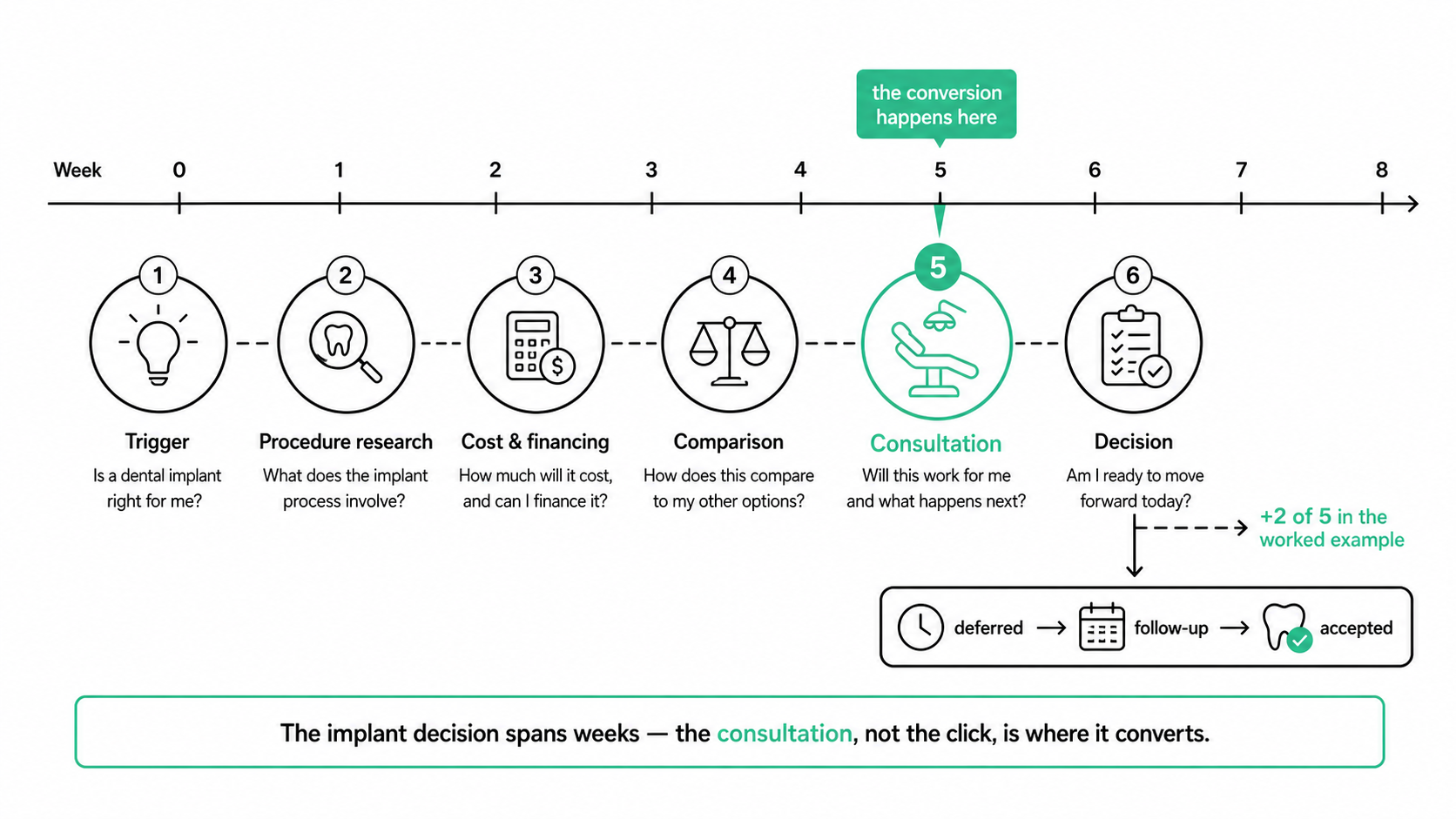
Dental implant marketing is the work of moving a patient from “I am missing a tooth” to a booked consultation — a decision that takes weeks, not minutes. Implant cases carry the highest value in general dentistry, so the marketing has to answer cost, fear and longevity before the patient ever calls the practice.
TL;DR
- The implant funnel has one goal — a booked consultation, not a booked appointment. Everything else on this page exists to shorten the weeks in between.
- Cost is the first search and the last objection. Publish ranges, cost drivers and financing, not a price list — and expect to be summarized rather than clicked: informational queries return an AI Overview 21.4% of the time against 4.3% for commercial ones (Ahrefs, 146,122,391 SERPs, September 2025), and when a summary appears users click a traditional result 8% of the time versus 15% without one (Pew Research Center, 68,879 searches, March 2025).
- “Dental implants near me” is decided in the map pack, where Google states results are based on relevance, distance and prominence, and that “more reviews and positive ratings can help your business’s local ranking” (Google Business Profile Help).
- Before-and-after galleries are a marketing use of patient information: HIPAA requires a signed authorization (45 CFR 164.508(a)(3)). Verbal consent at the chair does not cover a website.
- Demand for this service is small and expensive:
dental implant marketingruns 260 searches a month at a $40.54 CPC in our keyword core (Ubersuggest, US, 2026-07-26).
Why do implant patients behave differently from hygiene patients?
A hygiene patient books and shows up. An implant patient behaves like someone making a major purchase: several weeks of research, three or four providers compared, and three recurring doubts — what it costs, whether it hurts, and how long it lasts. That is why implant work is called high-ticket: one accepted case is worth many routine visits, and one lost case is worth the same in reverse.
The practical consequence is that the funnel’s finish line moves. You are not optimizing for “book a cleaning”; you are optimizing for a consultation, the single moment where a researcher becomes a treatment plan. Every asset below either shortens the research phase or gets the patient into that chair.
| Stage | Typical span | What the patient is doing | The question behind it | What moves them forward |
|---|---|---|---|---|
| 1. Trigger | Days | A tooth fails, breaks or is extracted; a denture stops fitting | “What are my options?” | A plain explanation of implants versus bridges and dentures |
| 2. Procedure research | 1–3 weeks | Reading how implants are placed, healing time, pain | “Will it hurt, and how long does it take?” | Step-by-step process and recovery content, sedation options |
| 3. Cost and financing | 1–3 weeks | Searching cost, insurance coverage, payment plans | “Can I afford this, and what drives the price?” | Ranges, cost drivers, financing options in writing |
| 4. Comparison | 1–2 weeks | Comparing three to five practices: reviews, cases, credentials | “Who should place it?” | Before-and-after cases, implant-specific reviews, clinician bio |
| 5. Consultation | One visit | Sitting down for a scan, a plan and a number | “Is this the right plan for me?” | A written plan, financing on the table, no pressure |
| 6. Decision | Same day to months | Accepting, deferring or shopping the plan elsewhere | “Should I do this now?” | Structured follow-up — a callback, the plan re-sent, a second visit |
Spans are what we observe in client work and vary widely by case type; treat the sequence as fixed and the timing as yours to measure. Full-arch cases — All-on-4 and similar protocols that restore an entire jaw on a small number of implants — stretch stages 3 and 4 the most, because the sum involved is larger and the patient rarely knows the term before searching for it.
What content does each stage of the implant journey need?
One asset per stage, each answering one question completely. The most common failure in dental marketing for implants is a single “Dental Implants” page asked to do all six jobs at once: it ranks for nothing specific, answers no question fully, and gives an AI assistant nothing quotable.
| Stage | Asset | Job it does | What to measure |
|---|---|---|---|
| Trigger | Implants vs. bridges vs. dentures | Frames the choice before a competitor does | Entrances from comparison queries |
| Procedure research | Implants overview: candidacy, process, healing, longevity | Removes the pain and timeline objection | Time on page, scroll depth |
| Procedure research | Full-arch / All-on-4 page | Captures a distinct, higher-value search | Rankings for full-arch terms |
| Cost and financing | Cost and financing explainer | Removes the affordability objection | Clicks to consultation booking |
| Comparison | Before-and-after cases, with authorization on file | Proves the work is yours | Assisted conversions from case pages |
| Comparison | Clinician page: training, placements, technology | Answers “who should place it?” | Consultation form referrers |
| Consultation | Booking page with what to expect, duration, cost of the consult | Reduces no-shows | Booked-to-attended ratio |
| Decision | Written treatment plan and follow-up sequence | Recovers “let me think about it” | Deferred cases reactivated |
Two notes on scope. Periodontists and oral surgeons placing implants run this funnel with an extra track — referrals from general dentists, covered in periodontist marketing. And a practice whose high-value mix includes aligners will recognize the same long deliberation cycle in orthodontic SEO, where the objection is aesthetic rather than surgical.
How should a practice handle the cost question?
Publish the logic, not a price list. Explain what the range depends on — single tooth versus full-arch, bone grafting, sinus lift, materials, sedation, whether the crown is included — and how financing works. Patients who find a straight answer shortlist you; patients who find nothing assume the worst and keep scrolling.
This is also the page most likely to be summarized rather than clicked. Cost queries are informational, and informational SERPs return an AI Overview 21.4% of the time versus 4.3% for commercial ones; medical queries are the most affected category at 44.1%, more than double the 20.5% all-keyword baseline (Ahrefs, September 2025). When the summary appears, the click rate on traditional results falls to 8% from 15% (Pew Research Center, March 2025). The honest conclusion for an implant practice: a cost page is bought as a citation and a shortlist entry, not as a traffic line.
There is no markup to buy your way in. Google states there are “no additional requirements to appear in AI Overviews or AI Mode, nor other special optimizations necessary,” and that “there’s also no special schema.org structured data that you need to add” — a page must be “indexed and eligible to be shown in Google Search with a snippet” (Google Search Central). What is left is the same discipline that wins organic: a direct answer in the first sentences, a table of cost drivers, no hedging. The mechanics of that layer belong on what AI visibility is; here it is one page doing its job well.
How do you win the local pack for implant searches?
The local pack — the three business listings with the map above organic results — closes “dental implants near me” the same way it closes “dentist near me.” Google names three factors: relevance, distance and prominence, and states that “businesses with complete and accurate info are more likely to show up in local search results” and that “more reviews and positive ratings can help your business’s local ranking” (Google Business Profile Help).
Two things are implant-specific. First, list implant procedures explicitly as services on the profile — including full-arch — so the profile is relevant to the query, not just to “dentist.” Second, procedure-specific reviews carry weight that generic ones do not: a review that says the implant feels like a natural tooth matches an implant search in a way that ten five-star reviews about a cleaning never will. Ask implant patients for a review at the restoration visit, when the result is in their mouth and the memory is good — asking everyone, the same way, with no reward attached.
Distance you cannot change, which is why a practice two towns away from the searcher wins on relevance and prominence or not at all. That is the same trade-off described in dental SEO, and implants are the procedure where it pays back fastest.
What can you publish from a real implant case?
Before-and-after images and patient stories are the strongest assets in stage 4 and the most frequently mishandled. Using patient information for marketing requires a signed authorization: “a covered entity shall not use or disclose protected health information for marketing purposes without an authorization” (45 CFR 164.508(a)(3)). The exceptions are narrow — a face-to-face communication, or a promotional gift of nominal value — and a website gallery is neither.
Practical rules that follow: get the authorization signed before publication and name the channels it covers (site, social, ads); do not repurpose clinical record photos taken for the chart; keep the signed form on file for as long as the asset is live; and shoot consistently — same angle, same lighting, same distance — because inconsistent pairs read as retouched. This is a summary of the requirement, not legal advice.
What does our own data say about implant demand?
Two datasets, both ours, both dated. The first is the demand behind this page — queries typed by practice owners and marketers, not by patients, which is why the volumes look small next to the money at stake.
| Query (US) | Monthly searches | CPC | What it tells an implant practice |
|---|---|---|---|
| dental marketing | 2 400 | $57.23 | The category head term; implants are a slice of it |
| dental seo | 1 900 | $57.39 | Where most practice budgets are decided |
| dental implant marketing | 260 | $40.54 | This page’s query — small, commercial, high pressure |
| orthodontic marketing | 260 | $23.085 | The adjacent high-ticket sub-niche, at half the CPC |
| dental marketing near me | 170 | $32.155 | Owners still shop locally for agencies |
| periodontist marketing | 30 | — | The referral-driven specialty, barely searched |
Source: Rotgar semantic core, Ubersuggest, US, 2026-07-26. Patient-side implant demand is a separate and far larger set of queries; this table is the agency-side market, and the CPC column is a fair proxy for how hard the sub-niche is contested.
What our AI-visibility pilot showed, honestly framed. On 2026-08-03 we ran four prompts from our fixed 16-prompt battery on Perplexity in a clean anonymous session. Citation rate was 0/4 — the expected zero point for a site that has not published this cocoon yet. The structural findings matter more: category prompts returned no brand opinions of their own but relayed agency listicles, one firm ranking itself first on a score it publishes about itself, and Reddit was the second most cited source. The limit, stated plainly: our dental prompts — including “dental marketing agency for implant marketing” — were not among the four run, the surface was one of four, and the IP was non-US. The dental measurement lands at the first full run, and we will publish it whether or not it flatters us.
Why is the consultation, not the click, the conversion?
Because the money moves in the chair. Marketing’s job ends at an attended consultation; case acceptance and follow-up belong to the practice. The practices that convert high-ticket work treat the deferred patient as a stage, not a loss: a scheduled callback, the treatment plan and financing sent in writing, and a defined second-visit path.
Worked example — where the leak actually is. The numbers below are arithmetic to show the shape of the funnel, not benchmarks; substitute your own analytics and fee schedule.
- The implant and cost pages together receive 300 visits a month.
- 6% call or submit a form: 18 inquiries.
- Half book a consultation: 9 booked; one no-shows, so 8 attend.
- 3 accept the plan at the visit; 5 leave to think about it.
- With no follow-up, those 5 are gone. With a callback and a written plan, 2 return: total 5 accepted cases instead of 3.
Nothing in that example required more traffic. Doubling visits to 600 would add roughly 3 more accepted cases and cost a quarter of marketing; adding follow-up added 2 and cost a front-desk routine. We do not publish an average implant case value — use your own to put a figure on the difference. Our client work has the same shape: for Dentalia Krasovsky in Beverly Hills we did technical SEO, mobile usability, speed and visibility in Google Search and Maps, and the client reported higher positions, month-over-month lead growth and positive ROI (client-reported, directional, no figures published).
What will implant marketing not fix?
The honest boundary, because implant budgets are the ones most often spent against the wrong problem.
| Will not fix | Why | What actually fixes it |
|---|---|---|
| A phone nobody answers by the third ring | Implant inquiries are researched calls; they call the next practice | Call coverage and a booking link that works after hours |
| A consultation that ends without a number | The patient cannot decide on something unpriced | A written plan and financing options handed over the same day |
| A practice that does not want full-arch cases | Demand you cannot schedule is a cost, not a win | Match the marketing to the chair time and skills available |
| Reviews describing a rushed or painful experience | Search visibility amplifies whatever the experience is | Fix the experience first; visibility comes second |
| An expectation of results in 30 days | Stages 2–4 take weeks per patient, before any ranking | Plan in quarters; measure inquiries and consultations monthly |
Dental SEO is the process of optimizing a dental practice’s website, Google Business Profile, and online reputation so the practice appears in Google Search, Maps, and AI answers when potential patients look for dental care. It brings researched, pre-qualified people to your door. What happens at the door is not a marketing deliverable.
Key takeaways
- Implant marketing is a consultation funnel, not an appointment funnel: six stages, weeks long, three recurring objections — cost, pain, longevity.
- One asset per stage beats one comprehensive implants page; the comparison, full-arch and cost pages each answer a different search.
- Publish cost logic and financing, not a price list. Informational queries return an AI Overview 21.4% of the time, medical queries 44.1%, and clicks drop to 8% from 15% when a summary appears — win the citation and the shortlist.
- No schema or file buys AI visibility: Google states there are no additional requirements beyond being indexed and snippet-eligible.
- The map pack decides “dental implants near me”: list implant services on the profile explicitly and collect procedure-specific reviews, since prominence and relevance are the two factors you can move.
- Before-and-after galleries need a signed HIPAA authorization before publication; the face-to-face and nominal-gift exceptions do not cover a website.
- Follow-up on deferred cases usually returns more than doubling traffic — measure inquiries, attended consultations and reactivated plans, not sessions.
FAQ
How do I get more dental implant patients?
Answer the three research questions — cost, pain, longevity — on dedicated pages, make the practice findable in the map pack with implant services listed and implant-specific reviews, and build a follow-up process for patients who defer. Implant volume comes from thoroughness across a six-week journey, not from more traffic at the top.
Should I advertise dental implant prices?
Publish the range and what drives it rather than a headline price. Cost drivers, insurance reality and financing options qualify the inquiry before it arrives and remove the objection that ends most research sessions. A teaser price attracts shoppers; explained pricing attracts patients who arrive at the consultation already prepared to decide.
Do implant patients respond better to ads or to search?
Both, at different stages. Search captures patients in stages 2–4 who are actively researching, and it compounds. Ads — especially retargeting people who read your implant or cost page — re-engage researchers who left without calling. Search is the foundation; paid is the accelerator, and at $40+ clicks it is a poor substitute for missing pages.
What makes implant marketing different from general dental marketing?
Case value and decision length. General dentistry converts on proximity and urgency; implants convert on weeks of research and accumulated trust, which is why the assets are content and proof rather than offers. It is a specialized slice of the wider dental marketing system, sharing the same profile and reputation foundations.
How long before implant marketing produces cases?
Plan in quarters. Pages need to be indexed and to earn rankings, and each individual patient spends weeks in stages 2–4 before booking. A realistic sequence is inquiries moving first, consultations next, accepted cases last — which is why inquiries and attended consultations are the monthly metrics, and case count is the quarterly one.
Get a free audit — see what an implant patient finds when they research your practice today. The simplest free audit starts with one clinic or selected location, one priority market and one patient language. It shows current visibility across Google Search, Google Maps, Google AI Overviews, ChatGPT, and Gemini, plus competitor gaps and prioritized fixes.