
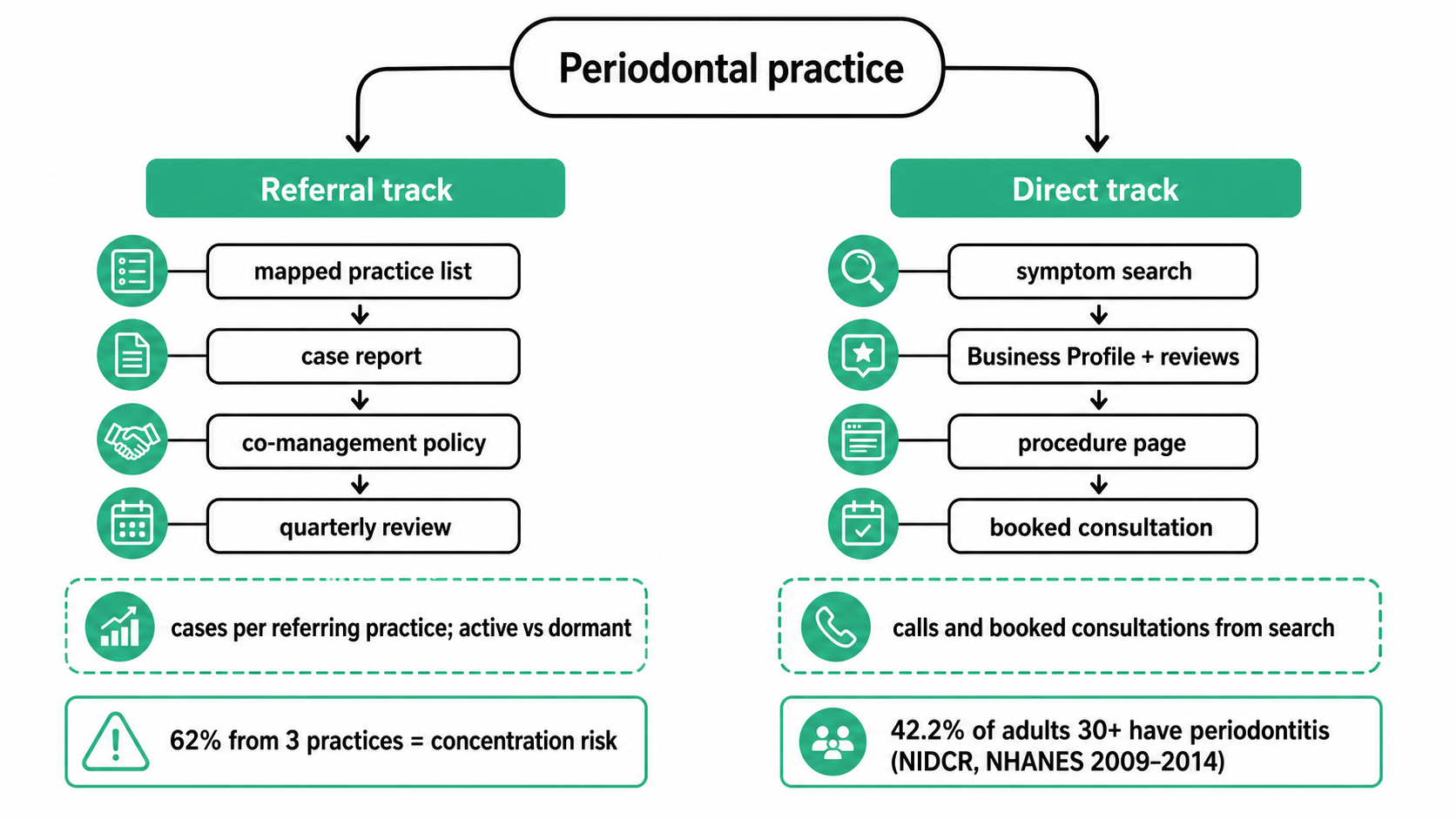
A periodontist is a dentist who specializes in the prevention, diagnosis, and treatment of periodontal disease and in the placement of dental implants, after three additional years of education beyond dental school (American Academy of Periodontology). Periodontist marketing therefore runs on two tracks that share almost nothing: referrals from general dentists, and direct patient demand from people searching their own symptoms.
TL;DR
- The two tracks have different audiences, different cycles and different failure modes. A practice that markets only to dentists is one retirement away from an empty schedule; a practice that markets only to patients leaves its highest-margin, lowest-cost channel to chance.
- The addressable patient population is documented, not guessed: 42.2% of US adults aged 30 or older have total periodontitis, rising to 59.8% of adults 65 or older (NIDCR, NHANES 2009–2014).
- The direct track is won in the same three factors every local business competes on. Google states local results are “mainly based on relevance, distance, and popularity,” and that “businesses with complete and accurate info are more likely to show up in local search results” (Google Business Profile Help).
- Agency-side demand for this topic is tiny —
periodontist marketingruns 30 searches a month in our keyword core, against 2 400 fordental marketing(Ubersuggest, US, 2026-07-26). Patient-side demand is where the volume lives, and it is not what that number measures. - Referral relationships are an asset with a measurable concentration risk. Track cases per referring practice per quarter, not a single total, or you will notice a decline a year late.
What makes periodontist marketing different from general dental marketing?
Two structural differences. The audience is split — one half of the effort is aimed at other dentists, the other at patients — and the consideration cycle on the patient side runs for weeks, because gum surgery and implants are researched the way major purchases are researched. A general practice optimizes one local funnel. A periodontal practice runs two, in parallel, with separate metrics.
| Referral track (dentist-facing) | Direct track (patient-facing) | |
|---|---|---|
| Audience | General dentists, hygienists, front-office staff | Adults with gum symptoms, missing teeth, failing restorations |
| Trigger | A case beyond the referring practice’s scope | A symptom, a search, or a dentist’s spoken recommendation |
| Main channels | Case reports, study clubs, CE events, co-management materials | Google Search, Google Maps, reviews, AI answers |
| Assets it needs | A referral pathway page, report turnaround, co-management policy | Symptom pages, procedure pages, complete Business Profile |
| Cycle | Months to build, years to keep | Days for urgent symptoms, weeks for implants and grafting |
| Failure mode | Silent drift: a referrer stops, nobody notices for three quarters | Invisibility: patients never learn the specialty exists |
| Metric | Cases per referring practice, active vs dormant referrers | Calls and booked consultations from search, positions on symptom and procedure queries |
Most marketing content written for periodontists covers only the right-hand column, because it is recycled general-dentistry advice. That is the gap this page exists to close: the referral track is a system that can be designed, staffed and measured, not a matter of who plays golf with whom.
How do periodontists build a referral system with general dentists?
By treating referrals as a managed pipeline with named practices, a contact cadence and a report turnaround — not as goodwill. The referring dentist has one dominant fear, that the patient will not come back, and every element of a working referral system answers it before it is spoken aloud.
| Action | Owner | Cadence | What it moves | Evidence it worked |
|---|---|---|---|---|
| Map every general practice in your realistic radius; mark who refers, who refers elsewhere, who has never referred | Practice manager | Once, then quarterly refresh | Turns a vague “network” into a finite list | A list with a status per practice |
| Send a treatment report on every referred patient, promptly and in a fixed format | Clinical + admin | Every case, no exceptions | The single strongest retention lever on this track | Report turnaround time, measured in days |
| State the co-management policy in writing: what you do, what returns to them, when | Doctor | Once, reviewed yearly | Removes the “will I lose the patient” objection | A page and a leaflet the referrer can read |
| Publish a referral pathway page on your site with forms, imaging requirements, contacts | Doctor + web | Once, kept current | Makes referring low-effort at the moment of decision | Form submissions and page visits |
| Run case discussions, study clubs, lunch-and-learns and CE sessions | Doctor | Monthly or quarterly | Keeps you top-of-mind for the next complex case | Attendance, and referrals from attendees |
| Review the referral table quarterly and act on dormant practices | Practice manager | Quarterly | Catches drift before it becomes a revenue problem | Count of practices reactivated |
Two notes on execution. First, communication with a referring dentist about a shared patient’s treatment is ordinary clinical correspondence, not marketing — but the moment a patient’s photo, story or name is used to promote the practice, it becomes a marketing use of protected health information and needs a signed HIPAA authorization. The requirement and its two narrow exceptions are set out on our dental marketing ideas page. Second, the referral pathway page has a second job: it is one of the few pages on a specialty site that other practices link to and quote, which matters for the direct track as well.
How do patients find a periodontist directly?
Increasingly by searching their own symptoms before anyone says the word “periodontist” — “bleeding gums,” “gum recession treatment,” “loose teeth,” “dental implants near me.” The mechanics are the same three factors every local business competes on: Google states that local results are “mainly based on relevance, distance, and popularity,” and that “businesses with complete and accurate info are more likely to show up in local search results.”
Three things follow for a specialty practice.
Relevance is where specialty practices lose by default. A Business Profile listing “Dentist” and nothing else is not relevant to a periodontal query. List the specialty and each procedure you actually perform — periodontal therapy, gum grafting, crown lengthening, implant placement, laser treatment — as services on the profile, and repeat them on the site in the words a patient would use.
Prominence responds to reviews and to being named elsewhere. Google notes that “more reviews and positive ratings can help your business’s local ranking.” For a referral specialty, reviews carry an extra load: the patient arrives already recommended by their dentist and checks you anyway.
Distance you cannot change, which is precisely why the two levers above are worth the work.
This is the same discipline that applies to any practice: dental SEO is the process of optimizing a dental practice’s website, Google Business Profile, and online reputation so the practice appears in Google Search, Maps, and AI answers when potential patients look for dental care. The periodontal version simply runs on a specialty vocabulary, inside the broader dental marketing system.
Which pages does a periodontal practice actually need?
Six, and they are not interchangeable. Each maps to a question a patient or a referring dentist is already asking, and each belongs to a track — which is how you decide what to write first.
| Page | What is being typed or asked | Track | Why it exists |
|---|---|---|---|
| What is a periodontist | “what is a periodontist,” “periodontist vs dentist” | Direct | Most patients do not know the specialty exists; this is also the question assistants get asked |
| Gum disease treatment | “bleeding gums,” “gum disease treatment,” “scaling and root planing” | Direct | Symptom-first entry point, and the largest addressable population |
| Gum recession and grafting | “receding gums,” “gum graft recovery,” “does a gum graft hurt” | Direct | Anxiety-heavy queries that reward calm, specific explanations |
| Dental implants | “dental implants near me,” “single tooth implant cost” | Direct | The highest-value direct procedure; the funnel is covered in dental implant marketing |
| Laser and advanced therapy | “LANAP,” “laser gum treatment” | Direct | Branded-procedure searches with unusually high intent |
| For referring dentists | “how do I refer to a periodontist,” forms, imaging, turnaround | Referral | Makes referring low-effort; the only page written for a professional reader |
The first page on that list is the one most practices skip and the one with the widest reach: it catches patients months before they know which kind of clinician they need, and it is the cleanest passage on the site for an assistant to quote.
What does the demand actually look like in numbers?
Two datasets, both dated, and they measure different things. The first is our own keyword core — practice-owner and marketer queries, not patient queries. Read it as a map of who is shopping for help, not of how many patients are looking for treatment.
| Query (US) | Monthly searches | CPC | What it tells a periodontal practice |
|---|---|---|---|
| dental marketing | 2 400 | $57.23 | The head term; specialty demand is a rounding error next to it |
| dental seo | 1 900 | $57.39 | Agency-side demand, still not patient demand |
| local dental seo | 1 000 | $68.15 | The most expensive click in the set — the local pack is what everyone is buying |
| dental implant marketing | 260 | $40.54 | The one high-value procedure with its own agency-side market |
| orthodontic marketing | 260 | $23.09 | Comparable sub-specialty, comparable scale |
| periodontist marketing | 30 | no CPC data | This page’s query: micro-volume, low competition, easy to own |
Source: Rotgar semantic core, Ubersuggest, US, 2026-07-26. The honest reading of the last row is that almost nobody markets to periodontists — which makes the topic cheap to own and tells you nothing about how many patients need care.
That second question has a documented answer. 42.2% of US adults aged 30 or older have total periodontitis, and 59.8% of adults aged 65 or older (NIDCR, from NHANES 2009–2014; Eke et al., JADA 2018). Against that, the number of patients who arrive by referral in any given quarter is small. The gap between prevalence and referral volume is the direct track’s entire business case.
How do AI answers change discovery for a specialty practice?
They add a third way a patient reaches you — an assistant summarizing what other pages say about you — and they reward the same thing the referral track produces: being named by other people. Google is explicit that there is nothing to buy or mark up: “There are no additional requirements to appear in AI Overviews or AI Mode, nor other special optimizations necessary” (Google Search Central).
What does correlate is third-party presence. Ahrefs’ study of 75,000 brands found branded web mentions correlate with AI Overview visibility at 0.664 against 0.218 for backlinks, with the authors noting that correlation is not causation. For a periodontal practice this lands in an unusual place: referring practices’ websites, study-club pages, local society listings and dental-school affiliations are exactly the kind of third-party mentions that feed both tracks at once. The referral network you build for cases is also an entity-strengthening asset.
Our own measurement, framed honestly. On 2026-08-03 we ran four buyer-intent prompts from our fixed battery on Perplexity in a clean anonymous session. The pattern was consistent: on a “best agencies” prompt the assistant returned a ranked table assembled from agencies’ own listicles, one firm ranking itself first on a self-published score; on a category prompt it named no brands at all and relayed directories, with Reddit the second most-cited source. The mechanism transfers to a patient asking for a periodontist — the answer is assembled from pages the practice does not own. The limit, stated plainly: our dental prompt battery has not been run yet, this was one surface on a European IP, and the dental measurement lands with the first full run. What AI visibility is and how it is scored is covered on our AI visibility hub; this page does not repeat the mechanics.
How do you measure both tracks without fooling yourself?
Separately, and at the level of the individual referring practice rather than a single monthly total. A total hides the only thing worth knowing on the referral side, which is concentration.
Worked example — reading a referral table. The arithmetic is trivial; doing it quarterly is the discipline.
- Last quarter: 34 referred cases from 12 practices that have ever referred.
- Three practices sent 21 of them — 62% of referral volume from 25% of referrers.
- Four practices that averaged two cases a quarter sent zero. Dormant, not lost, and invisible in the total.
- The total for the previous quarter was 33. Read as one number, the quarter looks flat. Read per practice, a quarter of the network went quiet and a concentration risk sits at 62%.
- Two actions follow: contact the four dormant practices this month, and set a ceiling — if any single practice exceeds roughly a third of referral volume, the direct track is underfunded.
On the direct side, count booked consultations from search, calls from the Business Profile, and positions on the symptom and procedure queries from the page table above. Then read the two side by side once a quarter. Our client work in dentistry has the same shape: for the Beverly Hills practice Dentalia Krasovsky we did technical SEO, mobile usability, speed, and visibility across Google Search and Maps; the client reported higher positions, month-over-month lead growth and positive ROI (client-reported; no figures published).
What will periodontist marketing NOT do?
It will not manufacture referrals from dentists who compete with you clinically, and no amount of visibility work makes a general dentist refer a case they intend to keep. It will not shorten a treatment decision that is genuinely slow — implant and grafting patients take weeks, and marketing that promises otherwise buys unqualified consultations. It cannot fix a report turnaround measured in weeks or a front desk that does not answer the phone; both are operational, and both end referral relationships faster than any competitor’s advertising. And nobody can guarantee a position in the local pack or a mention in an AI answer — distance is a stated ranking factor you cannot change, and Google publishes no mechanism for buying AI visibility.
Key takeaways
- Periodontist marketing is two systems, not one: a dentist-facing referral track and a patient-facing direct track, with separate assets, cycles and metrics.
- The referral track is a managed pipeline — a mapped list of practices, a report on every case, a written co-management policy, a referral pathway page, and a quarterly review that catches dormant referrers.
- The direct track is ordinary local visibility applied to a specialty vocabulary: profile completeness and reviews move the two factors Google names that you can influence; distance is the one you cannot.
- Six pages carry the work, and the “what is a periodontist” page is the one most practices skip and the widest-reaching of all — 42.2% of adults 30+ have periodontitis, and most of them cannot name the specialty.
- Agency-side demand for this topic is 30 searches a month against 2 400 for
dental marketing(Ubersuggest, US, 2026-07-26) — cheap to own, and no indication of patient demand. - AI answers are assembled from pages you do not own; branded mentions correlated at 0.664 against 0.218 for backlinks across 75,000 brands, which makes a referral network an entity asset as well as a case source.
- Measure per referring practice, not in totals. A flat quarterly total concealed a quarter of the network going dormant and a 62% concentration in three practices.
FAQ
How do periodontists get more referrals?
Systematically. Map every general practice in your radius and record who refers and who does not; send a prompt treatment report on every referred case; state in writing that the patient returns for restorative and ongoing care; publish a referral pathway page; and stay visible through case discussions and CE. Then review the table quarterly and act on dormant referrers.
Do periodontists need their own marketing if referrals already work?
Yes, for two reasons. Patients increasingly self-refer after searching their own symptoms, so a practice with no direct visibility is invisible to them. And referral volume concentrates: when three practices supply the majority of cases, one retirement or one sale reshapes the schedule. The direct track is the hedge.
What should a periodontist’s website include?
A plain-language explanation of what a periodontist is, symptom pages for gum disease and recession, procedure pages for implants and grafting, a page written for referring dentists with forms and turnaround times, and the trust signals patients check — credentials, reviews, and case results published with signed authorization.
How is periodontist marketing different from general dental marketing?
Two differences. The audience is split between referring dentists and patients, which means two sets of assets and two sets of metrics. And the consideration cycle is longer, because gum surgery and implants are researched for weeks. General dental marketing optimizes one local funnel; periodontist marketing runs a referral track and a direct-demand track side by side.
How long does it take to see results from periodontist marketing?
The two tracks pay back on different clocks. Profile and review work on the direct track typically shows movement in weeks; symptom and procedure pages compound over one to two quarters. Referral relationships are slower — a report cadence and a study-club presence are usually read in quarters, not months, which is why both tracks are started together.
Get a free audit — we will show you which of the two tracks is actually carrying your schedule. The simplest free audit starts with one clinic or selected location, one priority market and one patient language. It shows current visibility across Google Search, Google Maps, Google AI Overviews, ChatGPT, and Gemini, plus competitor gaps and prioritized fixes.