
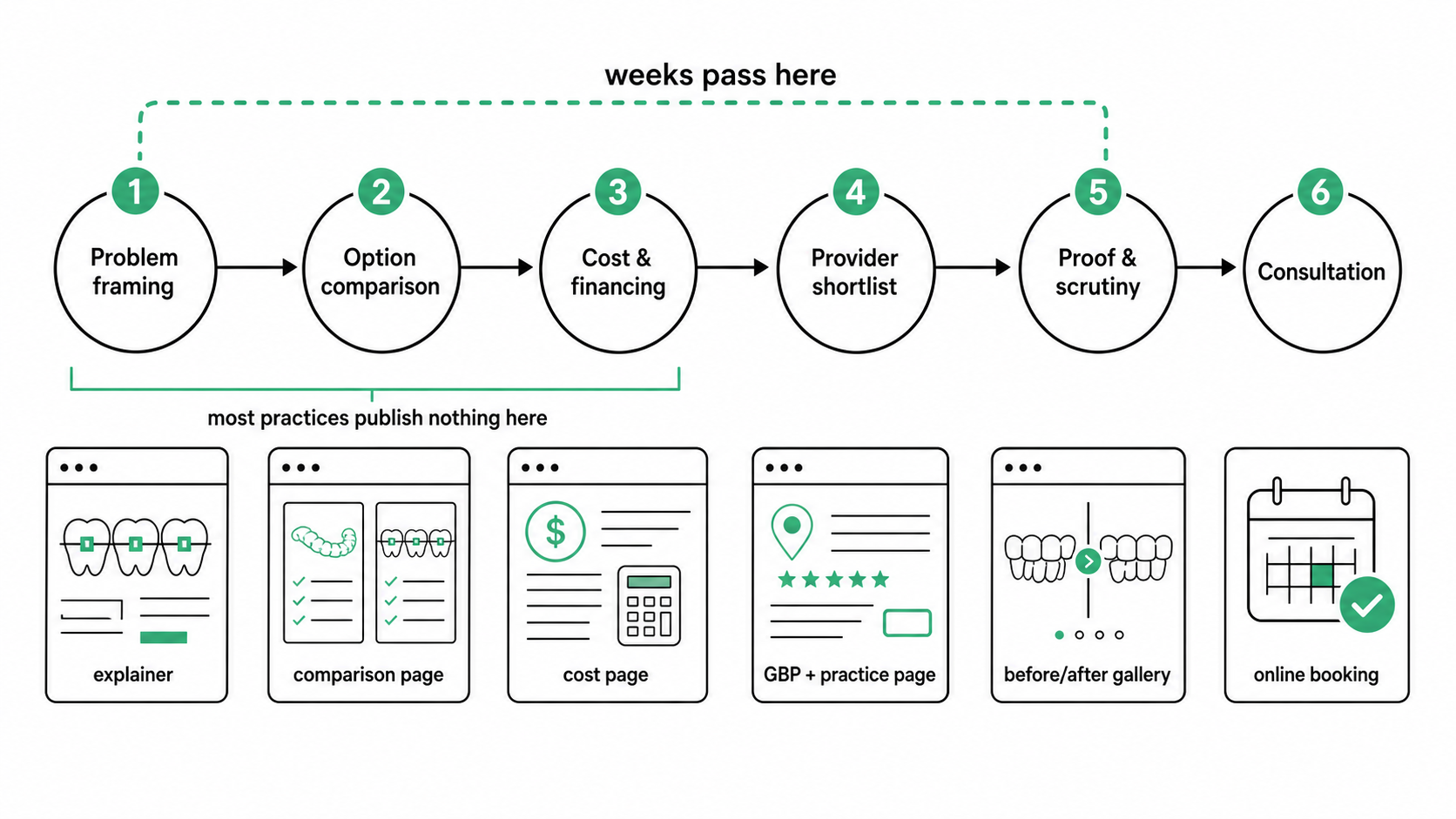
Orthodontic SEO is the work of making an orthodontic practice visible across the whole decision cycle of a braces or clear-aligner patient — not just at the “near me” moment. General dentistry converts on urgency and proximity; orthodontics converts on weeks of research, comparison, visual proof, and a consultation that has to be earned first.
TL;DR
- Orthodontics has two buyers with different objections in the same practice: the American Association of Orthodontists reports that one in three orthodontic patients is now over the age of 18 (AAO) — the rest are largely researched and paid for by parents.
- The sub-niche is measurably easier than the parent market. In our own keyword core,
orthodontic seocarries an SEO difficulty of 25 andlocal seo for orthodontistsa difficulty of 10, against 33 fordental marketing(Rotgar semantic core, Ubersuggest, US, 2026-07-26). - Our SERP review of 2026-07-28 found top-10 positions for
local seo for orthodontistsheld by a sites.google.com page and domains at DA 12–17 — thin enough that a properly built practice page competes immediately. - The local pack still ends the journey, and two of Google’s three named local factors are controllable: Google lists “relevance, distance, and prominence” and states plainly that “there’s no way to request or pay for a better local ranking on Google” (Google Business Profile Help).
- AI answers arrive on the query class orthodontics sits in: Ahrefs measured AI Overviews on 44.1% of medical queries — 5,924,866 of 13,430,263 SERPs in a September 2025 study of 146.1 million SERPs (Ahrefs).
What makes orthodontic SEO different from dental SEO?
The decision cycle and the second buyer. A patient choosing braces or Invisalign researches for weeks, compares three or four practices, studies before-and-after photos, and only then books a consultation — and for teen cases the researcher is usually a parent, not the patient. Visibility has to hold at every stage, or a competitor collects the consultation.
That length is the whole strategic difference. An emergency dental query resolves in one search and one call; an orthodontic case is a sequence of searches, each with a different question behind it — and a practice with one homepage is present for exactly one of them.
| Stage | What the patient is doing | Query shape | Asset that has to exist | What it must contain |
|---|---|---|---|---|
| 1. Problem framing | Deciding whether to treat at all | “is invisalign worth it”, “do I need braces as an adult” | Treatment explainer, written for adults and for parents separately | Candidacy, what treatment feels like, honest downsides |
| 2. Option comparison | Choosing a treatment, not yet a provider | “invisalign vs braces”, “clear aligners vs metal braces” | A genuine comparison page | Aesthetics, discipline required, treatment time, cost drivers |
| 3. Cost and financing | Deciding whether it is affordable | “how much do braces cost”, “invisalign payment plan” | Cost and financing page | Ranges, what moves the range, insurance reality, payment plans |
| 4. Provider shortlist | Comparing three or four practices | “orthodontist near me”, “best orthodontist [area]” | Google Business Profile plus a practice page that matches it | Correct category, treatments listed as services, current hours and photos |
| 5. Proof and scrutiny | Reading reviews, studying results | Brand and practice-name searches, review sites | Before-and-after gallery with written consent, recent procedure-named reviews | Real cases, comparable to the reader’s own situation |
| 6. Consultation | Booking, often after hours | Direct, map, or phone | Online booking that works without a call | Immediate confirmation, clear “what happens at the consult” |
Weeks pass between rows 1 and 6. A practice that funds only row 4 pays for the shortlist stage without ever entering the comparison the patient made before it.
Which queries does an orthodontic practice actually need to own?
Three axes, crossed: treatment (Invisalign, braces, retainers, clear aligners), audience (adult or parent of a teen), and intent (explainer, comparison, cost, provider). Most practices publish one “Orthodontics” page and cover a single cell of that grid. The map below is the structure; the volumes come from your own market, not from a national table.
| Axis / query family | Who is searching | Intent | Page that should own it | Common mistake |
|---|---|---|---|---|
| Brand treatment — Invisalign, clear aligners | Adults, and teens’ parents | Commercial research | Dedicated Invisalign page, not a paragraph on a general page | Brand mentioned only in a services list |
| Traditional braces — metal, ceramic | Mostly parents of teens | Commercial research | Braces page with treatment timeline | Treated as legacy content and left unmaintained |
| Comparison — Invisalign vs braces | Both audiences | Decision | One honest comparison page | Written as a sales page for the higher-margin option |
| Cost — braces cost, aligner cost, financing | Both, heavily | Transactional research | Cost and financing page | Omitted entirely, which sends the patient to a competitor’s number |
| Age framing — adult braces, braces for teens | Split by audience | Research | Separate adult and teen tracks | One page trying to reassure a 40-year-old and a 14-year-old at once |
| Retention — retainers, after treatment | Existing and prospective patients | Informational | Retainer page | Skipped, though it signals a practice that finishes cases |
| Provider — orthodontist near me, orthodontist + area | Shortlisting | Local commercial | Google Business Profile plus the matching practice page | Profile categorized as “Dentist” |
Two rules keep this from turning into forty thin pages. One query family, one page — two pages answering the same question compete with each other rather than with a competitor. And every page must carry something only this practice has: its own cases, price ranges, timelines. A page assembled from what other orthodontists wrote gives neither a patient nor an AI assistant a reason to prefer it.
Adults or parents of teens — who are you actually writing for?
Both, on separate pages. The American Association of Orthodontists reports one in three orthodontic patients is now over the age of 18 (AAO) — a split large enough that a single voice fails one audience. Adults buy discretion and fit-around-work treatment; parents buy safety, predictability, and a schedule the family can absorb.
| Adult patient | Parent of a teen | |
|---|---|---|
| Who searches and who pays | The same person | Parent searches and pays; the teen has veto power on appearance |
| Primary motivation | Appearance at work and on video calls; a problem postponed for years | Long-term outcome and doing right by the child |
| First objection | “Will people notice I’m wearing them?” | “Is this the right time, and is it safe?” |
| Second objection | Cost against a discretionary budget | Cost against a household budget with other claims on it |
| Proof that moves them | Before-and-after cases of adults of similar age | Reviews naming a child’s treatment and the practice’s handling of it |
| Deal-breaker | Appointments that cannot fit around a workday | A practice that talks past the parent to the child, or the reverse |
| Page that should exist | Adult treatment track, aligner-led | Teen treatment track, with the parent addressed directly |
The reviews row is where orthodontics diverges most sharply from general dentistry. “My daughter’s Invisalign results” is matched evidence for the next parent reading it; ten “great office” reviews are none. What a practice can never do is confirm treatment details in a public reply — responses thank the reviewer without confirming that anyone was a patient.
Why does the local pack still decide the orthodontic case?
Because every path through the cycle ends at “orthodontist near me”. The local pack — the three business listings Google shows above organic results on local searches — is where a weeks-long comparison finally converts to a call, and where a practice that won the research stage can still lose the patient.
Dental SEO is the process of optimizing a dental practice’s website, Google Business Profile, and online reputation so the practice appears in Google Search, Maps, and AI answers when potential patients look for dental care. The mechanics are the same ones described in local SEO for dental practices — profile completeness, reviews, citations, proximity. Google names three factors, “relevance, distance, and prominence,” notes that “more reviews and positive ratings can help your business’s local ranking,” and states there is “no way to request or pay for a better local ranking on Google” (Google Business Profile Help). Distance is fixed; relevance and prominence are the practice’s own work.
Three orthodontic specifics sit on top of that shared mechanic:
- Primary category decides which pack you enter. “Orthodontist” places the profile in orthodontic results; “Dentist” places it in a pack it will lose, competing against general practices on queries its patients never type.
- Treatments belong in the profile, not only on the site. Invisalign, clear aligners, braces, and retainers listed as Google Business Profile services are the profile-side half of the query map above.
- Procedure-named reviews outrank generic praise for relevance. Encourage patients and parents to name the treatment, the process, and the team — never scripted, never incentivized.
Profile, treatment pages and review routine are one system, described end to end in the dental marketing system. If the practice also places implants, the same long-cycle, high-fee playbook repeats with different objections in dental implant marketing.
What does our own data say about the orthodontic sub-niche?
That the competitive barrier here is unusually low. The table below is our agency-side keyword core — these are queries typed by practice owners and marketers, which is why the volumes are modest; read the difficulty column, not the volume column.
| Query (US) | Monthly searches | CPC | SEO difficulty | What it tells an orthodontic practice |
|---|---|---|---|---|
| dental marketing | 2 400 | $57.23 | 33 | The parent market, for scale and price context |
| dental seo | 1 900 | $57.39 | 31 | The head term the sub-niche sits under |
| orthodontic marketing | 260 | $23.09 | 26 | Sub-niche demand, at less than half the parent CPC |
| dental implant marketing | 260 | $40.54 | 31 | The other high-value sub-niche, priced higher |
| orthodontic seo | 210 | $32.70 | 25 | This page’s query |
| local seo for orthodontists | 90 | no data | 10 | The lowest difficulty in our entire dental core |
Source: Rotgar semantic core, Ubersuggest, US, collected 2026-07-26. The pattern is consistent: orthodontic queries score 5–23 points lower on difficulty than the market they sit inside. Our SERP review of 2026-07-28 explains why — for local seo for orthodontists, the top ten included a sites.google.com page and domains at DA 12–17. Thin results are not a promise of rankings, but they do mean authority is not the barrier here; structure and specificity are.
Worked example — where three more cases actually come from. A single-location practice runs its own arithmetic before choosing what to fund. The numbers are the practice’s own, not a benchmark.
- 900 sessions a month reach the site from orthodontic queries.
- 3% request a consultation: 27 requests.
- 55% of requests attend: about 15 consultations.
- 60% of attendees start treatment: 9 cases a month, against a goal of 12.
- Closing the gap needs 5 more consultations — either about 300 additional sessions, or one extra percentage point on the request rate.
- Decision that follows: the cost page and the before-and-after gallery are cheaper than 300 sessions, so they get built first.
Almost every orthodontic practice we look at has a conversion problem sitting in front of its traffic problem — and traffic is the more expensive of the two to fix.
Where do AI answers fit for an orthodontic practice?
Inside the same work, not beside it. Orthodontic research questions — whether aligners are worth it, what braces cost, how long treatment takes — are exactly the questions AI answers absorb, and medical queries are among the most likely to return one. The practice’s job is not to buy a new channel but to become the source those answers are built from.
Two measured figures set the size of the change. Ahrefs measured AI Overviews on 44.1% of medical queries, 5,924,866 of 13,430,263 SERPs in a September 2025 study spanning 146.1 million SERPs (Ahrefs) — and those answers reduce clicks: Pew found users clicked a traditional result on 8% of visits with an AI summary present, against 15% without, across 68,879 searches by 900 US adults in March 2025 (Pew Research Center).
There is no separate product to buy. Google states there are “no additional requirements to appear in AI Overviews or AI Mode, nor other special optimizations necessary,” and that a page must simply “be indexed and eligible to be shown in Google Search with a snippet” (Google Search Central). What changes is which pages get quoted: the comparison, the cost explainer and the candidacy page — exactly the rows in the query map most practices never wrote. How AI visibility is defined and measured is covered in what AI visibility is.
Our own measurement, honestly framed. On 2026-08-03 we ran a four-prompt pilot from our fixed battery on Perplexity in a clean anonymous session. On “best healthcare SEO agencies” the assistant returned a ranked table assembled from agencies’ own listicles, including a firm ranking itself first on a self-published score; on a categorical services prompt it named no brands at all and relayed directories and roundups, with Reddit the second most-cited source of the run. The transferable lesson: an assistant asked to recommend an orthodontist will likely build its answer from third-party pages before it reaches the practice’s own site. The limit, stated plainly: our dental prompt battery was not run in that pilot — one surface, European IP — so no dental citation figures are published here. Those come with the first full run.
What does a launch checklist look like for an orthodontic practice?
Eight checks, each pass or fail, each testable this week: profile category, profile services, comparison page, cost page, adult and teen tracks, before-and-after gallery, review flow, and after-hours booking. Every row is binary on purpose — partial credit is how practices convince themselves the foundation is finished while a competitor collects the consultations.
| Check | Test that it is true | If it fails | Effort |
|---|---|---|---|
| Primary category is “Orthodontist” | Open the profile; the primary category reads Orthodontist, not Dentist | The practice competes in the wrong local pack entirely | Minutes |
| Treatments listed as profile services | Invisalign, clear aligners, braces, retainers all present as services | Profile relevance underperforms on the treatment queries that matter | Under an hour |
| Comparison page exists | One page answers “Invisalign vs braces” honestly, including where braces win | The comparison stage happens on a competitor’s site | Days |
| Cost and financing page exists | Ranges, what moves them, insurance reality, payment plans | Patients assume the worst number and drop the practice from the shortlist | Days |
| Adult and teen tracks are separate | Two pages, two sets of objections, two sets of proof | One audience is addressed and the other is talked past | Days |
| Before-and-after gallery with written consent | Real cases, consent on file, comparable to a reader’s own situation | Nothing converts the comparison shopper at the proof stage | Weeks, ongoing |
| Procedure-named reviews arriving weekly | Recent reviews name treatment, process, and team | Relevance and prominence both weaken; a nearer practice wins the pack | Front-desk routine |
| Consultation bookable after hours | A patient can book without a phone call, and gets confirmation | Evening and weekend interest evaporates — the hours parents search | Hours of setup |
Sequence matters more than completeness. Rows one and two are free and take an afternoon; rows three to five convert the sub-niche’s low difficulty into rankings; rows six to eight turn rankings into booked chairs. A practice working on rows six to eight while row one is still wrong is optimizing a funnel it is not in.
What orthodontic SEO will NOT fix
- The decision cycle. No page or ad compresses weeks of research into a day. The goal is presence at every stage, not a shortcut through them.
- Missing visual proof. Without real before-and-after results, no volume of content converts a comparison shopper who has already seen a competitor’s gallery.
- A weak consultation. Marketing books the consult; the consult books the case. If attendance-to-start is the bottleneck, more traffic multiplies a loss.
- A capacity problem. A practice already booked out for months gets longer waits and worse reviews from more demand, not more cases.
Key takeaways
- Orthodontic SEO covers a six-stage decision cycle — framing, comparison, cost, shortlist, proof, consultation — and a practice funding only the shortlist stage buys the last step of a journey it never entered.
- The audience is split: AAO reports one in three orthodontic patients is over 18, so adult and teen tracks need separate pages, separate objections, and separate proof.
- Own the query map by treatment × audience × intent — one page per family — with comparison and cost pages treated as required, not optional.
- The local pack ends the journey. Primary category “Orthodontist”, treatments listed as profile services, and procedure-named reviews are the orthodontic layer on Google’s named relevance and prominence factors; distance is the one input a practice cannot change.
- The barrier here is unusually low:
orthodontic seoscores difficulty 25 andlocal seo for orthodontistsscores 10 in our core (Ubersuggest, US, 2026-07-26), and our 2026-07-28 SERP review found DA 12–17 domains and a sites.google.com page in the top ten. - Run the conversion arithmetic before buying traffic — in the worked example, one percentage point on the consultation-request rate equalled roughly 300 extra sessions.
- Treat AI answers as part of the same work: Ahrefs measured AI Overviews on 44.1% of medical queries, Pew measured 8% versus 15% click-through, and Google states no special optimization is required.
FAQ
How is orthodontic SEO different from dental SEO?
The decision cycle and the second buyer. General dentistry converts on urgency and proximity; orthodontics converts on weeks of comparison, cost research, and visual proof, with a parent often researching on a teen’s behalf. Orthodontic SEO therefore weighs comparison content, cost transparency, and procedure-named reviews far more heavily, on top of the same local pack mechanics.
How do I market an orthodontic practice?
Fix the Google Business Profile first — primary category “Orthodontist”, every treatment listed as a service — then publish the pages the decision cycle needs: an Invisalign versus braces comparison, a cost and financing page, and separate adult and teen tracks. Add a weekly review routine and a before-and-after gallery with written consent. That combination, not any single channel, fills the consultation calendar.
Do orthodontists need Invisalign-specific pages?
Yes. Patients search the brand by name, compare it directly against braces, and ask brand-specific cost questions — three distinct query families. A practice that mentions Invisalign only inside a services list is absent from exactly the searches its highest-value patients run, and has nothing for an AI assistant to quote when asked to compare the options.
How long does orthodontic SEO take?
In our client work, local pack movement typically shows within the first months, because profile and review work converts demand that already exists; competitive treatment queries take longer. The sub-niche helps: orthodontic seo scores 25 and local seo for orthodontists scores 10 for difficulty in our keyword core (Ubersuggest, US, 2026-07-26), against 33 for dental marketing.
Should an orthodontic practice publish treatment prices?
Publish ranges and what moves them — case complexity, treatment length, retention, financing terms — rather than a single teaser number. Practices that leave the cost page empty are removed from shortlists by patients who assume the worst figure, and cost questions are among the ones AI assistants are asked most directly.
Is orthodontic SEO worth it for a single-location practice?
Usually yes, and more so than in general dentistry, because the competitive barrier is lower. Our 2026-07-28 SERP review found top-ten results for orthodontic local queries held by a sites.google.com page and DA 12–17 domains. A single practice with a correct profile, a real comparison page, and a consent-backed gallery competes there immediately.
Get a free audit — we will show you how your practice looks to a parent comparing Invisalign providers this week, and which stage of the cycle you are missing. The simplest free audit starts with one clinic or selected location, one priority market and one patient language. It shows current visibility across Google Search, Google Maps, Google AI Overviews, ChatGPT, and Gemini, plus competitor gaps and prioritized fixes.