
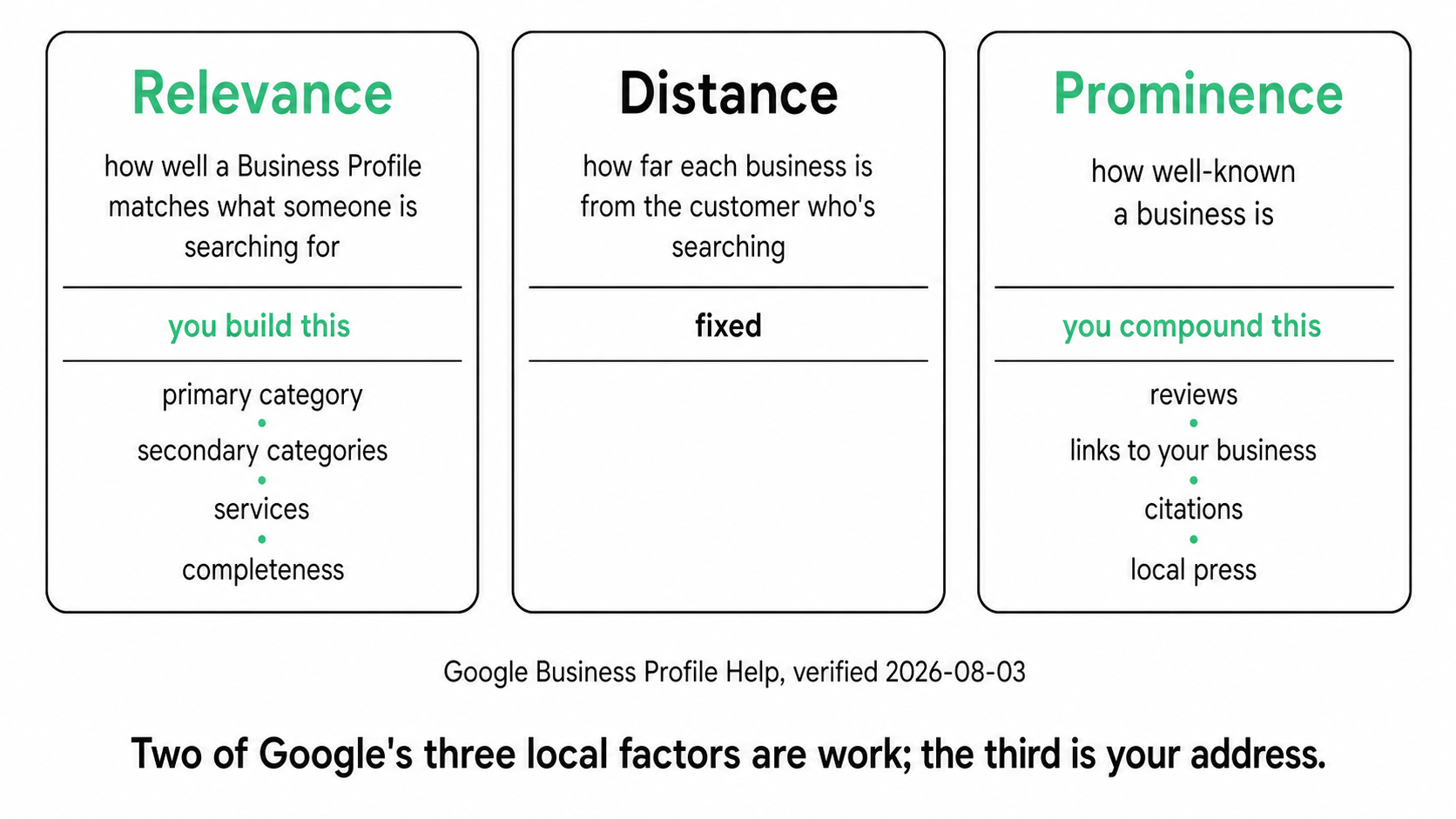
Local dental SEO is the work that puts a dental practice into Google’s local pack — the map with three practices that appears above all other results when someone searches “dentist near me.” Google ranks that pack on relevance, distance, and prominence. Two of those three are things a practice can build.
TL;DR
- Google names three local ranking factors: relevance, distance, prominence (Google Business Profile Help). Distance is fixed geography; the other two are work.
- Reviews sit inside prominence, in Google’s wording: “More reviews and positive ratings can help your business’s local ranking.”
- In our dental SERP sample (4 local queries, July 28, 2026) the pack held positions 1–3 on all three “near me” queries — and none returned an AI Overview.
- No markup shortcut exists for AI surfaces: “There are no additional requirements to appear in AI Overviews or AI Mode” (Google Search Central).
- Profile guidelines are enforceable — Google “reserves the right to suspend access to Business Profiles” for violations (Google). A keyword-stuffed name is a liability, not a tactic.
Why is the local pack the highest-value channel for a practice?
Because it takes the top of the page and converts without a website visit. In our dental SERP sample of 4 local queries (July 28, 2026), the pack held positions 1–3 on every “near me” query captured. On a phone the patient taps to call, for directions, or to book inside the listing — actions invisible to website analytics, which is why practices underestimate the channel.
One caveat: those queries are B2B (owners looking for agencies), not patients. The structure transfers; patient-side numbers are not ours to claim. What sat beneath the pack — a corporate careers page and generic geo-landers in the organic top 10 — is what a low barrier looks like.
How does Google actually rank “dentist near me” searches?
Google publishes the answer, and it names three factors: relevance, distance, and prominence. Relevance is how well your profile matches the query, distance is measured from the searcher, and prominence is how well-known the practice is online. Every legitimate local tactic moves one of the two you control.
| Factor | Google’s definition | What a practice controls |
|---|---|---|
| Relevance | “How well a Business Profile matches what someone is searching for” | Categories, the full service list, profile completeness |
| Distance | “How far each business is from the customer who’s searching” | Nothing — only expectations about your radius |
| Prominence | “How well-known a business is… based on info like how many websites link to your business and how many reviews you have” | Reviews and ratings, replies, citations, local links, press |
Source: Improve your local ranking on Google, verified August 3, 2026.
This is why we do not build separate “near me” pages: the phrase is resolved by the searcher’s location against your profile strength, not by a page containing it. In our semantic core the whole dental “near me” layer is 350 searches a month against 1,000 for local dental seo alone (Ubersuggest, US, July 26, 2026).
What does a complete Google Business Profile look like?
Your Google Business Profile (GBP) — a free Google business listing that controls how a practice appears in Maps and the local pack — is the asset the pack ranks. The website supports it.
| Element | What “done” looks like | Common failure |
|---|---|---|
| Primary category | Completes “this business IS a…” — Dentist, Cosmetic dentist, Orthodontist | Generic “Dentist” on an implant practice — wrong pack |
| Secondary categories | “Use as few categories as possible” (Google) | Stuffing, which dilutes relevance |
| Business name | The real name only; taglines and services break the rules | “Best Implants [City]” appended — suspension risk |
| Services | Every treatment you want found, with descriptions | Three listed out of twenty offered |
| Photos | Real practice, team, treatment photos, on a schedule | Stock imagery, or nothing since claiming |
| Posts and Q&A | Weekly posts; self-seeded questions answered | Empty Q&A — strangers answer for you |
| Booking link | Direct scheduling from the profile | A homepage link, adding a step |
| Hours and attributes | Hours, holidays, accessibility, languages, payment | Wrong holiday hours — a one-star review |
| NAP | Name, address, phone identical everywhere | An old address live in directories |
Name and category rules are not style advice: Google “reserves the right to suspend access to Business Profiles… that violate these guidelines” (Guidelines for representing your business).
Worked example: score the profile before spending anything
Score those nine rows, one point each. A profile typical at intake: primary category ✓, secondary ✗, name ✓, services ✗, photos ✓, posts/Q&A ✗, booking ✗, hours ✓, NAP ✗ — 5 of 9 = 56%. None of the four misses needs a budget or a developer; they need an owner. That is why local SEO moves earlier than organic does.
Get a free audit — one clinic or selected location, one priority market and one patient language.
Do reviews affect map pack rankings — and how do you stay HIPAA-aware?
Yes. Google states that “more reviews and positive ratings can help your business’s local ranking,” and that replying “shows that you value their feedback.” Reviews work twice: they influence whether you are shown, and they decide which of the three shown practices gets the call.
In dentistry the reply is the risky half. A public reply confirming someone is a patient, or referencing their treatment, discloses protected health information — even when the reviewer disclosed it first.
| Situation | Reply that creates exposure | Reply that does not |
|---|---|---|
| Review naming a procedure | “So glad your implant healed well, John!” | “Thank you for taking the time to share your experience.” |
| Complaint about a bill | “Your insurance denied the crown claim…” | “We’d like to look into this — please call our office manager.” |
| Complaint about pain or outcome | Any clinical detail or correction of facts | “We take this seriously and would like to discuss it directly.” |
| Review from a non-patient | “You were never treated here.” | “We can’t find this in our records; please contact us.” |
Legal review stays with your counsel; we build the workflow around it. The common failure is not a violation but silence — a practice unsure what it may write stops replying, and an unanswered profile is a weaker signal than a generic one.
What do your website and citations contribute?
- NAP and location signals. Real address in the footer, local phone number, embedded map, directions.
Dentiststructured data. Google’s guidance is to “use the most specificLocalBusinesssub-type possible” (structured data docs) — it disambiguates your entity; no feature is guaranteed by markup.- Mobile speed and treatment pages. “Near me” is phone behavior. Implant, Invisalign, and emergency pages carry procedure-plus-location intent the pack does not cover.
- Multi-location architecture. One distinct page per location, mapped to its own profile — see SEO for multi-location dental practices.
- Citations. Healthgrades, Zocdoc, Yelp, insurance listings. Fifty consistent citations beat two hundred inconsistent ones — inconsistency is the part that hurts.
- Local links. Sponsorships, community organizations, local press, dental society chapters: the cheapest prominence in the category, because few practices bother.
What changes when patients ask an AI assistant instead of Google?
The signals stay the same; the path above them gets shorter. Google is explicit that no special optimization exists for its AI surfaces: “There are no additional requirements to appear in AI Overviews or AI Mode… there’s also no special schema.org structured data that you need to add” (Search Central).
What changes is the click. Pew Research found 18% of Google searches produced an AI summary, and users who saw one clicked a traditional result on 8% of visits versus 15% without one (68,879 searches, 900 US adults, March 2025).
Our pilot (August 3, 2026; 4 prompts, Perplexity, clean anonymous session, European IP) showed the mechanism: on selection prompts the engine evaluated nobody — it relayed lists other people had published, including one agency’s own listicle ranking itself first. Dental prompts were not in that pilot, so this is a pattern, not a dental measurement; the dental battery ships with the first full run. What transfers: the third-party sources building prominence are the ones feeding AI answers. See AI visibility for dental practices and what AI visibility is.
How much local dental demand is there — and what is it worth?
The dental local layer in our semantic core is 1,440 searches a month across five queries, with cost per click running from $32 to $94 — small volume, high commercial value. These numbers measure practice owners searching for help, not patients searching for a dentist; CPC is the proxy for value.
| Query | Volume/mo (US) | CPC | SERP note |
|---|---|---|---|
local dental seo |
1,000 | $68.15 | Head term of this page; SERP not captured (tool error, flagged) |
dental marketing near me |
170 | $32.16 | Pack at 1–3; a careers page and geo-landers in the top 10 |
dental seo near me |
90 | — | Pack at 1–3; agency city-landing pages beneath it |
dental marketing company near me |
90 | $93.80 | Pack at 1–3; two agency self-listicles in the top 10 |
local seo for orthodontists |
90 | — | The only one with an AI Overview; a sites.google.com page in the top 10 |
Volumes and CPC: our semantic core, Ubersuggest, US, July 26, 2026. SERP notes: our own capture, July 28, 2026 (4 queries).
Two readings: the near-me layer is small and belongs inside one strong page — this one; and the pages holding those results are weak enough to displace.
Local SEO for orthodontists and dental specialists
Specialists play the same game on a longer clock. An Invisalign patient reads reviews, compares results, and checks financing for weeks before the “near me” search that ends it. The pack wins the call; reviews and content decide which three names were on the shortlist. Orthodontic categories and procedure-level reviews are covered in our orthodontic SEO and marketing guide.
What local SEO will NOT fix
- A reputation problem. A 3.2-star average needs service recovery first; optimization only speeds up exposure to it.
- A non-compliant profile. If the name breaks Google’s guidelines or the primary category is wrong, the fix is structural — potentially a suspension appeal, not a checklist.
- Geography. Distance is not optimizable. Patients outside a realistic radius belong to the wider dental marketing system.
- Capacity. More calls into an unanswered phone is a scheduling problem in marketing costume.
How does Rotgar run local SEO for dental practices?
Rotgar is a healthcare SEO and AI search agency that helps medical and dental practices acquire patients from Google Search, Google Maps, and AI assistants like ChatGPT and Gemini. Local work is the Maps half of our Google Search and Maps service.
- Audit. Pack presence, profile scored on the nine rows above, review velocity, citation consistency, local competitors — mapped to relevance, distance, prominence.
- Profile build-out. Categories, services, photos, posts, Q&A, booking — completed, then maintained.
- Review system. A repeatable request process and HIPAA-aware reply templates your team can use.
- Site and citations.
Dentiststructured data, NAP cleanup, the core citation set, local links. - Reporting. Calls, direction requests, and bookings from the profile, plus pack positions — monthly, against the baseline.
Dentalia Krasovsky, a dental practice in Beverly Hills, went through this work with us: technical SEO, mobile usability, page speed, and visibility across Google Search and Maps. The practice reported higher rankings, month-over-month lead growth, and positive ROI (client-reported case; exact figures are not published). A Boston dental practice reported similar directional growth (case). Both are Search and Maps outcomes, not AI citations.
Key takeaways
- Google names three local factors and only two are workable; every legitimate tactic is one of those two under another name.
- Reviews are a stated ranking input, not a reputation nicety — and in dentistry no reply may confirm patient status.
- The Business Profile, not the website, is what the pack ranks. Score it on nine elements: 5 of 9 is normal at intake, and the misses are usually free to fix.
- The “near me” layer is 350 searches a month in our dental core — it belongs inside one strong page, never in separate city pages.
- Name and category guidelines carry suspension risk; keyword-stuffed names are borrowed rankings with a due date.
- AI surfaces need no special markup, but they shorten the click path (18% of searches carried an AI summary; 8% vs 15% clicks — Pew) and read the same sources that build prominence.
FAQ: local dental SEO
What is local SEO for dentists?
Local SEO for dentists is the work that puts a dental practice into Google’s local pack — the map with three practices shown above all other results for searches like “dentist near me.” It centers on the Google Business Profile, reviews, citations, and the local signals on the practice website.
How do I get my dental practice into the Google map pack?
Complete and correctly categorize your Google Business Profile, keep a steady flow of fresh reviews with professional replies, make name, address, and phone consistent everywhere, and let the website confirm your location and services. Google ranks the pack by relevance, distance, and prominence — two of which you can improve.
How important are Google reviews for dental practices?
Google states that “more reviews and positive ratings can help your business’s local ranking,” and reviews are also how a patient chooses between the three practices displayed. Volume, recency, rating, and reply behavior all matter — and a reply must never confirm that the reviewer is a patient.
Can I rank for “dentist near me” in a neighboring city?
Realistically, no. Distance is a stated ranking factor, measured from the searcher rather than from your marketing plan. Practices serving a wider area complement local SEO with treatment content, specialist pages, and — where the economics work — paid search.
How long does local SEO take for a dental practice?
Profile and review work usually moves first, because most profiles at intake are incomplete rather than penalized. Competitive markets and reputation repair take longer. We set market-specific expectations in the audit instead of quoting a standard timeline.
What’s the difference between local SEO and regular dental SEO?
Local SEO targets the map pack, driven by your Business Profile, reviews, and citations. Dental SEO is the process of optimizing a dental practice’s website, Google Business Profile, and online reputation so the practice appears in Google Search, Maps, and AI answers when potential patients look for dental care — see our dental SEO page. Patients use all of it; a complete strategy covers all of it.
Find out who holds the pack in your market — and what it takes to displace them.
The simplest free audit starts with one clinic or selected location, one priority market and one patient language. It shows current visibility across Google Search, Google Maps, Google AI Overviews, ChatGPT, and Gemini, plus competitor gaps and prioritized fixes.
Get a free audit · Book a 30-minute call · Rated 5.0 on Clutch (26 verified reviews)