
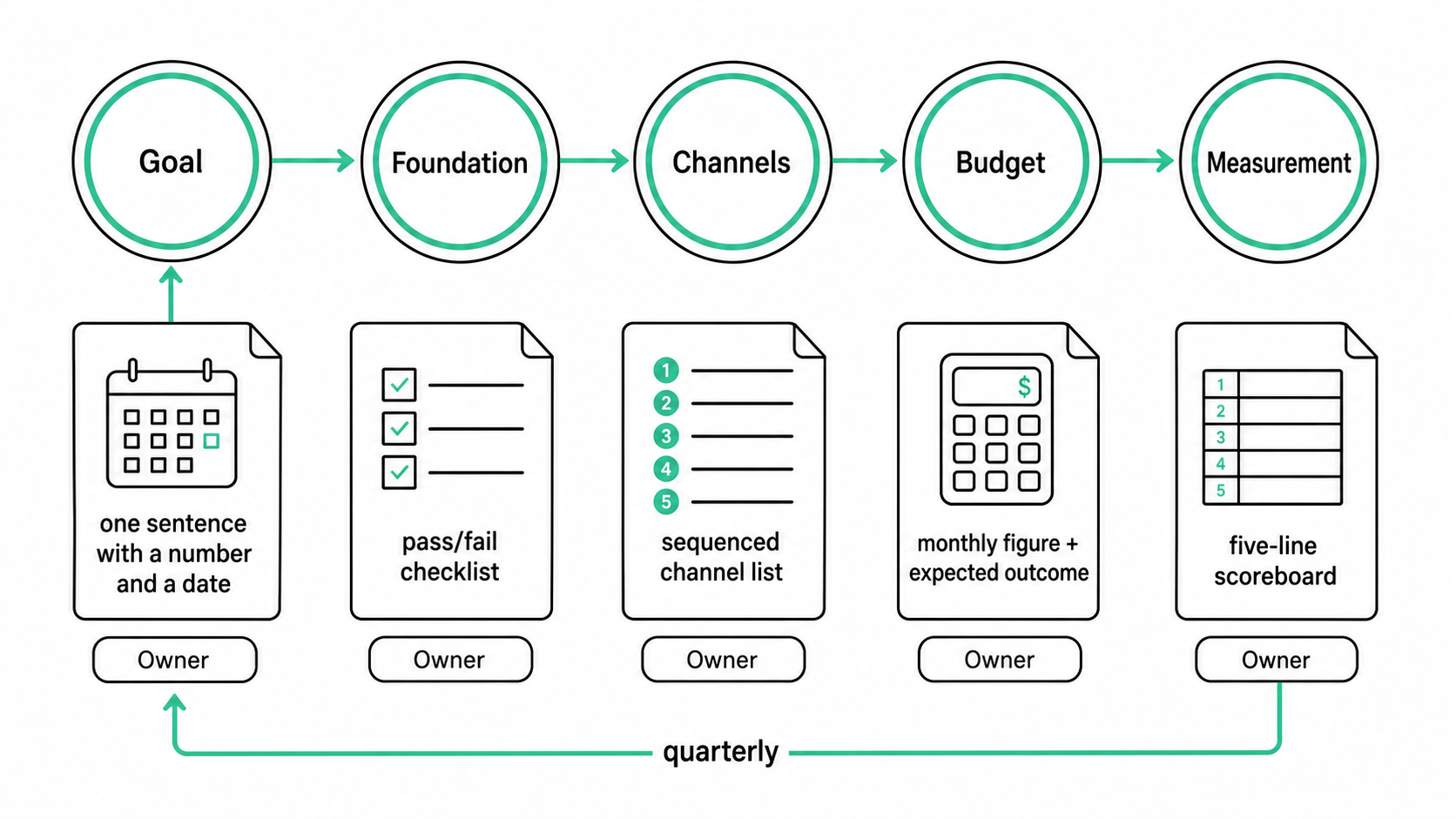
A dental marketing strategy is a written plan that connects a practice’s growth goal to specific channels, budgets, and metrics — typically built around Google Search, Google Maps, reviews, and increasingly AI answers. Some practices call the document a dental marketing plan; the name matters less than the discipline. Without one, spend scatters across tactics that never compound.
TL;DR
- Five decisions, five written outputs: the goal in booked appointments, the funnel fixes that precede any spend, two or three channels chosen by practice size, a budget with a timeline, a monthly scoreboard.
- Foundation before traffic is not an opinion. Google names “relevance, distance, and prominence” as local ranking factors and states “there’s no way to request or pay for a better local ranking on Google” (Google Business Profile Help) — profile and review work moves two of the three; ads move none.
- Channel choice follows structure: solo practices compete on one profile and its treatment pages, 2–5 location groups on location-by-service architecture, DSOs on governance and profile consistency.
- AI answers are a line item, not a channel. Ahrefs measured AI Overviews on 44.1% of medical YMYL queries across 146.1 million SERPs (September 2025); Pew found users clicked a result on 8% of visits with an AI summary present, versus 15% without.
- Budget honestly: an engagement of this scope starts around $3,000 per month, against a $57.23 CPC for
dental marketingclicks in our keyword core (Rotgar semantic core, Ubersuggest, US, 2026-07-26).
What does a dental marketing strategy actually decide?
Five things, in order, each producing a document a practice can hold someone to. A strategy is not a list of tactics — it is the set of constraints deciding which tactics get funded, who owns them, and when the decision is revisited. A plan that cannot answer all five rows in writing is a wish list.
| Step | Question it settles | Written output | Owner | Revisited |
|---|---|---|---|---|
| 1. Goal | How many new patients, of which type, by when? | One sentence with a number and a date | Practice principal | Quarterly |
| 2. Foundation | What must be true before we buy traffic? | Pass/fail checklist with fix dates | Office manager | Monthly until clean |
| 3. Channels | Which two or three, in what order? | Sequenced channel list, a start date each | Owner + agency | Quarterly |
| 4. Budget | What are we spending, against what outcome? | Monthly figure with expected outcome per channel | Owner | Quarterly |
| 5. Measurement | What number says this is working? | Five-line monthly scoreboard | Front desk + agency | Monthly |
This page is the framework. The catalog of tactics that fills it lives on dental marketing ideas; the channel-by-channel view of what a practice can buy from an agency is on dental marketing. Ideas without this framework are the fourteen half-finished projects most practices already have.
Step 1: How do you set a goal in chairs, not clicks?
Write the goal in booked appointments and case types, with a number and a date: 25 new patients a month within twelve months, including three implant consultations. Traffic, rankings and impressions are diagnostics, not goals — they move for reasons that never reach the schedule. Split it by procedure, because hygiene and implants demand different pages, different profile services and different budgets.
Worked example — where the eleven missing patients actually are. A two-doctor practice books 14 new patients a month and wants 25. The arithmetic is the practice’s own; the point is that it gets done before any channel is chosen.
- Gap: 11 new patients a month.
- The office logs 60 new-patient calls a month and answers 70% in business hours: 18 calls reach voicemail.
- At the practice’s own 45% call-to-booked rate, those 18 calls are worth roughly 8 patients — recoverable with call handling, not marketing spend.
- That leaves 3 patients a month to be won with visibility, out of 11 that looked like a visibility problem.
- Decision: fix call handling in month one, size the channel budget against 3 patients, not 11.
Almost every practice we audit finds some version of this split. It is the cheapest step in the plan and the most often skipped, because it produces work for the front desk rather than an invoice for a vendor.
Step 2: What has to be true before you buy any traffic?
Five things, all testable in an afternoon. Sending traffic into a leaking funnel is the most expensive mistake in dental marketing: the money buys the click, and the profile, the page or the phone loses the patient. Each row is pass/fail — partial credit is how practices convince themselves the foundation is done.
| Foundation | Test it is true | If it fails | Cost to fix |
|---|---|---|---|
| Google Business Profile | Category correct, every service listed, hours including holidays, photos under 12 months, booking link live | Relevance and prominence both underperform | 1–2 hours of staff time |
| Review flow | New reviews weekly, from a routine offered to every patient | Ranking and patient choice both suffer | Front-desk process, no spend |
| Website on a phone | Fast on 4G, one page per treatment you want to be known for, tappable number | Clicks arrive and leave; nothing for an assistant to quote | Days to weeks |
| Call handling | Someone answers, or a system returns every missed call | The largest silent leak in most practices | Staffing or answering service |
| Booking path | A patient can book after hours without calling | Evening and weekend interest evaporates | 1–3 hours of setup |
The first two rows have a source behind them. Google’s local ranking documentation names relevance, distance and prominence, notes “more reviews and positive ratings can help your business’s local ranking,” and states plainly that “there’s no way to request or pay for a better local ranking on Google” (Google Business Profile Help). Distance is the one input a practice cannot change — which is why the other two come first.
The website row carries a constraint dental content specifically triggers. Health sits in what Google calls YMYL, and its guidance states systems “give even more weight to content that aligns with strong E-E-A-T for topics that could significantly impact the health, financial stability, or safety of people,” with clear authorship part of the “who, how and why” test (Google Search Central). A treatment page written by nobody is a weaker asset in dentistry than in almost any other local category.
Step 3: Which channels should your practice pick, and in what order?
Two or three, sequenced, chosen by the structure of the practice rather than by what is fashionable. For nearly every practice the first channel is search and Maps, because it captures patients already looking for care and compounds; the second is reviews, because they multiply every other channel; paid and social come after, for gaps and launches.
Dental SEO is the process of optimizing a dental practice’s website, Google Business Profile, and online reputation so the practice appears in Google Search, Maps, and AI answers when potential patients look for dental care. What that work looks like — and what breaks first — depends on how many locations sit behind it.
| Decision | Solo / single location | Group, 2–5 locations | DSO / 6+ locations |
|---|---|---|---|
| First channel | One profile, one set of treatment pages | Location × service pages, one profile per location | Template architecture plus per-location profile governance |
| Second channel | Review routine at the front desk | Review routine standardized across offices | Review operations with per-location reporting |
| Third channel | Paid search on 2–3 high-value procedures | Paid aimed at the weakest locations, not the loudest | Centralized paid, budget shifted by location performance |
| What breaks first | Nothing gets finished — no owner | Duplicate, cannibalizing location pages | Profile drift: hours, categories, names diverging |
| Who owns it | The owner, agency doing the work | Office manager per location, one accountable marketer | Marketing team plus per-location gatekeeper |
| Reporting unit | Booked appointments per month | Booked appointments per location | Booked appointments per location, normalized per chair |
| Wrong move | Running five channels at once | One shared profile for several offices | Auto-generated location pages with no local content |
Two channels done completely beat five done partially — the constraint is attention and ownership, not budget. Social sits in the third tier for most practices: it builds recognition rather than capturing demand, and carries patient-privacy requirements search does not, which is why it has its own playbook in social media for dental practices.
Where does AI search fit into a 2026 dental marketing strategy?
As a line item under search, not a separate channel with its own budget. Dental queries are among the most likely to return an AI answer, and that answer is assembled from pages the practice mostly does not own. Ahrefs found AI Overviews on 44.1% of medical YMYL queries in a September 2025 study of 146.1 million SERPs (Ahrefs); Pew found users clicked a traditional result on 8% of visits when an AI summary appeared, against 15% when none did, across 68,879 searches in March 2025 (Pew Research Center).
There is no product to buy against it: Google states there are “no additional requirements to appear in AI Overviews or AI Mode, nor other special optimizations necessary,” only that a page “be indexed and eligible to be shown in Google Search with a snippet” (Google Search Central). The AI line item is the same work as steps 2 and 3, held to a higher standard of clarity and attribution, with its own scoreboard row — see what AI visibility is.
What does our own data say about planning demand?
Two datasets, both ours, both dated. The first is the demand behind these decisions — queries typed by owners and marketers, not patients, which is why volumes are modest and CPCs are not.
| Query (US) | Monthly searches | CPC | What it tells a practice planning |
|---|---|---|---|
| dental marketing | 2 400 | $57.23 | Category head term; the CPC is the price of the channel you skip by planning |
| dental seo | 1 900 | $57.39 | Agency demand, not patient demand |
| local dental seo | 1 000 | $68.15 | The most expensive click in the set sits on the local layer of step 3 |
| dental marketing strategy | 590 | $30.22 | This page’s query — more owners search for a plan than for a tactic list |
| dental implant marketing | 260 | $40.54 | Small volume, high value: the procedure split from step 1, priced |
Source: Rotgar semantic core, Ubersuggest, US, collected 2026-07-26. Read the CPC column as the alternative price of every step above.
What our pilot showed, honestly framed. On 2026-08-03 we ran four buyer-intent prompts from our fixed battery on Perplexity in a clean anonymous session. On “best healthcare SEO agencies” the assistant returned a ranked table assembled from agencies’ own listicles, one of them ranking itself first on a self-published score; on “who provides GEO services” it named no brands at all and relayed directories and roundups, with Reddit the second most-cited source. An assistant recommending a practice builds its answer from third-party pages the same way — which is why listings consistency and mentions sit inside step 3, not in a separate AI budget. The limit: our dental battery has not been run yet, these prompts were agency-side, one surface, European IP. Dental figures come from the first full run.
Step 4: What should a dental practice budget, and over what timeline?
Write a monthly figure with an expected outcome attached, per channel. In our client work, an agency engagement covering technical work, local visibility, content and reporting starts around $3,000 per month, with scope set by market competition; expect foundational results in the first months and compounding growth after — not a straight line in week two.
Budget against the goal from step 1, not a percentage of revenue borrowed from an industry post: if the gap is three patients a month and an implant case is worth several thousand dollars, what a program may cost is arithmetic rather than a benchmark. What sits inside a retainer and how to read a quote is broken down on dental SEO pricing and ROI. Two rules keep the number honest — every figure carries an expected outcome and a review date, and no channel gets funded while its foundation row still fails.
Step 5: What do you measure, and how often?
Five numbers, monthly, read in one sitting; decisions quarterly. Rankings and sessions belong in the agency’s diagnostics, not the practice’s scoreboard — they move weekly and tempt owners into killing a plan before it has had a quarter to work.
| Metric | Where it comes from | A bad number means |
|---|---|---|
| New-patient calls | Call tracking or practice phone log | Demand is not reaching you, or is not answered |
| Form and online bookings | Website and booking system | The path from page to appointment is broken |
| Direction requests and profile calls | Google Business Profile insights | Local visibility or profile completeness is weak |
| Booked appointments kept | Practice management system | The gap is scheduling and reminders, not marketing |
| Source of each new patient | Front-desk question, one field | You cannot attribute, so you cannot reallocate budget |
The fifth row is the one practices skip and the one that makes the other four actionable. Our own client work is reported the same way: for the Beverly Hills practice Dentalia Krasovsky we did technical SEO, mobile usability and speed work, then visibility in Google Search and Maps, and the client reported higher rankings, month-over-month lead growth and positive ROI — directional and client-reported, with no figures published, because they are the client’s numbers and we cannot audit them.
When is a written strategy the wrong thing to build?
When the constraint is not demand. Four situations where a marketing plan is the wrong next move:
- The schedule is already full. More patients on a booked calendar produces longer waits and worse reviews. The work is capacity, case mix or pricing.
- The practice is short-staffed. A plan depending on the front desk to collect reviews, answer calls and ask one intake question will not survive a stretched team.
- The practice is being sold within the year. Search and content pay back over quarters; a twelve-month horizon does not fit a six-month build.
- The clinical or scheduling experience is the problem. Marketing accelerates whatever the practice already is. If patients leave after the first visit, growth spend speeds that up.
Marketing also will not fix insurance mix, a location patients cannot park at, or a treatment plan patients do not understand.
Which strategy-level mistakes cost practices the most?
Five, at the level of the plan rather than the tactic, each costing quarters:
- Chasing every channel at once. Depth in two beats presence in five; the scarce resource is attention, not budget.
- Switching agencies every three months. Every reset discards the measurement history the next decision needed.
- Measuring clicks instead of chairs. A diagnostic promoted to a goal gets optimized at the expense of the goal.
- Funding channels while a foundation row fails. Usually ads pointed at a profile and a phone that lose the patient anyway.
- No written plan at all. The most common of the five, and why the other four stay invisible for a year.
Key takeaways
- Five decisions, five written outputs — goal, foundation, channels, budget, measurement — each with an owner and a review date.
- Set the goal in booked appointments and case types, then locate the gap: in the worked example, 8 of 11 missing patients were unanswered calls, not missing visibility.
- Fix the foundation first. Google names relevance, distance and prominence as local factors and states there is no way to pay for better local ranking.
- Choose channels by structure: solo on one profile and its treatment pages, a 2–5 location group on location × service architecture, a DSO on governance and profile consistency.
- Give AI answers a line item, not a channel budget: 44.1% of medical YMYL queries return an AI Overview (Ahrefs), clicks fall from 15% to 8% when a summary appears (Pew), and Google requires no special markup.
- Budget with an outcome and a timeline attached; engagements of this scope start around $3,000 per month, against a $57.23 CPC for
dental marketingclicks (Ubersuggest, US, 2026-07-26). - Measure five numbers monthly, decide quarterly, and record the source of every new patient.
FAQ
What should a dental marketing strategy include?
A goal written in booked appointments with a date, a pass/fail foundation checklist with fix dates, two or three sequenced channels chosen by practice size, a monthly budget with expected outcomes per channel, and a five-line scoreboard read monthly. Each item needs a named owner inside the practice.
How much should a dental practice spend on marketing?
Enough to close the gap identified in step 1, and no more until it closes. In our client work, agency retainers covering technical, local, content and reporting work start around $3,000 per month, with scope set by market competition. Percentage-of-revenue rules of thumb substitute for the arithmetic rather than answering it.
How long until a dental marketing strategy works?
Foundational wins — profile completeness, review flow, call handling, booking — typically show within the first months, because they convert demand that already exists. Compounding growth from treatment content and authority builds after that. Plans measured in weeks get killed before the second phase starts.
What is the difference between a dental marketing strategy and dental marketing ideas?
A strategy decides which tactics get funded, by whom, and against what number; ideas are the tactics themselves. Practices with a list of ideas and no strategy accumulate half-finished projects with no owner. Build the framework here first, then fill it from the ideas catalog.
Do I need a separate AI marketing plan for my dental practice?
No. AI answers are a line item under search: the profile accuracy, treatment content and third-party consistency that produce local visibility are what get a practice quoted, and Google states no special markup is required. What changes is the standard of clarity and attribution, plus one more scoreboard row.
Can I build a dental marketing strategy myself?
Yes — the five steps above are the whole framework, and steps 1, 2 and 5 are internal work no vendor can do for you. Where practices usually need outside help is execution depth on step 3, and speed.
Get a free audit — we will map your practice against this framework and show you which step is actually blocking growth. The simplest free audit starts with one clinic or selected location, one priority market and one patient language. It shows current visibility across Google Search, Google Maps, Google AI Overviews, ChatGPT, and Gemini, plus competitor gaps and prioritized fixes.