
To get more dental patients, fix the channels patients actually use to choose a dentist, in this order: your Google Business Profile and reviews first, then pages for the treatments you want more of, then the patients already in your database. Most practices do not need more marketing — they need the basics finished.
TL;DR
- Two of Google’s three stated local ranking factors respond to work your front desk can do this month. Google says local results are based on “relevance, distance, and prominence,” that “businesses with complete and accurate info are more likely to show up in local search results,” and that “more reviews and positive ratings can help your business’s local ranking” (Google).
- Do not buy the review lever. Google prohibits merchants from offering “incentives – such as payment, discounts, free goods and/or services - in exchange for posting any review” (Google Maps UGC policy).
- The cheapest new appointments are not new patients at all: reactivating overdue hygiene and unfinished treatment plans fills chair time in days and costs staff hours, not media budget.
- Patients now ask assistants before they ask you: 17% of US adults use AI chatbots at least monthly for health advice and information, rising to 25% of adults under 30 (KFF, June 2024); and when Google shows an AI summary, users click a search result in 8% of visits versus 15% without one (Pew Research Center, March 2025).
- This question is asked by owners, not patients:
how to get more dental patientsruns 50 searches a month at a $51.29 CPC in our keyword core (Ubersuggest, US, collected 2026-07-26) — small volume, expensive clicks, which is why the advice around it is mostly agency advertising.
Where is your practice losing patients right now?
Before pulling any lever, find the leak. Four checks, twenty minutes, no tools: are you in the map pack, do you win the review comparison, does your site answer treatment questions, and does someone convert the call? Most practices find their answer in one of the four — and it is often the fourth.
- Are you visible? Search “dentist near me” on a phone near the practice. Are you in the local pack — the three business listings Google shows above organic results on local searches? If not, levers 1 and 2 are your whole plan for the next month.
- Do you look chosen? Open the two practices ranked above you and compare review count, rating, and the date of the most recent review. Patients run that comparison in seconds.
- Does your site answer? Open your implant or Invisalign page. Does it cover cost logic, process, and recovery — or is it three paragraphs and a stock photo?
- Does someone convert the call? Marketing produces the ring; the front desk books the chair. Call your own practice at 4:50 p.m. and again at lunch. A missed call is patient loss no channel report will ever show you.
The honest version: much of what practices call a marketing problem is an operations problem. If checks 1–3 pass and check 4 fails, more visibility only buys unanswered phones.
Which channels bring dental patients fastest?
Speed and ceiling are different things. Profile work, reviews, and reactivation produce booked appointments within weeks; treatment pages and question content take a quarter but keep paying. The table below sorts every realistic channel by time to first signal, using the ranges we see in client work — not published benchmarks.
| Channel | What it actually moves | First signal | Ongoing cost | Ceiling |
|---|---|---|---|---|
| Reactivating your existing base | Overdue hygiene, unfinished treatment plans | Days | Staff hours, recall software | Size of your list |
| Google Business Profile completeness | Map pack visibility, calls, direction requests | 2–4 weeks | Staff hours | Capped by distance |
| Review routine | Which of two nearby practices gets chosen | 2–6 weeks | Staff hours | Compounds indefinitely |
| Paid search | Impressions on demand | Days | Continuous ad spend | Stops when spend stops |
| Referral program | Pre-trusted patients who arrive ready to book | 1–2 months | Small, one-off design | Your patient volume |
| Treatment pages (implants, veneers, Invisalign) | High-value case inquiries | 6–12 weeks | 3–6 hours per page | High |
| Question content | Research-stage patients; citations in AI answers | 2–4 months | About one page a week | High |
| Social media | Familiarity, not demand capture | 2–3 months | Weekly production | Low for booking, useful for cosmetic |
| Being answerable by AI assistants | Whether you are named when a patient asks | 1–2 quarters | Ongoing, no product to buy | Emerging |
Read it top-down, not by ambition: a practice that launches ads before finishing rows two and three pays for clicks that land on a profile patients will not choose. The channel-by-channel economics sit on our dental marketing page; the seven levers below are the order we implement them in.
Levers 1–2: What do the Business Profile and reviews actually do?
They decide the map pack, which sits above every website link on local dental searches. Google names three local ranking factors — relevance, distance, and prominence — and states that “businesses with complete and accurate info are more likely to show up in local search results” and that “more reviews and positive ratings can help your business’s local ranking” (Google). Distance you cannot change. The other two you can.
Lever 1 — finish the profile. Primary and secondary categories, every service you actually perform, holiday hours, real photos from inside the practice, a booking link, and answers in the Q&A block. In audits we run, most profiles are partly filled and untouched since the day they were claimed.
Lever 2 — make the review ask a routine, not a campaign. The same person, the same short link, handed to every patient at checkout — not only the ones you expect to be happy. Recency and specificity (“my Invisalign finished three weeks early”) beat raw totals in the comparison a patient runs.
One hard boundary: never attach a reward. Google prohibits offering “incentives – such as payment, discounts, free goods and/or services - in exchange for posting any review,” and content posted because of an incentive is removed (Google Maps UGC policy). Asking everyone, every time, carries no risk at all.
Levers 3–4: Which pages turn researchers into booked cases?
Two levers that decide whether a patient who found you actually calls. High-value treatments are researched for weeks before anyone books, and one “Services” page listing twelve procedures answers none of what that research asks.
Lever 3 — a page per treatment you want more of. Implants, veneers, Invisalign, sedation for anxious patients. Each page covers candidacy, the process, recovery, how the price is built up, and what financing exists. A patient comparing two practices reads the one that explains, not the one that lists.
Lever 4 — answer the questions patients ask before booking. Log what your front desk is asked for two weeks: cost, pain, sedation, insurance, duration, what happens after six years away. Each question is a search someone runs today and, increasingly, an answer an assistant assembles from whoever answered it best. Tactic-level detail for both levers is cataloged in our dental marketing ideas.
Levers 5–6: Why are referrals and reactivation the cheapest patients?
Because you have already paid to acquire them. Reactivation and referrals are the two levers digital-marketing articles skip, and they are the fastest source of booked chair time — the productive hours a chair is occupied — in almost every practice we audit.
Lever 5 — a referral program a patient can repeat out loud. One sentence, one benefit, visible at checkout. If the front desk cannot explain it in a single breath, no patient will repeat it to a colleague. Keep the reward attached to the referral and never to a review.
Lever 6 — reactivate the base you already have. Overdue hygiene recalls, treatment plans presented and never scheduled, patients who changed insurance and quietly stopped coming. Practices sit on hundreds of dormant records while paying to acquire strangers.
Worked example — sizing lever 6 before you spend anything. This is arithmetic, not a benchmark; the only numbers that matter are the ones from your own practice management software.
- The practice has 1,800 active records; a report shows 420 patients overdue for hygiene by six months or more.
- The front desk works a list of 60 a week by phone, in the gaps, with an email and SMS follow-up.
- One in six reached patients books: 10 appointments a week, roughly 40 a month, from records already in the system.
- Media cost of the campaign: zero. Real cost: about four hours of front-desk time a week for seven weeks, then the list is worked.
- Track two numbers only — contacts attempted and appointments booked. Their ratio is the entire lever.
Run the same arithmetic before any new channel. If a lever cannot be written as a number you will read next month, it is a hobby, not a plan.
Lever 7: Do patients really look for dentists in AI answers?
Enough of them to matter, and the share is growing. KFF found that 17% of US adults use AI chatbots at least once a month to find health advice and information, rising to 25% of adults under 30 (KFF, fielded June 3–24, 2024). On Google itself the answer increasingly replaces the click.
Pew Research Center found that around 18% of Google searches produced an AI summary in March 2025, and that users who saw one clicked a traditional search result in 8% of visits versus 15% when no summary appeared (Pew Research Center). For a practice, that is the same visibility question with a different surface: being named in the answer now matters as much as being clickable under it.
There is nothing to buy here. Google states there are “no additional requirements to appear in AI Overviews or AI Mode, nor other special optimizations necessary,” and that “there’s also no special schema.org structured data that you need to add” — a page must simply “be indexed and eligible to be shown in Google Search with a snippet” (Google Search Central). What that means in practice is that levers 1–4 are also your AI levers: a resolvable profile, consistent information, real reviews, and pages that answer questions plainly. The mechanics of that channel are covered separately in what AI visibility is.
What does our own data say about this question?
Two datasets, both ours, both dated, both with their limits stated. The first is the demand behind this page — and the thing to notice is who is searching: owners and practice marketers, not patients, which is why the volumes are small and the clicks expensive.
| Query (US) | Monthly searches | CPC | What it tells a practice |
|---|---|---|---|
| how to get more dental patients | 50 | $51.29 | This page’s query: tiny volume, agency-priced clicks |
| dental marketing | 2 400 | $57.23 | The category head term — an agency market, not patient demand |
| dental seo | 1 900 | $57.39 | Same market, search half |
| local dental seo | 1 000 | $68.15 | The most expensive click in the vertical |
| dental marketing strategy | 590 | $30.22 | More owners look for a plan than for tactics |
| dental practice marketing | 320 | $41.66 | Practice-level framing of the same intent |
| dental implant marketing | 260 | $40.54 | High-ticket cases have their own demand |
| lead generation for dentists | 90 | $24.73 | The “just send me patients” framing |
Source: Rotgar semantic core, Ubersuggest, US, collected 2026-07-26. Read these CPCs correctly: they are what agencies pay to reach you, not what you would pay to reach a patient. That is the honest reason so much content answers this question — and why every lever above is scored by what it books.
What our AI-visibility pilot showed, framed honestly. On 2026-08-03 we ran four buyer-intent prompts from our fixed prompt battery on Perplexity in a clean anonymous session. On “best healthcare SEO agencies” the engine did not evaluate anyone — it rebuilt a ranked table from agencies’ own published listicles, one firm ranking itself first on a score it invented. On “who provides GEO services” it named no brands at all and relayed directories, with Reddit the second most cited source. The mechanism transfers directly to a patient asking for the best dentist in a city: the answer is assembled from pages the practice does not own — directories, roundups, review platforms, forums. The limits, plainly: four prompts, one surface, a European IP address, and the dental prompts in our battery have not been run yet. That dental measurement lands at the first full 16-prompt run, and we will publish it whichever way it goes.
What order should a practice do this in?
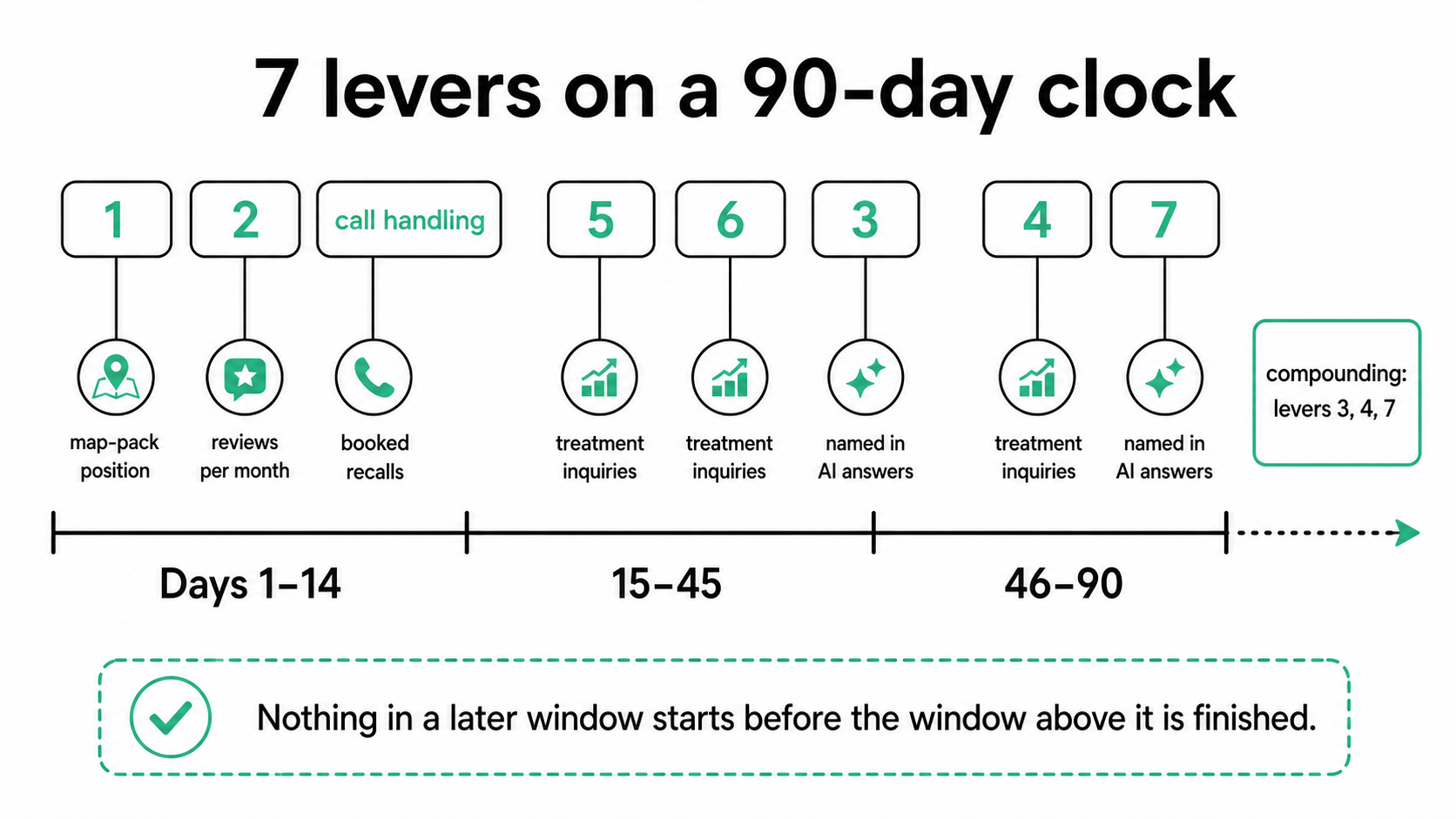
Ninety days, three windows, nothing started before the one above it is finished. This sequence is the whole page: levers do not compete for budget, they compete for the attention of the two or three people who will actually do them.
| Window | Actions | Owner | Done means |
|---|---|---|---|
| Days 1–14 | Profile completed (categories, services, hours, photos, booking link, Q&A); review link live at checkout; call handling checked at peak and after hours | Office manager | Profile 100% filled; every patient asked; missed-call rate known |
| Days 15–45 | Reactivation list pulled and worked; top three treatment pages rebuilt; referral offer written in one sentence | Office manager + whoever owns the site | List contacted once; three pages live; offer visible at checkout |
| Days 46–90 | One question page a week; measurement routine set (calls, new patients, reviews, map-pack position); AI answers checked for your practice name | Practice owner reviews monthly | Six to eight pages live; one dashboard read monthly |
Turning this sequence into a funded plan with goals, channel choices, and KPIs is a separate exercise — that is the job of a dental marketing strategy.
What will NOT get you more dental patients?
Five recurring moves that consume budget and produce nothing. Each appears here because it shows up in practice audits, not because it makes a tidy list.
| What practices try | Why it fails | Do this instead |
|---|---|---|
| Buying or rewarding reviews | Prohibited; reviews get removed and the profile is put at risk | Lever 2 — the same ask, offered to everyone, every time |
| Asking only patients you expect to be happy | Same policy family; it also corrupts the signal you are building | Ask everyone; fix what the negative reviews describe |
| City pages for towns you have no office in | Distance is a stated ranking factor that cannot be faked | Levers 1–2 — an accurate profile and consistent listings |
| Discount advertising to fill the schedule | Buys price-shoppers who do not return and depresses case value | Lever 6 — reactivate patients who already chose you |
| Changing agency every three months | Levers 3, 4, and 7 pay back over quarters, not weeks | Pick three levers, finish them, read the numbers monthly |
One more limit worth stating plainly: none of these levers fix a schedule that is empty because the phone is unanswered, the recall system is off, or the practice is genuinely too far from where its patients live. Visibility multiplies what happens after the call; it does not replace it.
Key takeaways
- Diagnose before you spend: visibility, review comparison, treatment pages, call conversion. Fixing the wrong one is the most common waste in the category.
- Levers 1–2 come first because Google’s own documentation ties local ranking to profile completeness and reviews — two of its three stated factors, and the only ones you control.
- Never reward a review: Google prohibits incentives “in exchange for posting any review,” and incentivized content is removed.
- Levers 5–6 are the fastest booked chair time in most practices — reactivation and referrals cost staff hours, not media budget, and the worked example above sizes them before you start.
- Lever 7 is real but slower: 17% of US adults use AI chatbots monthly for health information (KFF), and Google searches with an AI summary convert to a click 8% of the time versus 15% without (Pew).
- There is no product that buys AI visibility — Google states no special markup or optimization is required — so levers 1–4 double as the AI work.
- Ninety days, three windows, two numbers per lever. Practices that run three levers to completion beat practices that start nine.
FAQ
Why is my dental practice not getting new patients?
Usually one of four causes: you are not in the map pack, your review profile loses the comparison against nearby practices, your website does not answer what patients research before booking, or calls are not being converted into appointments. Run the four checks at the top of this page — the answer is almost always visible in twenty minutes.
What is the fastest way to get more dental patients?
Reactivating your existing base — overdue hygiene and unfinished treatment plans — books chair time within days and costs only front-desk hours. For genuinely new patients, completing your Google Business Profile and starting a systematic review routine is the fastest visible movement, with first signals typically in two to six weeks.
How many new patients does a dental practice need per month?
It depends entirely on your model, capacity, and case mix: a solo general practice, a hygiene-heavy office, and an implant-focused clinic need very different numbers. Derive it from open chair time and production goals rather than from an industry average — published “norms” are marketing material, not planning inputs.
How do I get more dental implant patients specifically?
Implants are researched, compared, and financed over weeks, so the levers shift toward content: a full implant page covering candidacy, process, recovery, and price logic, plus answers to the cost and pain questions, plus reviews from patients naming the procedure. Implant cases also justify the longest content investment, since a single accepted case funds a quarter of the work.
Do I need an agency to get more dental patients?
Levers 1, 2, 5, and 6 are genuinely do-it-yourself and should be, since they run on staff routines you own. Practices usually bring in help for the parts that compound and take skill: sequencing, technical and local SEO, treatment content, and AI visibility. If the internal work is not happening, an agency will not fix that either.
Get a free audit — we will show you which lever is broken in your practice. The simplest free audit starts with one clinic or selected location, one priority market and one patient language. It shows current visibility across Google Search, Google Maps, Google AI Overviews, ChatGPT, and Gemini, plus competitor gaps and prioritized fixes.