
By Evgeniy Yudin · Updated August 2026
AI SEO for doctors is the work of making a physician or practice visible in AI-generated answers — Google AI Overviews, ChatGPT, and Gemini — where patients increasingly ask for provider recommendations. It is not a replacement for SEO: AI answers are assembled from the same websites, reviews, and listings that classic SEO improves.
TL;DR
- About a third of US adults (32%) turned to AI chatbots for health information in the past year — the same share that uses social media for it (KFF poll, 1,343 adults, February 24 – March 2, 2026).
- Medical queries trigger a Google AI Overview 44.1% of the time against a 20.5% baseline — the highest rate of any YMYL category (Ahrefs, 146 million SERPs, November 2025).
- There is nothing to install: Google states there are “no additional requirements to appear in AI Overviews or AI Mode, nor other special optimizations necessary” (Google Search Central).
- When an AI summary appears, users click a traditional result on 8% of searches versus 15% without one, and a source inside the summary on 1% of visits (Pew Research Center, 68,879 searches, March 2025).
- In our own pilot (Perplexity, four prompts, August 3, 2026), “Best healthcare SEO agencies” returned a ranked table of eight firms assembled from two of those firms’ own listicles — recommendation answers are built from third-party lists, not provider websites.
What changes for a doctor when patients ask an AI instead of Google?
The assets do not change; the unit of success does. Classic SEO wins a position a patient clicks. An AI answer names a provider inside generated text, assembled from your site, your Google Business Profile, your reviews, and directory listings — the same assets, summarized and attributed rather than ranked. The differences are narrow and specific:
| Asset | What classic SEO does with it | What AI answers add | Deep mechanics |
|---|---|---|---|
| Service pages | Rank for “condition + city” queries | Supply the sentence the assistant paraphrases — one service per page, patient wording | Generative engine optimization |
| Physician bio | Builds E-E-A-T signals | Becomes the entity record: the model must resolve “Dr. Smith” to one person, one specialty | Same |
| Google Business Profile | Feeds Maps and the local pack | Feeds Maps, the local pack, and AI Overviews on local queries | Healthcare SEO |
| Patient reviews | Influence local ranking and conversion | Become quotable evidence — assistants summarize what reviewers say, not the star count | Same |
| Directories (Healthgrades, Zocdoc) | Citations and referral traffic | Corroboration: assistants prefer facts confirmed by an independent source | How to rank in ChatGPT answers |
| Measurement | Rank tracking, clicks, calls | Prompt testing: does the assistant name you | Same |
Nothing in the right-hand columns replaces the left: a practice with a thin site and an unclaimed profile has nothing for an assistant to cite.
Where do AI answers about doctors come from?
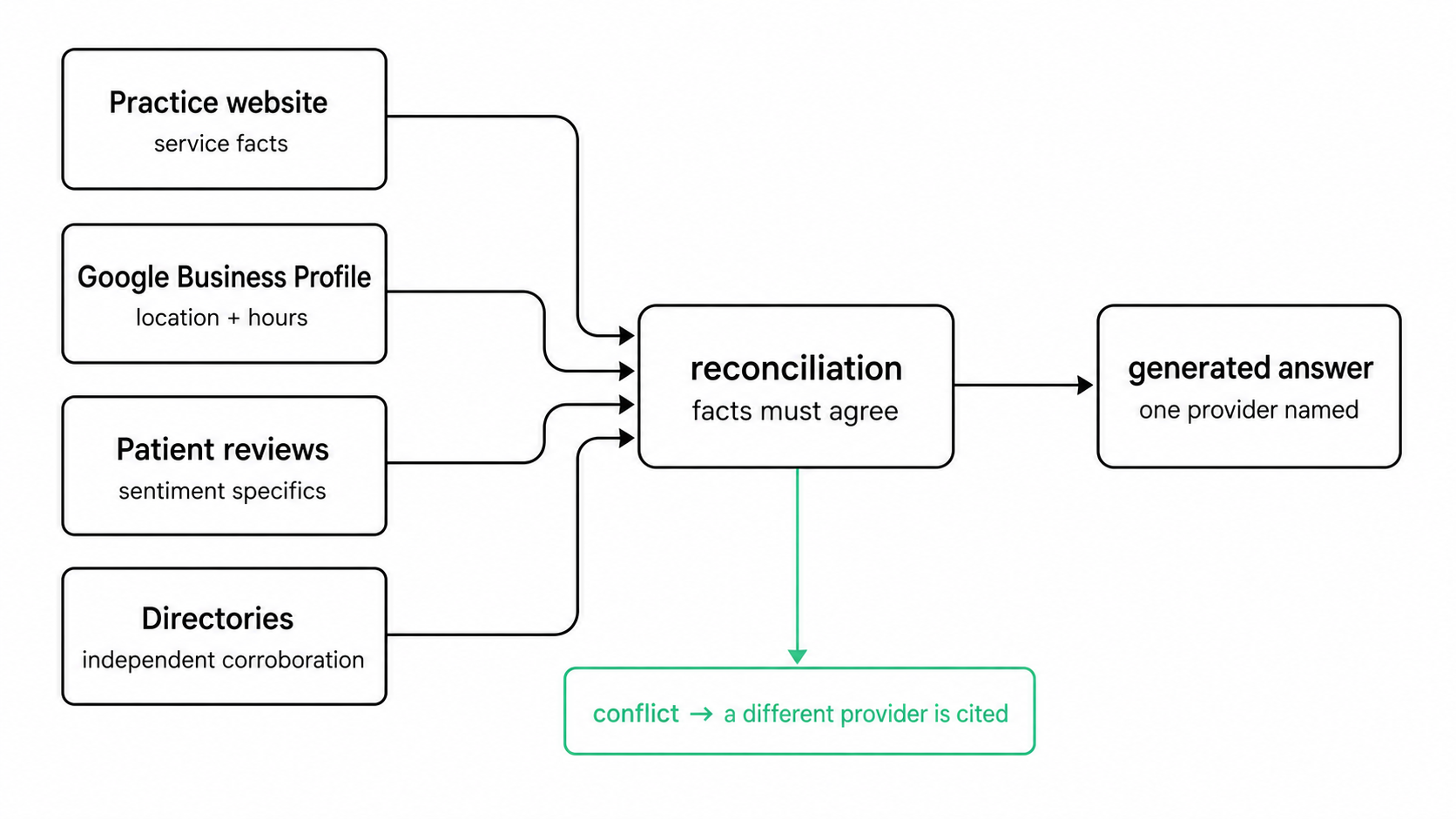
From a small, knowable set of sources. AI assistants assemble provider recommendations from the practice website, the Google Business Profile listing, patient reviews, and healthcare directories — then reconcile them against each other. A physician becomes citable by being consistent across all four, not loud in one.
| Source | What it supplies to the answer | Who controls it | How it fails |
|---|---|---|---|
| Practice website | Services, conditions, locations, physician facts — the text an assistant quotes most directly | You | Thin service pages; facts trapped in images, PDFs, or JavaScript-only widgets |
| Google Business Profile — the listing holding a practice’s name, address, phone, categories, and reviews on Google | Location, hours, categories, proximity; feeds Maps and AI Overviews on local queries | You, once claimed | Unclaimed listing; wrong primary category; addresses that disagree with the site |
| Patient reviews | Sentiment and specifics: wait times, bedside manner, a named procedure | Patients; you control volume and response | Low volume, no recency, no responses — nothing specific to summarize |
| Healthcare directories (Healthgrades, Zocdoc, Vitals) | Independent corroboration that a physician exists, holds a specialty, practices at an address | Partly you (claim and correct listings) | Stale profiles from a previous employer; name variants; retired affiliations |
| Third-party lists and roundups | The ranked shortlists that category answers (“best X in Y”) are assembled from | Nobody, directly | Absence — the most common gap we see |
Google AI Overviews — the AI-generated summary above organic results on many queries — sits on top of Google’s ordinary index: no separate submission, “no special schema.org structured data that you need to add,” and AI-feature traffic reported inside the standard Search Console “Web” search type.
What makes a physician citable?
An assistant cites a source it can parse, trust, and reconcile with other sources. Four properties do most of the work, and all four are verifiable before you publish:
- Answer-first content. Each section opens with a direct, self-contained answer in its first 40–60 words — a sentence that still makes sense when lifted out of the page.
- Consistent physician data everywhere. Identical name, specialty, credentials, and affiliation across the website, Google Business Profile, and every directory. Consistency lets a model resolve mentions to one entity; contradictions get a physician dropped for someone unambiguous.
- A credential-rich bio page. Education, board certifications, hospital affiliations, years in practice, languages spoken — stated plainly, not implied. These are the raw materials of E-E-A-T, Google’s quality framework of experience, expertise, authoritativeness, and trust.
- Physician schema. Structured data labelling the bio page as a
Physician—medicalSpecialty, credentials,worksFor— so machines read the facts instead of inferring them. Useful for parsing; not a documented ranking input.
Why is the bar higher in medicine than in other niches?
Because health is a YMYL topic — Your Money or Your Life, Google’s label for subjects that can significantly affect health, financial stability, or safety. Google states its systems “give even more weight to content that aligns with strong E-E-A-T” on those topics, and that of the four aspects, trust is the most important.
Two measurements make the consequence concrete. Medical queries return an AI Overview 44.1% of the time versus a 20.5% baseline across 146 million SERPs (Ahrefs, November 2025) — twice the average exposure to a generated answer. And the answer absorbs the click: Pew tracked 68,879 Google searches by 900 US adults in March 2025 and found a traditional-result click rate of 8% when an AI summary was present versus 15% when it was not, with source links inside the summary clicked on 1% of visits.
For a practice, the citation is the impression: the shortlist forms inside an answer the practice never sees.
What did we measure? Perplexity, four prompts, August 3, 2026
We ran four buyer-intent prompts from our fixed battery on Perplexity in a clean anonymous session. Rotgar appeared in 0 of 4 answers. The zero was expected; the useful output was the structure of the answers — who gets named, and on whose authority.
| Prompt (verbatim) | What the answer contained | What it cited |
|---|---|---|
| “Best healthcare SEO agencies” | A ranked table of eight agencies, one incumbent at #1 | That agency’s own listicle — ranking itself first, with a self-invented “AI Visibility Score” of 4.9/5 — plus a rival’s list |
| “Who provides generative engine optimization services?” | No brands named on the engine’s own authority; categories only | Third-party listicles and directories (Clutch category pages, DesignRush) |
| “Where can I get an AI visibility audit?” | A list of tools, plus advice to “look for a GEO audit agency” | SE Ranking, Reddit threads (three citations), YouTube, vendor landing pages |
| “What is generative engine optimization?” | A definition plus a comparison table | Heavyweight publishers only: Semrush, Wikipedia, Coursera, Mailchimp |
Three findings transfer to “best [specialty] near me”-type provider questions. Ranked-list answers are assembled from third-party lists, so a practice absent from every roundup and directory in its market is absent from the answer regardless of site quality. Self-published comparative content gets relayed verbatim, invented metrics included. Community threads are a first-class source; Reddit was cited three times in the audit-intent prompt.
Honest framing: a four-prompt pilot on one surface from a European IP address, not a full US-region run across ChatGPT, Gemini, and AI Overviews — those require logged-in manual sessions. The citation rate is provisional; the structural finding, which source types hold the citation slots, is what we act on.
What should a practice fix first?
The first fixes are the ones a working SEO base requires — there is no AI-specific shortcut around them.
- Physician bio pages — one per doctor, with credentials, specialty, affiliations, and
Physicianschema. - FAQ blocks with direct answers — 40–80 words each, on the questions patients ask before booking.
- Service pages with unambiguous wording — one service per page, named the way patients search for it, not the way billing names it.
- Unified NAP data — identical name, address, phone across website, profile, and directories.
| Item | What to state | How to verify | Done when |
|---|---|---|---|
| Physician bio | Name, degree, specialty, board certifications, affiliations, locations | Read the first paragraph alone: does it identify the physician? | One canonical bio URL per doctor, linked from every service page they staff |
| Entity consistency | One spelling of the name; one primary specialty; one address format | Diff the data across site, profile, and top five directories | Zero mismatches; stale employer affiliations removed |
| Google Business Profile | Correct primary category, hours, service list, photos, review responses | Open the listing logged out; compare against the site | Claimed, complete, consistent with the website |
| Structured data | Physician, MedicalClinic, FAQPage matching visible content |
Run each template through a schema validator | Parses without errors; markup matches what a visitor sees |
One constraint is specific to healthcare: under HIPAA, a covered entity needs valid written authorization before using or disclosing protected health information for marketing (45 CFR §164.508) — which covers patient stories and testimonials. Review responses follow the same rule: acknowledge, invite an offline conversation, never confirm that someone is a patient. We work HIPAA-aware; legal sign-off stays with the practice.
This base is also what medical SEO is. Sequencing the whole queue — which locations and service lines go first — is the job of a documented healthcare SEO strategy.
How do you measure AI visibility for a practice?
By prompt testing, not rank tracking. Fix a list of questions a patient would ask, run them in clean logged-out sessions on each surface, and record whether the practice is mentioned, cited with a link, or recommended — plus who was named instead. The score is citation rate: answers naming you, divided by prompts run.
Worked example. A practice builds a battery of 12 prompts: four intents (specialty + city, “best [specialty] near me”, a procedure question, an insurance question) across three surfaces. Named in four answers, its citation rate is 4 ÷ 12 = 33%. Re-run the identical battery next month: 6 ÷ 12 = 50% is a trend; a single reading is noise. Our own pilot scored 0 ÷ 4 = 0% — useful only because the battery is fixed and dated.
What AI SEO will NOT do for a doctor
- Replace the SEO foundation. Healthcare SEO is the process of optimizing a medical organization’s website, Google Business Profile, and online reputation so patients find its providers and services in Google Search, Maps, and AI answers. AI SEO layers on top of it.
- Guarantee a citation. No one outside the model vendors controls which sources an assistant quotes. The work raises the probability of citation; any guarantee of AI placements is a claim nobody can honor.
- Work on inconsistent data. When directories, the profile, and the website disagree about a physician’s name, specialty, or location, AI systems cite a provider whose data agrees with itself.
- Come from special markup. Google is explicit that no AI-specific files, “AI text files,” or schema types are required for AI Overviews or AI Mode.
- Turn a citation into a booking. Being named is the top of the funnel; the profile, the reviews, and the booking flow still decide whether the patient calls.
Key takeaways
- AI SEO for doctors is an overlay on classic SEO: same website, profile, reviews, and directories — a different unit of success, citation instead of position.
- The medical vertical meets AI answers more often than almost any other: 44.1% of medical queries trigger an AI Overview versus a 20.5% baseline (Ahrefs, 146M SERPs).
- Patient behavior has moved: 32% of US adults used an AI chatbot for health information in the past year (KFF, n=1,343, Feb–Mar 2026); 77% worry about the privacy of what they share.
- Nothing needs to be installed. Google requires no special markup for AI features — indexing plus snippet eligibility is the gate.
- Citability comes from four properties: answer-first passages, entity-consistent physician data, credential-rich bios, and
Physicianschema. - Ranked-list answers are assembled from third-party sources. In our August 3, 2026 pilot, “Best healthcare SEO agencies” was answered from two agencies’ own listicles — a practice absent from every list in its market is absent from the answer.
- Measure with a fixed, dated prompt battery and a citation rate (4 ÷ 12 = 33%); a single reading is noise, and no honest provider guarantees a citation.
FAQ: AI SEO for doctors
What is AI SEO for doctors?
AI SEO for doctors is the work of making a physician or practice visible in AI-generated answers — Google AI Overviews, ChatGPT, and Gemini — when patients ask for provider recommendations. It builds on the same assets as classic SEO: the website, Google Business Profile, patient reviews, and directory listings.
How do doctors appear in ChatGPT answers?
ChatGPT assembles provider answers from sources it can retrieve and reconcile: practice websites, review platforms, and directories such as Healthgrades and Zocdoc. A doctor appears when those sources describe the physician consistently — same name, specialty, affiliation — with direct, quotable statements of fact.
Is AI SEO different from regular SEO?
It is an overlay, not a separate discipline. AI answers are built from the same websites, listings, and reviews that regular SEO improves. The difference is emphasis: answer-first formatting, entity-consistent data across sources, structured data machines can parse, and measurement by prompt testing rather than rank tracking.
Can a doctor rank in Google AI Overviews?
AI Overviews cite sources rather than “rank” them. Google states there are no additional requirements or special optimizations to appear — a page must be indexed and eligible to be shown with a snippet. A doctor’s content becomes eligible when it answers the query directly and is corroborated by the practice’s profile and listings.
Do patient reviews affect AI answers?
Yes. Reviews on Google Business Profile and healthcare platforms are among the sources assistants draw on when recommending providers. Volume, recency, and what reviewers say about a physician shape how they are described. Responses must stay HIPAA-aware: never confirm that a reviewer is a patient.
How often should a practice check its AI visibility?
Monthly, on an unchanged prompt list. Answer compositions shift between runs and model versions, so comparability comes from keeping the battery, the wording, and the session conditions identical. Two consecutive readings are the minimum for a trend.