
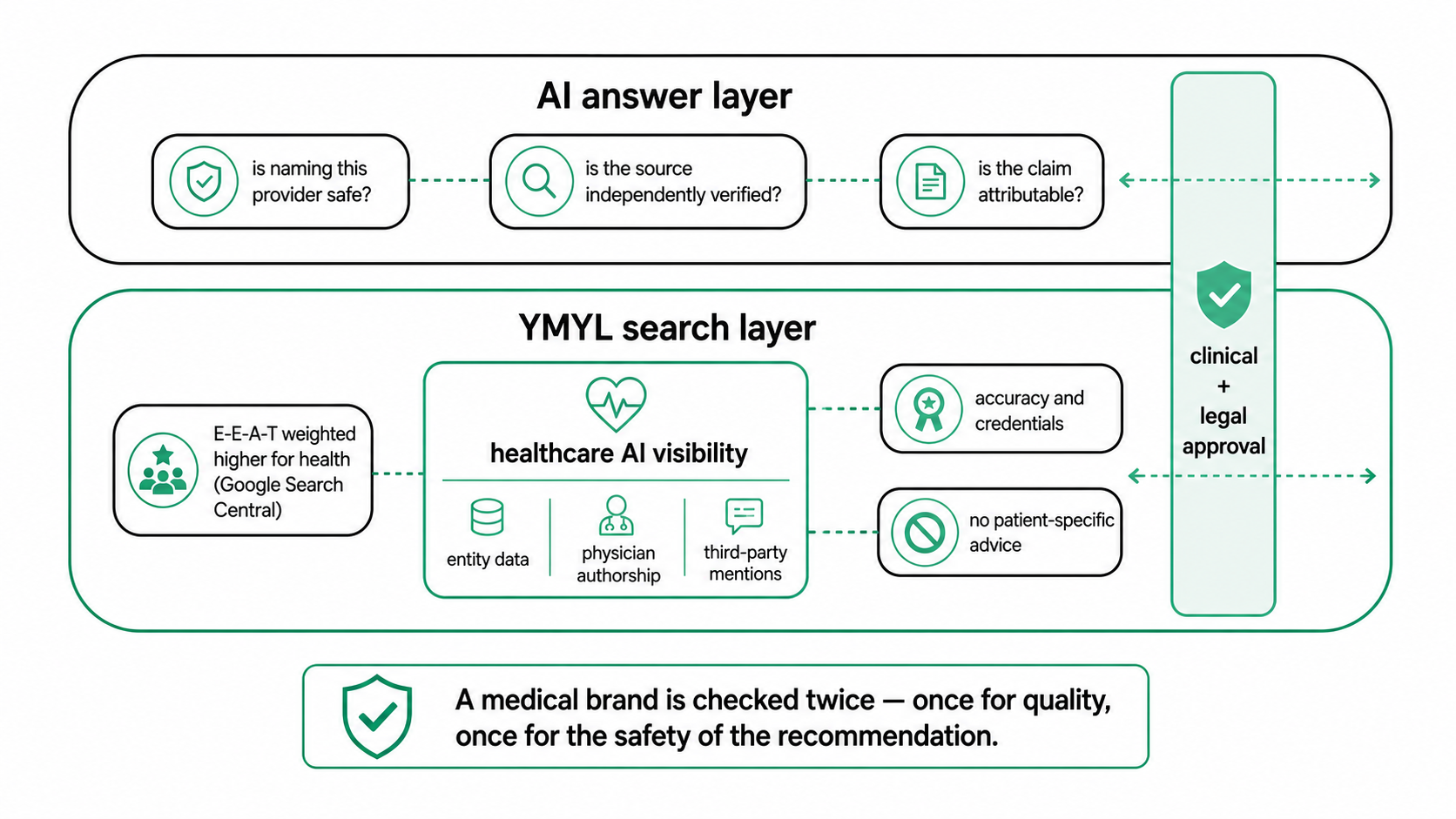
Answer engine optimization (AEO) is the practice of structuring content so answer engines — AI Overviews, voice assistants, chat-based search — can extract a direct, self-contained answer and attribute it to your brand. In healthcare, that discipline runs under stricter rules: AI systems double-check medical brands before citing them.
TL;DR
- 32% of US adults used AI chatbots for health information in the past year — 29% physical health, 16% mental health (KFF Tracking Poll, February–March 2026, n = 1,343).
- Medical brands pass two gates: Google weights E-E-A-T higher for health topics (Search Central), then the answer engine decides whether naming a provider is safe. There is no markup shortcut — “There are no additional requirements to appear in AI Overviews or AI Mode” (Google).
- Our pilot, August 3, 2026: asked “Best healthcare SEO agencies,” Perplexity returned a table of eight agencies built from two agencies’ own listicles — First Page Sage ranked itself #1 with a self-assigned “AI Visibility Score 4.9/5.” Rotgar: 0 of 4 prompts.
- Rules differ by market (HIPAA, GDPR, the UK CAP Code, MOHAP/DHA approval, Health Canada); every clinical claim needs a named clinical owner.
What does answer engine optimization for healthcare mean?
For a medical practice, AEO means being the source AI assistants trust enough to name when a patient asks who to see — across ChatGPT, Gemini, Google AI Overviews, and Perplexity (surface behavior observed July–August 2026). The discipline is general — the same discipline buyers call generative engine optimization. How it plays out in medicine is not: every claim has to survive clinical review before it survives an algorithm. That difference is this page; patient acquisition from AI answers is the outcome it feeds.
Why do AI systems double-check medical answers? (YMYL × AI)
AI platforms treat health queries as high-stakes: a generated medical recommendation carries liability, so source-selection filters are stricter for healthcare than for most verticals (SERP observation, July–August 2026). The practical consequence: entity clarity and E-E-A-T signals decide citations more than keyword coverage does.
Healthcare lives under Google’s YMYL classification — “Your Money or Your Life,” the category for topics that can affect health, finances, or safety. AI answers add a second gate: the brand is checked by the search system applying YMYL standards, then by the answer engine deciding whether naming this clinic is safe. Generic GEO tactics assume one gate.
How is healthcare AI visibility different from general AI visibility?
The mechanics are identical; the tolerances are not. In a low-stakes niche volume offsets a weak trust signal; in medicine a weak signal is disqualifying, and an unowned claim is a liability before it is a ranking problem.
| Dimension | General brand | Healthcare brand |
|---|---|---|
| Quality bar | Standard E-E-A-T | YMYL: E-E-A-T weighted higher for health topics |
| Who may make a claim | The marketing team | A named clinician owns every clinical statement |
| Regulatory layer | Generic advertising law | Market-specific advertising and privacy rules |
| Reviews and testimonials | Free to solicit and republish | No reply may confirm patient status; testimonials need consent |
Who approves the claim in each market?
Answer engines are global; medical advertising rules are not. The same page can be compliant in one market and not in another.
| Market | Rules that touch AI-facing content | Who signs off |
|---|---|---|
| United States | HIPAA — marketing uses of protected health information need written authorization (45 CFR §164.508); FTC health-claim rules | Privacy officer, counsel, physician |
| EU / EEA | GDPR — health data is a special category (Art. 9); national advertising law | Data protection officer, counsel, clinician |
| United Kingdom | CAP Code section 12: marketers “must not discourage essential treatment for conditions for which medical supervision should be sought” (rule 12.2) | The responsible clinician; the ASA adjudicates |
| UAE | Health-advertising approval from MOHAP (and DHA in Dubai) before publication | Health authority permit; medical director |
| Canada | Food and Drugs Act advertising rules, Health Canada oversight, provincial college standards | The regulated professional and the college |
An orientation map for planning, not legal advice: rules vary by state, province, and emirate.
Which signals decide whether AI cites a clinic?
Four signals do most of the work; healthcare changes their weight, not their nature.
| Signal | Why it weighs more in healthcare |
|---|---|
| Entity consistency | Practice, provider, and knowledge-graph data must match everywhere |
| Physician authorship | Credentialed bylines survive YMYL review; anonymous copy does not |
| Reviews and reputation | Assistants cross-check patient sentiment before naming a practice |
| Third-party mentions | Directories, registries, and press are independent verification |
Book a 30-minute call — one clinic or selected location, one priority market and one patient language.
What do patients actually ask AI — and what must the clinic have?
Patient prompts are rarely “best clinic near me.” They ask about price, eligibility, outcomes and recovery — and each type is answered from a different source (our observations, July–August 2026).
| Vertical and typical patient prompt | Question type | What AI answers today | What the clinic needs to be in that answer |
|---|---|---|---|
| Dental — “How much does a dental implant cost?” | Price and scope | Ranges from directories and insurer pages | A dated, clinician-reviewed price-range page stating what is included |
| Fertility / IVF — “What are IVF success rates?” | Outcome data | Registry data; clinic sites rarely cited | An outcome page naming the registry, cohort, period, and method |
| Plastic surgery — “Who does rhinoplasty, and how do I check credentials?” | Provider selection | Surgeons pulled from directories, reviews, press | Surgeon-level entity data: credentials, consistent profiles, legal advertising |
| Dermatology — “Is this treatment suitable for my condition?” | Eligibility and safety | A cautious explanation plus “see a professional” | Physician-reviewed explainers that defer diagnosis to a consultation |
The competition is encyclopedic sources, not only the practice down the road, so the winnable slot is the specific one: your ranges, your protocol, your outcomes, your clinicians. None of it lands without the entity layer — see our method for AI visibility measurement.
Who does AI recommend to your patients? Our own measurement
On August 3, 2026 we ran the first pilot of our fixed prompt battery on Perplexity in a clean anonymous session. Rotgar was named in 0 of 4 answers — the expected zero point. What matters is who occupied the answers instead.
| Prompt (verbatim) | Rotgar named | Who appeared instead | Sources cited |
|---|---|---|---|
| “Best healthcare SEO agencies” | No | A ranked table of eight: First Page Sage (#1), Intrepy, Cardinal, Focus Digital, REQ, Healthcare Success, k2md, Media Cause | First Page Sage’s own listicle, ranking itself #1 with a self-assigned “AI Visibility Score 4.9/5,” and Intrepy’s own listicle |
| “Where can I get an AI visibility audit?” | No | Tool vendors with free-audit pages | SE Ranking, Reddit threads, YouTube |
| “Who provides generative engine optimization services?” | No | No brands named | Clutch, DesignRush, agency blogs |
The healthcare row is the one clinic owners should read twice. Its patient-facing equivalent — “best dental implant clinics in Boston,” “top fertility clinics” — works the same way: the engine does not evaluate providers, it relays a list somebody else published. Here that list was written by an agency ranking itself first, with an invented metric passed along as data.
So the sources deciding whether AI recommends you are mostly not on your website: directories, review platforms, health portals, roundups. Your site is the entry ticket; presence in those sources puts you in the answer. Run your own prompts verbatim in a clean session and record who was named instead — the method is on our AI visibility score page. Caveat: four B2B prompts (three shown; the fourth, a definition query, returned Semrush and Wikipedia), one surface, a European IP. The structure transfers, not the numbers.
What evidence do we have from medical search work? (client-reported)
A healthcare organization in Oklahoma reported 30% more new patients contacting the office after finding the website through Google Search — read the client-reported case. A Boston dental practice reported substantial growth in keyword visibility and leads — read the case. Those are search results: they prove the specialization, not AI citations. The original published protocol specifies a fixed set of 16 buyer-intent prompts tested monthly across Google AI Overviews, ChatGPT, Gemini, and Perplexity, scored by citation rate.
How do HIPAA-aware review and content workflows work?
Reviews are citation fuel and a compliance trap at once. Replying in a way that confirms someone is a patient, or building content around patient stories without documented consent, creates exposure no marketing win justifies. We build HIPAA-aware workflows for reviews and content; legal review stays with your counsel. It is an AI-visibility issue too: practices that handle reviews carelessly usually stop handling them at all, and a silent profile is a weak citation signal.
What answer engine optimization will NOT do for a practice
- It will not guarantee a citation. No one controls generated answers (August 2026) — we control the signals and measure the outcome.
- It will not compensate for thin credentials. Anonymous content, stale provider data, or a neglected review profile caps results regardless of tactics.
- It will not replace medical and legal review, or be solved by markup. Clinical claims need physician sign-off, compliance stays with your counsel, and structured data only disambiguates the entity.
When AEO is premature for a practice
If entity data contradicts itself, if reviews have not come in for months, or if the site is technically unreadable, the foundation comes first — start from our answer engine optimization services page, or, if you are choosing a partner, our GEO agency page.
How does Rotgar run AEO for healthcare?
Rotgar works exclusively with clinics on AI visibility in Google AI Overviews, ChatGPT, and Gemini.
- Entity audit. Practice and provider data across the web and the knowledge graph.
- Baseline measurement. Your market’s prompts in Google AI Overviews, ChatGPT, and Gemini, your citation rate — plus who is named instead of you.
- Content and structure. Answer-first pages with physician authorship and dated review lines; clinical statements go to your clinicians first.
- Third-party layer. Presence in the directories and roundups engines cite, plus HIPAA-aware review workflows.
- Monthly re-measurement of citation rate against the baseline.
For a vertical example, see AI visibility for dental practices; for the vocabulary, what generative engine optimization is.
Key takeaways
- Healthcare AI visibility is the general discipline at tighter tolerances: two quality gates, and a clinical owner for every claim.
- Demand exists now — 32% of US adults used AI chatbots for health information in the past year (KFF, February–March 2026).
- The answer a patient sees is usually assembled from third-party lists — our pilot showed Perplexity’s agency ranking sourced from two agencies’ own listicles, self-assigned score included.
- Because self-published rankings travel, transparency is the durable position: publish outcome data with its source, cohort, and date.
- Compliance and visibility are one workflow, and it starts with a measured baseline: zero is normal, and the competitors named instead of you are the roadmap. No markup shortcut exists.
FAQ: answer engine optimization for healthcare
How is healthcare AEO different from traditional medical SEO?
The foundation is shared: site health, authority, content. AEO adds passage-level structure, entity engineering, and prompt-level measurement aimed at generated answers rather than ranked links. Our guide on AI SEO for doctors covers the doctor-specific angle.
Can ChatGPT or Gemini recommend a specific doctor or clinic?
Yes — assistants do name specific providers for some queries, and they are cautious about it (observed July–August 2026). Being named depends on the signals this page covers: entity clarity, credentials, reviews, third-party verification. Nobody can guarantee the mention.
Do patient reviews affect whether AI cites a practice?
In our client work and SERP observations (August 2026), yes — reviews are among the strongest third-party verification signals AI systems check before naming a practice. Fresh, steady, professionally handled reviews beat a stale average.
Is AI search optimization HIPAA compliant?
The work itself — entity signals, content structure, measurement — touches no patient data. The sensitive layer is reviews and testimonials, which we run through HIPAA-aware workflows: no confirming patient status, no patient data in content. Legal review stays with your counsel.
How long does it take for a practice to appear in AI answers?
It depends on the starting point: practices with clean entity data and an active review flow move faster than those needing foundation work. Movement is measured in months and tracked against a baseline from the first month.
Do AI assistants name your practice — or the one across the street?
An AI Visibility Audit starts with one clinic or selected location, one priority market and one patient language. It shows current visibility in Google AI Overviews, ChatGPT, and Gemini, plus competitor gaps and prioritized fixes.
Book a 30-minute call · Rated 5.0 on Clutch (26 verified reviews)