
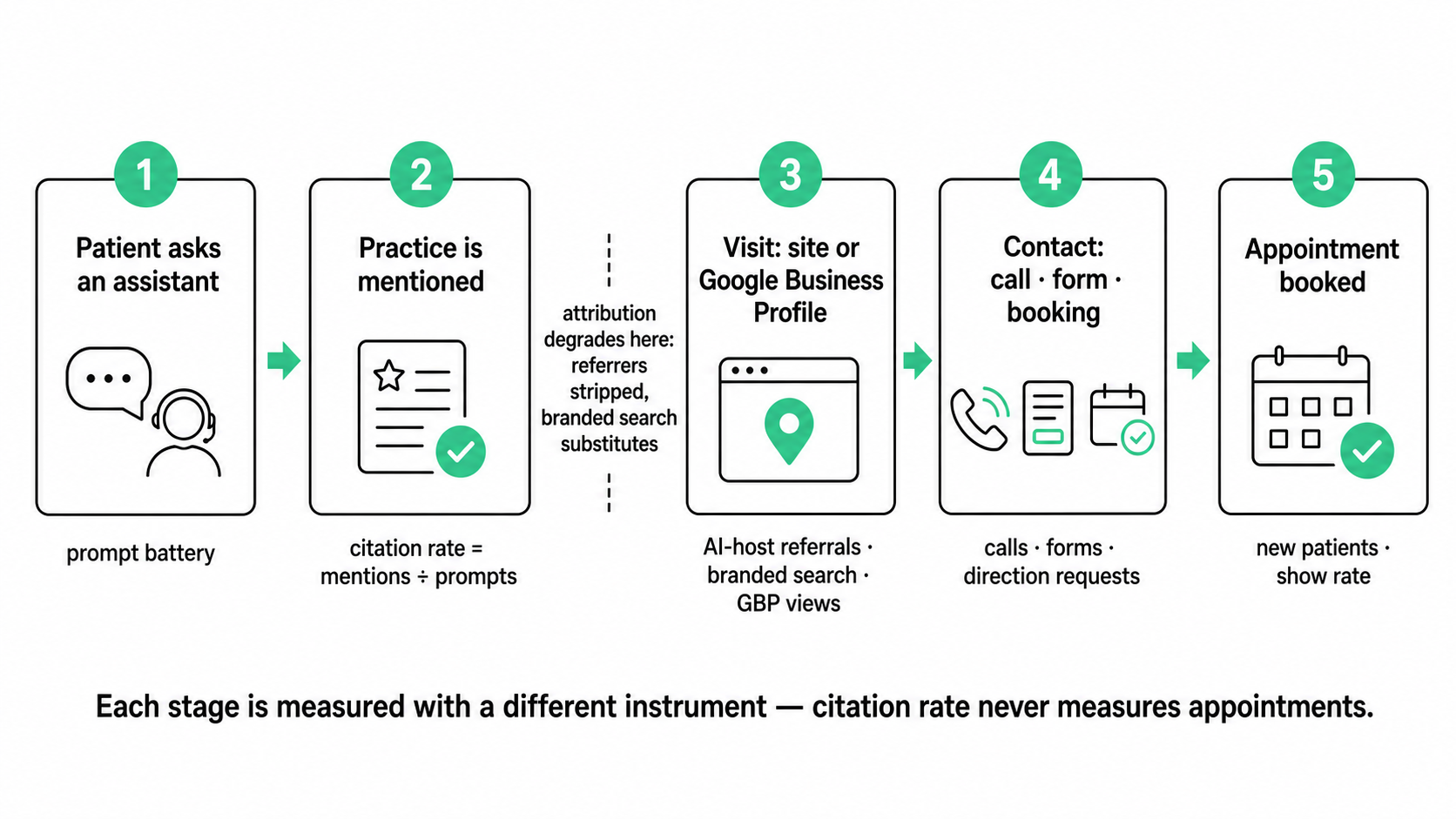
Patient acquisition is the system of channels that turns a person with a health problem into a booked appointment. AI-driven patient acquisition is the part that begins inside an AI answer: a patient asks ChatGPT or Gemini, your practice is named — and the booking still happens on your site, your Google Business Profile, or your phone.
TL;DR
- An AI mention is a leading signal, not a conversion. The business path continues off the assistant — on the clinic’s page or Google Business Profile, through a call, form, or booking widget. That is where acquisition is counted.
- 32% of US adults turned to AI chatbots for health information in the past year, 29% for physical-health questions (KFF, fielded February 24 – March 2, 2026, n=1,343).
- Being inside the answer beats being a link under it: with an AI summary present, users clicked a result in 8% of visits versus 15% without (Pew, 68,879 searches, March 2025).
- In our own pilot (Perplexity, August 3, 2026), category-level answers named no individual practices at all — they reproduced listicles, directories, tools, and Reddit threads. Practice names enter later, at local and offer-level prompts.
- Traffic that does arrive is pre-qualified: the average AI search visitor is estimated at 4.4× the value of an organic visitor (Semrush, 2025). Direction, not a guarantee.
How does AI visibility turn into patient acquisition?
AI visibility is the degree to which AI assistants and AI search features mention, cite, or recommend a brand in generated answers — measured by citation rate across a fixed set of prompts and platforms. It converts to patients through a chain, not a jump: question → mention → visit → contact → booked appointment. Each link needs its own instrument.
| Stage | What happens | What we measure | Instrument |
|---|---|---|---|
| 1. Patient asks | Someone describes a symptom, procedure, or need to ChatGPT, Gemini, Perplexity, or AI Overviews | Which prompts the market produces; commercial vs research intent | Fixed prompt battery, per specialty and city |
| 2. Practice is mentioned | The assistant names or cites your practice | Citation rate: prompts with a mention ÷ total prompts | Monthly runs, clean sessions, 4 surfaces |
| 3. Patient moves off the assistant | A cited link, a Business Profile tap, or a branded search | AI-host referrals; branded search; GBP views | GA4, Search Console, GBP Insights |
| 4. Patient contacts you | Phone call, form, chat, or booking widget | Calls, forms, direction requests | Call tracking, form events, GBP actions |
| 5. Appointment is booked | Front desk or scheduler converts the inquiry | New patients, show rate, revenue per patient | Practice management system |
Two properties of the chain shape the plan. Attribution degrades between stages 2 and 3: assistants strip referrers inconsistently, and a patient who reads your name in ChatGPT then Googles it arrives as branded organic traffic. And stages 4 and 5 are not marketing — they belong to the front desk. A practice that wins stage 2 and loses stage 4 has bought expensive silence.
Which patient prompts carry commercial intent, and which are research?
Most health prompts are research: patients describe symptoms and want to understand them. A minority are commercial: patients ask who to see, where, and how to choose. Only the commercial layer produces named practices — which is why a battery built on symptom questions shows a flat zero forever, however good the work is.
| Prompt type | Medical example | Intent | Practice named? |
|---|---|---|---|
| Symptom / condition | “Why does my jaw click when I chew?” | Research | Almost never — publisher sources |
| Procedure / treatment | “How long do dental implants last?” | Research, pre-decision | Rarely — clinical bodies, guides |
| Provider selection | “How do I choose a fertility clinic?” | Commercial-informational | Sometimes — criteria lists |
| Local recommendation | “Best implant clinic in Dallas” | Commercial | Frequently — the money layer |
| Offer / access | “Which clinics offer a free consult?” | Commercial, high-intent | Frequently — offer pages, directories |
| Brand check | “Is [practice name] a good clinic?” | Navigational | Always — sentiment beats presence |
Build the battery from the bottom four rows; track the top two only as topical-authority context. Our page on AI visibility measurement covers assembling and freezing a battery; the AI visibility score explains the arithmetic behind the number.
Where do practices actually appear? What our own measurement showed
On August 3, 2026 we ran a pilot of our fixed prompt battery on Perplexity in a clean anonymous session. The structural finding matters more than our zero: in category-level answers the assistant named no providers on its own authority. It relayed third-party lists.
| Prompt (verbatim) | What the answer contained | What it cited |
|---|---|---|
| “Who provides generative engine optimization services?” | Categories and criteria — no brands in the answer body | Directories and listicles: Clutch’s category page, DesignRush, agency roundups |
| “Where can I get an AI visibility audit?” | Named tools and free-audit products | Tool vendors, Reddit threads (cited three times), YouTube |
| “Best healthcare SEO agencies” | A table of eight agencies | Two agencies’ own self-published listicles, one ranking itself #1 |
| “What is generative engine optimization?” | A definition plus a comparison table | Heavyweight publishers only: Semrush, Wikipedia, Coursera |
Read the third row again: the “best provider” answer was assembled from other people’s lists, not the providers’ own websites. This matches Ahrefs’ study of 75,000 brands: branded web mentions correlate with AI Overview visibility at 0.664 (Spearman) versus 0.218 for backlinks — a ~3× gap.
For a practice, the to-do list is not “publish more blog posts”: be present and accurate in the directories and roundups your specialty is judged by, keep the Business Profile complete, and give assistants an unambiguous entity to attach a recommendation to. Caveats: four prompts, one surface, a European IP — a zero point, not a benchmark. The pattern of who gets cited held across all four.
What moves a practice from “mentioned” to “recommended”?
A mention says the assistant knows you exist; a recommendation says it will stake an answer on you. The difference is carried by verifiable third-party signals — the ones a cautious human would check — plus enough on-site clarity to state what you do, where, and for whom without guessing.
| Signal | Why it moves the needle | Owner |
|---|---|---|
| Consistent entity data across site, Business Profile, directories | Contradictions make an assistant hedge, not recommend | Practice + agency |
| Third-party mentions in directories, roundups, local press | What assistants actually cite in provider questions (our pilot; Ahrefs 0.664) | Agency + PR |
| Reviews at volume and recency on Google and specialty platforms | Supplies the “why this one” clause | Practice ops |
| Practitioner credentials as content — bios, licenses, affiliations | Medical answers pass a stricter trust gate: AEO for healthcare | Practice + agency |
| Answer-first service pages stating price, eligibility, process | Extractable facts instead of brochure prose | Agency |
| A complete Google Business Profile | Google’s guidance: keep Business Profile information current (Search Central) | Practice |
Google states plainly that there are no additional requirements or special optimizations to appear in AI Overviews or AI Mode. Nobody can sell a shortcut, because none exists — only ordinary discoverability done thoroughly, which is what our generative engine optimization agency page offers as a service.
Does an AI mention actually produce patients?
Honestly: it points in the right direction and does not guarantee an appointment. The measurable chain thins between the answer and the phone call, so we treat AI visibility as a leading indicator validated against practice-level outcomes — calls, forms, booked appointments — not as a channel that reports its own conversions.
Two numbers define the frame. Pew’s analysis of 68,879 searches found AI summaries reduce clicking (8% of visits produced a result click with a summary present, versus 15% without). Google reports the clicks that do arrive from AI Overview pages are higher quality, with users spending more time on the site. Fewer clicks, better clicks: counting sessions understates the channel; counting them as patients overstates it.
What we can point to with a name attached is the search path itself converting. A healthcare organization in Oklahoma reported 30% more new patients contacting the office after finding the website through Google Search, following technical SEO, service-page, and content work — client-reported. Read the case. We cite it for what it is: evidence that the search-to-appointment path converts for a medical organization, through a Google channel. It is not an AI-attributed result and we do not present it as one. Rated 5.0 on Clutch across 26 verified reviews.
When is AI-driven patient acquisition premature for a practice?
- No search foundation. If the site barely indexes or the Business Profile is incomplete, an assistant has no raw material to cite.
- Operational leaks. If the front desk misses calls or the next opening is six weeks out, more demand accelerates the loss.
- No baseline. Without a first measurement on a frozen prompt set, later “growth” is unfalsifiable.
- A research-only battery. Symptom questions produce a permanent zero — practices are not named at that layer.
- Expecting guarantees. Guaranteed citations do not exist; AI answers are stochastic and vary between runs (August 2026).
What AI-driven patient acquisition will NOT do: fix a broken front desk, manufacture demand your market does not have, or report a clean cost-per-patient the way a paid channel does.
How does Rotgar run AI-driven patient acquisition?
Rotgar works exclusively with clinics on AI visibility in Google AI Overviews, ChatGPT, and Gemini.
- Prompt battery for your market. Real patient phrasings for your specialty and city, weighted toward the commercial layers above.
- Baseline measurement. The original published protocol specifies a fixed set of 16 buyer-intent prompts tested monthly across Google AI Overviews, ChatGPT, Gemini, and Perplexity, scored by citation rate.
- Gap map. Who gets recommended instead of you, and which sources those answers are built from.
- Implementation. Entity consistency, third-party presence, credential-backed content, answer-first service pages, Business Profile hygiene.
- Monthly re-measurement plus outcome check. Citation rate against baseline and — separately — calls, forms, and appointments from the practice’s own systems.
The service layer this page sits under: AI search optimization for medical practices.
Key takeaways
- Patient acquisition through AI is a chain — question, mention, visit, contact, booking — each link with its own instrument. Citation rate measures link two; only the practice management system measures link five.
- An AI mention is a leading signal. Validate it against calls and appointments; never report it as a conversion.
- Prompt intent decides everything: local, offer, and provider-selection prompts name practices; symptom and procedure prompts do not.
- Provider-level answers are assembled from third-party sources. Our pilot found category answers naming nobody and citing directories, listicles, and Reddit; Ahrefs puts brand mentions at ~3× the correlation of backlinks.
- Demand at the top of the chain is real: 32% of US adults used AI chatbots for health information in the past year (KFF, March 2026).
- Fewer clicks, better clicks: AI summaries roughly halve result clicks (Pew), while AI-sourced visitors are estimated at 4.4× an organic visitor’s value (Semrush).
- There is no AI markup and no shortcut (Google, August 2026) — only entity clarity, third-party presence, credentials, and a complete Business Profile.
FAQ
How do AI mentions turn into new patients?
Through a chain: a patient asks an assistant, your practice is named, the patient moves to your site or Business Profile, then calls or books. The assistant books nobody. Measure citation rate at the mention stage and calls or appointments at the outcome stage, then compare trends.
Can you attribute booked appointments to ChatGPT or Gemini?
Rarely and imperfectly. Assistants pass referrer data inconsistently, and many patients read your name in an AI answer then search for it directly, arriving as branded traffic. The workable approach is triangulation: citation rate, branded search, AI-host referrals, and appointments moving together.
Which patient questions actually name a clinic in AI answers?
Local recommendation prompts (“best implant clinic in Dallas”), offer prompts (“who offers a free consultation near me”), provider-selection prompts, and brand checks. Symptom and procedure questions almost never name practices — those answers cite clinical bodies and publishers (August 2026).
Do patients trust AI answers about doctors?
Partly. KFF’s poll found 32% of US adults used AI chatbots for health information in the past year, while 77% are concerned about the privacy of medical details shared with AI tools (February–March 2026). Trust signals inside the answer — credentials, reviews, recognizable sources — carry disproportionate weight.
How much does a patient acquisition strategy cost?
It depends on your market, specialty, and starting point. As a reference, Rotgar’s engagements run on retainers from $1,000 per month, scoped after an AI Visibility Audit.
Want to know whether AI assistants name your practice?
An AI Visibility Audit starts with one clinic or selected location, one priority market and one patient language. It shows current visibility in Google AI Overviews, ChatGPT, and Gemini, plus competitor gaps and prioritized fixes.
Book a 30-minute call · Rated 5.0 on Clutch (26 verified reviews)