
TL;DR
- A generative engine optimization agency makes a brand citable inside AI-generated answers — ChatGPT, Gemini, Google AI Overviews, Perplexity — and measures whether the brand is actually named, prompt by prompt. The same service is sold as an answer engine optimization agency, an LLM SEO agency, or an AI search optimization agency.
- The discipline has a published research basis: “GEO: Generative Engine Optimization” (Aggarwal et al., KDD 2024) reported visibility gains of up to 40% in generative engine responses from content-side changes, varying by domain.
- No agency can sell placement. Google states there are “no additional requirements to appear in AI Overviews or AI Mode, nor other special optimizations necessary” — so a guaranteed-citation promise is a promise about something nobody controls.
- Across the “GEO agency” keyword cluster, the results are generalist SEO shops, offshore contractors, and self-published “best agencies” listicles — not one GEO agency with a healthcare focus (SERP observation, July 2026).
- Our pilot measurement (Perplexity, August 3, 2026) on the prompt “Who provides GEO services?” returned no brand names at all — only directories and listicles as sources (Clutch’s GEO category, DesignRush, and others). Ask an AI assistant for a GEO agency and you are reading a directory, not a recommendation.
A generative engine optimization agency makes your organization visible, trusted, and citable in AI-generated answers — ChatGPT, Gemini, Google AI Overviews, Perplexity. Rotgar is a GEO agency specialized in healthcare: we build AI visibility for medical and dental practices and measure it monthly, prompt by prompt.
Buyers call the same discipline answer engine optimization (AEO), LLM SEO, or AI search optimization — the work is identical: making a brand easy for AI systems to understand, trust, and cite.
What does a generative engine optimization agency do?
Generative engine optimization (GEO) is the practice of making a brand’s website, content, and entity signals easy for AI systems — ChatGPT, Gemini, Google AI Overviews — to understand, trust, and cite in generated answers. An agency doing this work operates by surface: which AI systems your buyers use, what each one reads, and which signals make it confident enough to name you.
That is a wider job than “SEO with a new name,” and a narrower one than the pitch decks suggest. It adds entity engineering, passage-level content structure, third-party citation building, and prompt-level measurement on top of the classic search foundation — but no private channel into the models. Google’s documentation is explicit: standard SEO fundamentals are the guidance for AI features, and no new machine-readable files or AI-specific markup are required.
Why a separate service exists at all: Ahrefs, comparing 150,000 keywords with AI Overviews against 150,000 without (March 2024 vs March 2025), found a 34.5% lower average click-through rate for the top-ranking page when an AI Overview was present. Semrush’s AI search study (July 2025, 500+ topics) adds the other half: the average AI search visitor converted at 4.4x the rate of a traditional organic visitor, and ChatGPT cited pages ranking in position 21 or lower roughly 90% of the time. Fewer clicks, better-qualified ones, and a citation pool that is not the classic top ten.
For the full service scope in the medical vertical, see our generative engine optimization services; for the discipline without the sales layer, what generative engine optimization is.
What types of GEO providers are there?
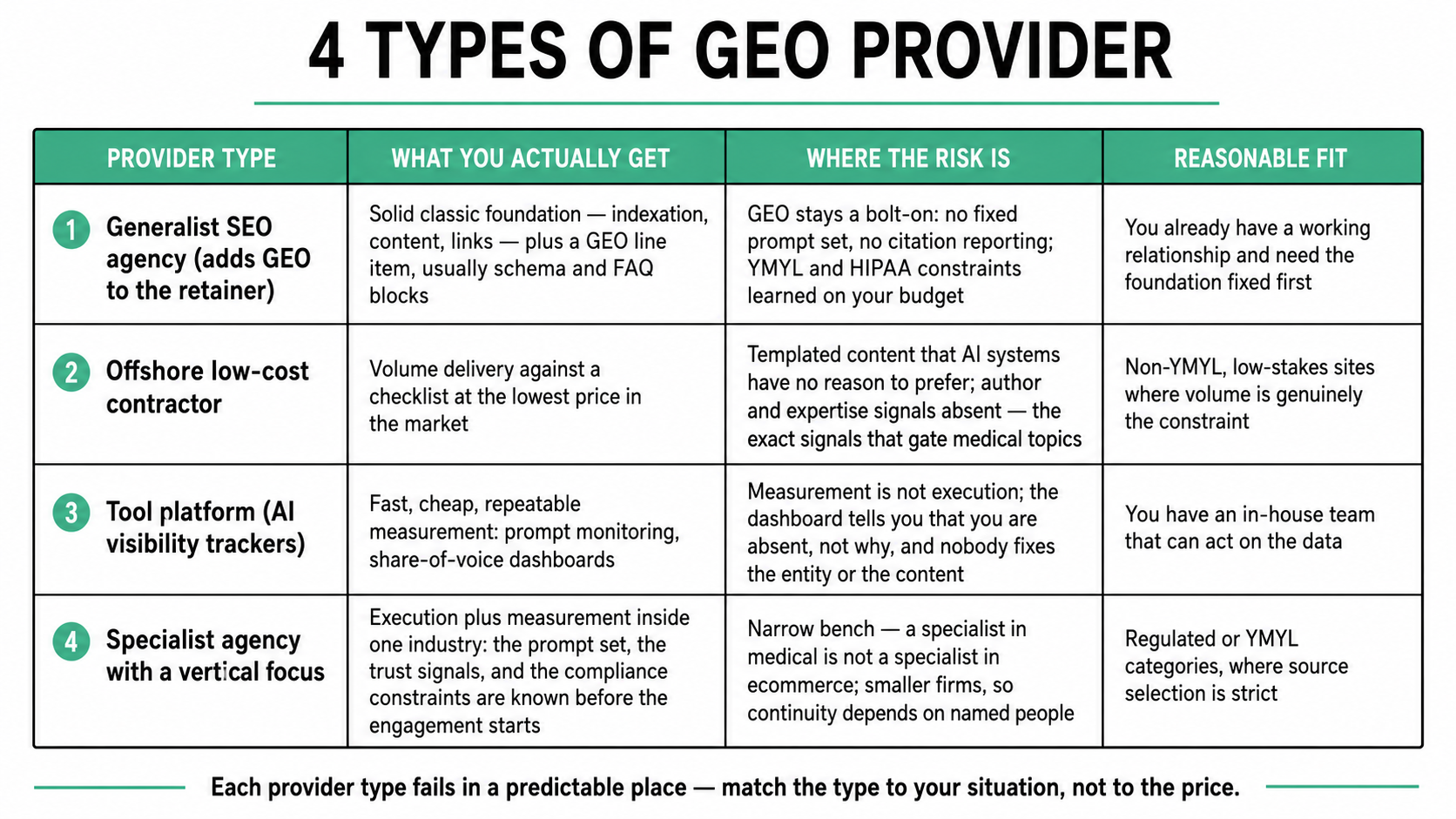
Four kinds of provider sell GEO today, and they are not variations of one offer. A generalist SEO agency adds it to an existing retainer; an offshore contractor sells volume against a checklist; a tool platform sells measurement without execution; a vertical specialist sells fewer things to fewer industries.
| Provider type | What you actually get | Where the risk is | Reasonable fit |
|---|---|---|---|
| Generalist SEO agency (adds GEO to the retainer) | Solid classic foundation — indexation, content, links — plus a GEO line item, usually schema and FAQ blocks | GEO stays a bolt-on: no fixed prompt set, no citation reporting; YMYL and HIPAA constraints learned on your budget | You already have a working relationship and need the foundation fixed first |
| Offshore low-cost contractor | Volume delivery against a checklist at the lowest price in the market | Templated content that AI systems have no reason to prefer; author and expertise signals absent — the exact signals that gate medical topics | Non-YMYL, low-stakes sites where volume is genuinely the constraint |
| Tool platform (AI visibility trackers) | Fast, cheap, repeatable measurement: prompt monitoring, share-of-voice dashboards | Measurement is not execution; the dashboard tells you that you are absent, not why, and nobody fixes the entity or the content | You have an in-house team that can act on the data |
| Specialist agency with a vertical focus | Execution plus measurement inside one industry: the prompt set, the trust signals, and the compliance constraints are known before the engagement starts | Narrow bench — a specialist in medical is not a specialist in ecommerce; smaller firms, so continuity depends on named people | Regulated or YMYL categories, where source selection is strict |
The market is thin in one specific place. Across the agency keyword cluster we tracked, the top results were generalist agency landing pages, offshore providers, and self-published listicles — with no GEO agency positioned on healthcare (SERP observation, July 2026).
What should a GEO engagement include?
A GEO engagement should produce six things you can inspect: a measured baseline, corrected entity signals, restructured answer-first content, valid structured data, third-party citations, and a monthly report scored by citation rate. A proposal whose line items do not map onto that list is a content retainer wearing a new label.
| Work | Deliverable you receive | How to verify it happened |
|---|---|---|
| Baseline measurement | Fixed prompt set (documented, not ad hoc) with the current citation rate per surface | You can re-run any prompt yourself in a clean session and get a comparable answer |
| Entity and knowledge-graph signals | Consistent organization, location, and practitioner data across site, profiles, and directories | Search your brand name; the entity panel and profile data agree with the site |
| Answer-first content structure | Question-shaped headings with self-contained 40–60-word answers; comparison tables | Copy any section out of context — it still answers the question |
| Structured data | Valid schema (Organization, Physician, Service, FAQPage) deployed, not just recommended | Rich Results Test and Search Console enhancement reports pass |
| Third-party citations | Presence in the directories, listicles, and community threads AI answers actually cite | The citation list of a real AI answer for your category includes those sources |
| Technical crawler access | Crawlers not blocked; pages indexed and snippet-eligible | Server logs and robots rules reviewed; pages appear in Search with snippets |
| Monthly reporting | Citation rate per surface against baseline, plus rankings, calls, and booked appointments | Same prompts, same method, month over month — the numbers are comparable |
Note the last column: every row is verifiable without trusting the agency’s dashboard. In a market where nobody can guarantee the outcome, the only defensible promise is a process you can audit.
How do you choose a GEO agency?
Judge the process, not the claims. Most “best AI SEO agencies” lists are written by agencies about themselves. Instead of ranking anyone, here are six criteria applicable to any candidate, including us.
| Criterion | What to ask | Red flag |
|---|---|---|
| Measurement discipline | “Show me your fixed prompt set and how you score citation rate month to month.” | “We track traffic growth” instead of citation metrics |
| Platform-specific mechanics | “What exactly do you do differently for AI Overviews vs ChatGPT?” | “We optimize for all AI at once,” with no per-surface detail |
| Entity and structured data competence | “How do you handle knowledge graph consistency and schema?” | The conversation is only about “content” |
| Industry specialization | “What changes in your process for a YMYL niche like healthcare?” | The same pitch for an ecommerce store and a clinic |
| Honest limitations | “What can you not guarantee?” | “We guarantee placement in ChatGPT answers” |
| Verifiable evidence | “Where are your reviews and case outcomes published?” | Cases with no source, no date, no client attribution |
An agency that survives these six rows is worth a call. One that fails row five is telling you in advance how the engagement will end.
What does our own measurement say about finding an agency?
It says the shortlist an AI assistant gives you is a directory, not a judgment. On August 3, 2026 we ran the first live slice of our fixed prompt battery on Perplexity (clean session, English). On the category prompt “Who provides GEO services?” the answer named no brands at all — it described service categories and cited listicles and directories: Clutch’s GEO category, DesignRush, and a set of agency blogs.
Three practical conclusions for a buyer:
- Being listed is not being vetted. The names an assistant surfaces are the names in the directories it cites — an off-page marketing outcome, not a quality signal. Apply the six criteria yourself.
- Self-published rankings leak into AI answers. On a related vertical prompt, Perplexity reproduced an agency’s own “best agencies” listicle — that agency at #1, complete with a self-invented score. Treat any ranked list as a source with an author.
- Ask an agency for its own measurement, not its boast. Our citation rate at the pilot was 0/4: the honest zero point of a site whose AI-search content had just been published. The value of a baseline is the delta on re-measurement, and we publish ours either way.
Why does healthcare need a specialized GEO agency?
In healthcare, AI visibility is gated by trust twice: the answer engine must trust the source, and the source must survive Google’s YMYL standards. Healthcare is a YMYL category — “Your Money or Your Life,” topics that can affect a person’s health — and across the medical queries we track (SERP observation, July 2026), AI systems are measurably more selective about medical sources than about most other topics.
Practically, that raises the entry ticket: physician-level E-E-A-T signals, named authorship with verifiable credentials, claims that survive a fact check, HIPAA-aware handling of reviews and patient-adjacent content. It also removes options a generalist uses by default — patient testimonials as content fuel, medical advice written for engagement, aggressive claim language. A generalist agency learns these constraints on your budget. The vertical mechanics are covered on AI search for healthcare organizations.
When do you NOT need a GEO agency yet?
A GEO agency is premature when the search foundation is missing: if your practice barely exists in Google Search and Maps, AI assistants have nothing to cite. Fix the foundation first — AI visibility compounds on top of it. Three situations where we will tell you to wait:
- No search foundation. The site barely indexes, the Google Business Profile is incomplete. Classic search work comes first, and it is cheaper.
- Operations cannot absorb patients. If calls go unanswered, visibility only accelerates the leak.
- Your patients do not use AI search for this decision yet. An empirical question — the audit tests your market’s actual prompts rather than assuming.
To test the foundation yourself before paying anyone, use our AI search optimization guide and the AI visibility score method — the same checklists we work from.
How do we measure AI visibility?
The original published protocol specifies a fixed set of 16 buyer-intent prompts tested monthly across Google AI Overviews, ChatGPT, Gemini, and Perplexity, scored by citation rate. The prompt universe is fixed at the start of the engagement, the measurement runs monthly in clean sessions, and the score is citation rate — the share of prompts where your brand is named.
Fixing the prompts is what makes the number honest: a moving prompt set can always be made to show improvement. The full protocol is published on our page about how we measure AI visibility.
How does Rotgar work as your GEO agency?
Rotgar works exclusively with clinics on AI visibility in Google AI Overviews, ChatGPT, and Gemini. Rated 5.0 on Clutch across 26 verified reviews. The engagement runs in five stages:
- Surface audit. Where your practice appears — and disappears — in Google AI Overviews, ChatGPT, and Gemini.
- Baseline. Your market’s prompts, your current citation rate, your named competitors.
- Priorities. The fixes ranked by expected impact, foundation first.
- Implementation. Entity, content, technical access, citations — executed by our team.
- Monthly measurement. AI visibility against the baseline, with approved aggregate patient actions reported separately.
Among our documented outcomes: a healthcare organization in Oklahoma reported 30% more new patients contacting the office after finding the website through Google Search — following technical SEO, service-page and content work. (Client-reported outcome.) Read the case. That is a search result, not an AI-citation case, and we do not dress it up as one.
An AI Visibility Audit starts with one clinic or selected location, one priority market and one patient language. It shows current visibility in Google AI Overviews, ChatGPT, and Gemini, plus competitor gaps and prioritized fixes.
Key takeaways
- A GEO agency makes a brand understandable, trustworthy, and citable for AI systems, and reports whether assistants actually name it; AEO agency, LLM SEO agency, and AI search optimization agency are labels for the same discipline.
- Four provider types compete for this work — generalist agency, offshore contractor, tool platform, vertical specialist — and each fails in a predictable place; match the type to your situation before comparing prices.
- A defensible engagement produces six inspectable outputs: fixed-prompt baseline, entity signals, answer-first content, valid schema, third-party citations, monthly citation-rate reporting.
- Nobody sells placement in AI answers. Google states no special optimizations exist for AI Overviews or AI Mode, so a guaranteed-citation promise is a disqualifier, not a differentiator.
- AI assistants recommend agencies by reading directories and self-published listicles — our August 2026 Perplexity pilot returned zero brand names on the category prompt — so apply the criteria yourself instead of trusting the shortlist.
- Healthcare passes a double trust gate — the answer engine’s source selection plus Google’s YMYL standards — which makes physician E-E-A-T, verifiable claims, and HIPAA-aware workflows the entry ticket rather than an upgrade.
- If Google Search and Maps visibility is missing, hiring a GEO agency is premature: AI answers cite what already exists.
FAQ: hiring a GEO agency
What does a generative engine optimization agency do?
A GEO agency makes a brand understandable, trustworthy, and citable for AI systems: entity and knowledge-graph signals, answer-first content, technical crawler access, structured data, third-party citations, and monthly measurement of whether AI assistants actually name the brand.
How is a GEO agency different from a traditional SEO agency?
The foundation is shared, but a GEO agency adds surface-specific work: passage structure for answer extraction, entity engineering, citation building across third-party sources AI systems trust, and prompt-level measurement. A traditional SEO agency typically stops at rankings.
How much does a GEO agency cost?
Cost depends on the number of surfaces, markets, and how much foundation already exists. As a reference point, Rotgar’s ongoing engagements run on retainers from $1,000 per month, scoped after an AI Visibility Audit.
Can an agency guarantee citations in ChatGPT or Gemini?
No. AI answers are generated, not sold, and no agency controls them (as of August 2026); Google’s documentation states no special optimizations exist for its AI features. A guarantee of citation means the agency either misunderstands the systems or is comfortable promising the uncontrollable.
How do you measure results from AI search optimization?
By citation rate against a fixed prompt set, tested monthly per surface, alongside classic metrics: rankings, calls, and booked appointments. We publish our measurement protocol and score ourselves by the same method.
Does a medical practice need a healthcare-specialized GEO agency?
In our client work, yes. Medical AI answers pass a double trust gate — the answer engine’s source selection and Google’s YMYL standards — so physician E-E-A-T, HIPAA-aware workflows, and verifiable claims carry more weight than content volume.
Want the six criteria applied to your market? We will walk through the prompt set for your specialty and what your current citation rate looks like.
Book a 30-minute call · Rated 5.0 on Clutch (26 verified reviews)