
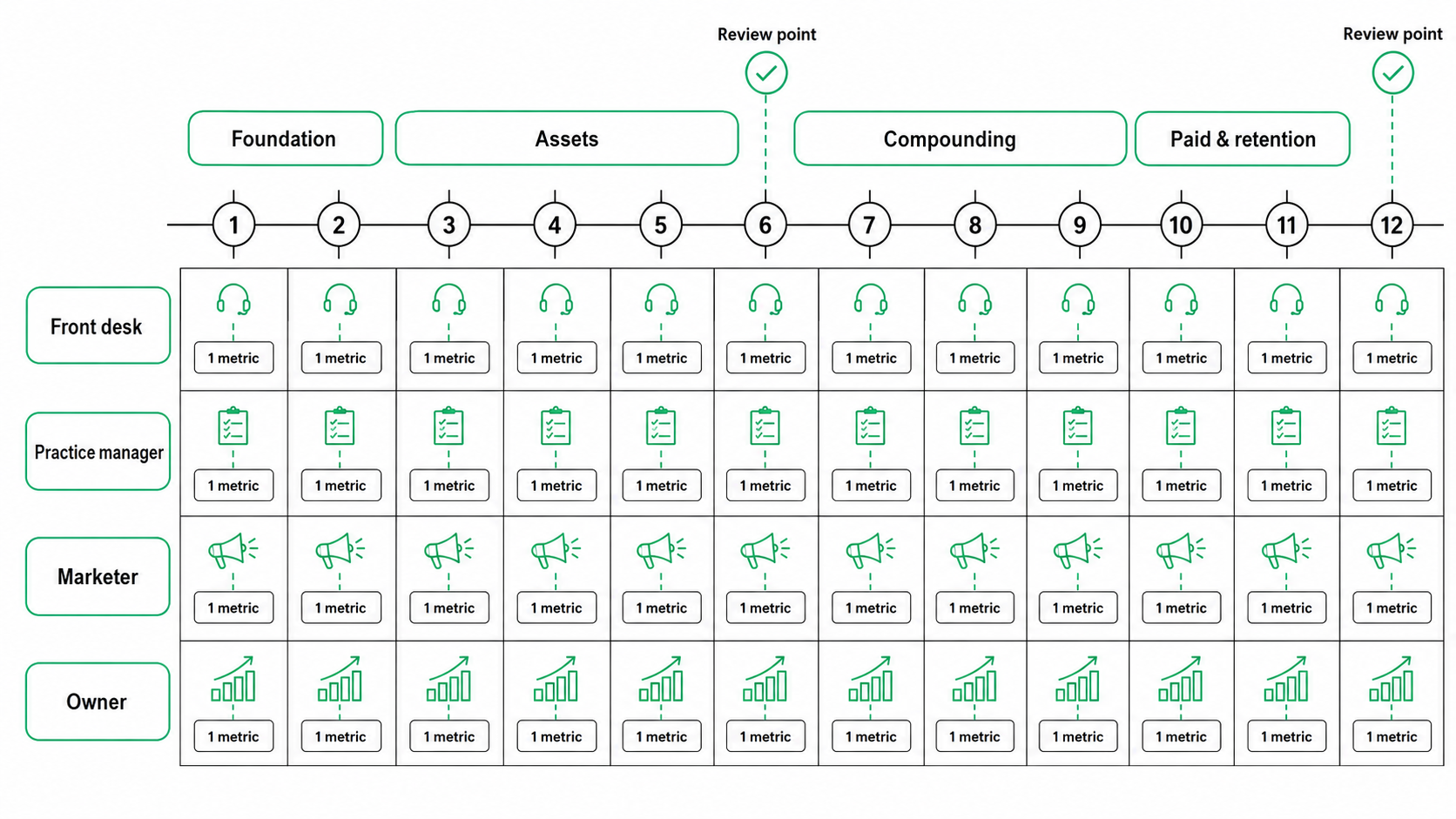
A medical practice marketing plan is a dated calendar of marketing work with one named owner per item and one metric per month: foundation in the first 30 days, service-line pages by day 60, referrals and the first review by day 90, then a quarterly cycle through month 12. Month one costs nothing but staff time.
This is the execution layer of medical practice marketing. Channel choice and budget belong to the marketing strategy for a medical practice: strategy decides what and why, this plan fixes when, who, and how it is measured.
TL;DR
- A plan is four things, not a tactic list: a dated calendar, a named owner per item, a baseline recorded before anything starts, a standing review rhythm.
- Month one is Google Business Profile plus a working booking path. Local ranking rests on relevance, distance, and prominence: “There’s no way to request or pay for a better local ranking on Google.”
- Medical search is an AI-answer surface: Ahrefs’ study of 13.4 million SERPs found 44.1% of medical queries trigger an AI Overview, against 20.5% across all keywords (September 2025).
- A KFF poll of 1,343 US adults (February 24 – March 2, 2026) found 32% used AI chatbots for health information in the past year.
- Our pilot on August 3, 2026 (4 prompts, Perplexity) returned 0/4 brand mentions: provider answers were built from third-party listicles and directories — which is why listings sit in month 5, not month 12.
What does a medical practice marketing plan contain?
A working plan contains four elements: a calendar with dates (30/60/90 days, then months 4–12), one named owner per line, baseline numbers captured before the first change, and a fixed review rhythm. Channel mix, budget, and positioning are strategy, decided before the calendar is written. The distinction is practical: “we compete on local search and referrals” becomes actionable only once someone records that the front desk owns review requests from week two, measured in new reviews per month.
Google Business Profile is the free listing that controls how a practice appears in Google Maps and the local pack — the map block with three listings shown above organic results.
Service line is a distinct clinical offering patients search for by name (bariatric surgery, sports medicine, allergy testing) — the unit both patients and search engines work in.
Days 1–30: what should a practice fix before spending anything?
The first 30 days fix what marketing amplifies: the profile patients find and the path they use to book. No paid channel launches until both work — spend applied to a broken intake process buys more missed calls.
| Task (days 1–30) | Owner | Done when | What it should move |
|---|---|---|---|
| Complete and verify the Google Business Profile | Practice manager | Every field filled: primary category, services, hours, photos, booking link | Maps views, direction requests, profile calls |
| Test the booking path as a patient would | Practice manager | Phone answered in three rings; forms reach a monitored inbox; booking completes on mobile | Booked appointments per 100 site visits |
| Make review requests a front-desk habit | Front desk | A scripted ask at checkout, a written response to every review | New reviews per month; response rate |
| Align name, address, phone, hours everywhere | Front desk | Site, Google profile and directories match character for character | Prominence; fewer wrong-hours calls |
| Record the baseline | Practice manager | One sheet: calls, bookings, direction requests, form fills, positions | It makes month 12 provable |
Two rules govern this month. Review responses stay HIPAA-aware: never confirm in public that a reviewer is a patient. And completeness is not cosmetic — Google states that businesses with complete and accurate information are more likely to show up in local results.
Days 31–60: which pages should a practice publish first?
Days 31–60 build the pages patients search for: one page per core service line, plus the questions patients ask before they call. Two service-line pages published properly beat twelve blog posts — they are what turns a search into an appointment.
- One page per core service line, starting with the two with the most open capacity and the best margin. Each names the condition and procedure in the patient’s words, states who performs it, and ends with a booking action.
- Pre-booking questions as content: cost, insurance accepted, what a first visit involves, recovery time — the questions an assistant quotes when a patient asks.
- Directory listings aligned — Healthgrades, Zocdoc, Yelp — matching the site and Google profile exactly. Prominence work and citation work at once.
A healthcare organization in Oklahoma reported 30% more new patients contacting the office after finding the website through Google Search — following technical SEO, service-page and content work. (Client-reported outcome.)
Days 61–90: how does a practice add referrals and proof?
Days 61–90 add the two assets that compound: physician referral relationships and patient proof. Both are slower than a listing fix and both outlast it, which is why they start once the foundation holds.
- Referral outreach to adjacent physicians. Identify specialists whose patients need your services, prepare a one-page referral summary (what you treat, response time, how to send a patient), book intro calls. Track referrals by partner, not “relationships built”.
- First video or photo testimonials. Any use of patient information or a patient’s story in marketing requires prior written authorization under the HIPAA Privacy Rule (45 CFR §164.508) — collected before the camera comes out.
- The first metrics review. Compare against the day-1 baseline, keep what moved bookings, cut what did not, set next quarter’s targets. This meeting turns a 90-day plan into a 12-month one.
What does the full 12-month plan look like?
The template below gives each month one block of work, one owner, and one metric. It is a template, not a prescription: a practice with no usable website rebuilds before month 3; a practice with a full schedule swaps months 10–11 for capacity work.
| Month | Primary work | Owner | Metric that proves it |
|---|---|---|---|
| 1 | Profile completed; booking path tested; baseline recorded | Practice manager | Baseline sheet exists; booking path passes a live test |
| 2 | Review collection at every checkout; every review answered | Front desk | New reviews per month; response rate |
| 3 | Two highest-capacity service-line pages published | Marketer or agency | Impressions and clicks on those service queries |
| 4 | Pre-booking content: cost, insurance, first visit, recovery | Marketer | Entrances to those pages; calls attributed |
| 5 | Directory listings claimed and aligned (Healthgrades, Zocdoc, Yelp) | Front desk | Listing consistency; Maps views |
| 6 | Quarter review and rebaseline; cut what did not move | Practice owner | New patients by source, quarter over quarter |
| 7 | Referral outreach: one-page summary, ten intro calls | Owner or physician | Referrals from named partners |
| 8 | Service and FAQ pages rewritten answer-first; indexing checked | Marketer | Priority pages opening with a 40–60 word answer |
| 9 | Patient testimonials with written authorization; physician videos | Marketer + front desk | Conversion rate of service pages |
| 10 | Paid search or retargeting on the service with open capacity | Marketer or agency | Cost per booked appointment |
| 11 | Email recall for patients overdue for a visit | Front desk | Reactivated appointments |
| 12 | Annual review: channel-by-channel result, next year’s plan | Practice owner | New patients and cost per new patient, by channel |
Read the right-hand column first: a month with no pullable metric is decoration.
Where do AI answers fit into a practice marketing plan?
AI answers belong in month 8, not month 1 — but they belong. Medical queries are the most AI-affected category in search: Ahrefs measured AI Overviews on 44.1% of medical queries across 13.4 million SERPs, and 32% of US adults told KFF they had used an AI chatbot for health information.
The implication is narrow and cheap. Google states there are “no additional requirements to appear in AI Overviews or AI Mode, nor other special optimizations necessary”, and that no new files or special schema.org markup are needed — pages only have to be indexed and snippet-eligible. Month 8 is a rewrite pass, not a budget line: each service page and FAQ answer opens with a self-contained 40–60 word answer an assistant can lift whole.
The reason to bother is the click math. Pew Research, analyzing 68,879 Google searches by 900 US adults in March 2025, found about 18% produced an AI summary, and users clicked a traditional result on 8% of those visits versus 15% without one. The mechanics are on how to show up in AI Overviews; this page schedules them.
What our own measurement changed in this calendar
Our first pilot moved listings and reviews earlier in the calendar and website polish later. On August 3, 2026 we ran 4 prompts from our fixed 16-prompt battery on Perplexity in a clean anonymous session; Rotgar appeared in 0 of 4 answers — the expected zero point. What the engine cited instead was the useful output. On “Best healthcare SEO agencies” it returned a table of eight named agencies assembled almost entirely from those agencies’ own listicles, with the top-ranked firm citing its own roundup and a self-assigned score. No first-party service page decided that answer; third-party lists did.
Honest framing: 4 prompts, one surface, a European IP — not the full protocol and not a US-strict reading, since ChatGPT, Gemini, and Google AI Overviews block anonymous runs. The structural finding still transfers: when someone asks an assistant for a provider, the answer is built from directories, review platforms, and roundups. That is month 5 work.
Marketing ideas worth adding later
These medical practice marketing ideas are additions, not substitutes: adding one before its precondition is met is how plans stall.
| Idea | Add it when | Effort | What it should move |
|---|---|---|---|
| Retargeting visitors who left without booking | Service pages exist and convert | Low budget, medium setup | Return visits; bookings |
| Short physician-introduction video per service page | Service pages are published | Medium | Service-page conversion rate |
| Community event or free screening day | There is open capacity to fill | High | Local awareness; new reviews |
| Email recall for patients overdue for a visit | The patient list is clean and consented | Low | Reactivated appointments |
| FAQ written answer-first for AI assistants | After the month-8 rewrite | Low | Mentions in AI answers |
| Patient-education seminar with a referral partner | Referral relationships exist | High | Referrals from named partners |
For a longer clinic-level list, see marketing ideas for clinics.
Tips that keep the plan alive
Most medical practice marketing tips reduce to execution discipline, not tactics. A plan dies from drift, not from picking the wrong channel.
- Hold a weekly 30-minute review slot — what shipped, what moved, what is blocked.
- Assign one owner for the whole calendar. A plan owned by a committee is owned by nobody.
- Rebaseline quarterly. Repeat the day-90 review and reset targets from real numbers.
- Do not launch a new channel until booking works. Marketing amplifies whatever the front desk does.
- Change one thing per month. Three simultaneous changes make none of them measurable.
What this plan will NOT do
- It will not choose your channels. That is a strategy decision made before month 1.
- It will not fix capacity. With a full schedule, more demand produces longer waits, not more revenue.
- It will not produce results on a fixed date. Local visibility and referrals move over months; no one can promise a position or a timeline as fact.
- It will not survive without a baseline. Without recorded numbers, month 12 can only be argued about.
- It will not replace clinical reputation. Marketing brings patients to the door; the visit decides whether they return.
Key takeaways
- A plan is a calendar with owners and metrics: dates, one named owner per line, a baseline recorded first, a fixed review rhythm.
- Month one costs time, not money — profile, booking path, review habit, consistent business details. Local ranking rests on relevance, distance, and prominence, and cannot be purchased.
- Months 2–6 build assets: service-line pages where capacity is open, pre-booking content, aligned directory listings — the layer that also feeds AI answers about providers.
- Months 7–12 compound: referral outreach, authorized patient proof (45 CFR §164.508), an answer-first rewrite, and only then paid spend.
- AI visibility is a rewrite, not a budget line: Google requires no special markup, only indexed, snippet-eligible pages — but 44.1% of medical queries show an AI Overview, and clicks fall from 15% to 8%.
- Our zero-point pilot (0/4, Perplexity, August 3, 2026) showed provider answers built from third-party listicles — hence listings in month 5.
- Discipline beats tactics: one owner, a weekly 30-minute review, one change per month, a quarterly rebaseline.
FAQ
What should a medical practice marketing plan include?
Four things: a dated calendar (30/60/90 days, then months 4–12), a named owner for each item, baseline metrics for calls, bookings, and search positions, and a standing review rhythm. Channel choice and budget are set beforehand, in the strategy. Without owners and baselines, nothing is measurable.
How do you write a marketing plan for a medical practice?
Start with the patient path: how patients find the practice — Google Search, Maps, referrals — and what happens when they call. Fix that path first, then sequence by month: foundation in month 1, service-line pages in months 3–4, listings in month 5, referrals and proof in months 7–9, paid spend last.
What are quick marketing tips for a small practice?
Complete the Google Business Profile, make review requests a daily front-desk habit, and verify that every form and phone number works. These three cost nothing and move numbers within weeks. After that, publish one service-line page per month instead of spreading effort thin.
How often should a marketing plan be updated?
Review metrics monthly and rebaseline quarterly. The 30/60/90 structure exists for that: day 90 closes with a review that sets the next quarter’s targets, and month 12 closes the year channel by channel. A plan untouched for six months is usually running channels that stopped working.
Can a front desk run this plan?
Partly, and the split should be written down. The front desk can own review requests, listing accuracy, email recall, and weekly metric logging — month 1 is largely front-desk work. Service-line pages, the rewrite pass, and referral outreach usually need a marketer or an agency.
Should a small practice budget for AI search separately?
No. AI visibility here is a rewrite pass in month 8, not a budget line: Google states no special markup or extra requirements are needed for AI Overviews. The paid part, if any, is the directory and review presence already scheduled in month 5.
Get a free audit — it gives you the baseline that month 1 of this plan starts from. The simplest free audit starts with one clinic or selected location, one priority market and one patient language. It shows current visibility across Google Search, Google Maps, Google AI Overviews, ChatGPT, and Gemini, plus competitor gaps and prioritized fixes.