
TL;DR
- Google states local results are “mainly based on relevance, distance, and popularity,” that complete business information drives relevance, and that “more reviews and positive ratings can help your business’s local ranking” — so the free profile-and-review layer opens this list.
- Paying for reviews is not an option: Google removes ratings “that have been paid for, directly or in kind” and bars offering payment, discounts, or free services in exchange for a review.
- 32% of US adults report using AI chatbots for physical or mental health information in the past year (KFF Tracking Poll, fielded February 24 – March 2, 2026, n=1,343).
- Pew Research tracked 68,879 Google searches by 900 US adults in March 2025: 18% produced an AI summary, and users clicked a traditional result in 8% of those visits versus 15% without one.
- Payback differs by an order of magnitude: profile, review and listing fixes move in weeks; content in quarters. Client-reported: a New York surgery institute recorded roughly 20K search impressions in the first five months of technical SEO plus service-line content work.
The highest-return marketing ideas for a clinic cost nothing but staff time: a complete Google Business Profile, a systematic review request, answered profile Q&A, correct directory listings, and a working booking link. Paid ideas — video, retargeting, ads — only pay back once that layer exists. These 15 ideas, grouped by budget and sequenced by payback speed, are the tactical layer of medical practice marketing.
What are the best marketing ideas for a clinic, ranked by budget?
In order: fix the Business Profile and reviews (free), publish service-line and pre-booking content (staff time), then add production and paid media (real budget).
| # | Idea | Budget | Effort |
|---|---|---|---|
| 1 | Complete the Google Business Profile end to end | $0 | 2–3 hours once |
| 2 | Systematic review requests after visits | $0 | 15 min/day at the desk |
| 3 | Reply to every review | $0 | 20 min/week |
| 4 | Own the profile’s Q&A section | $0 | 1 hour, then monthly |
| 5 | Connect online booking to the profile | $0 with most schedulers | 1 hour |
| 6 | Consistent name, address, phone, hours everywhere | $0 | 3–4 hours once |
| 7 | A page per high-margin service line | Low | 1 page/week |
| 8 | The ten questions patients ask before booking | Low | 1 page/week |
| 9 | Physician bio pages with credentials | Low | 1 hour per physician |
| 10 | A pricing-approach page | Low | Half a day |
| 11 | A formalized referral program | Low | Half a day setup |
| 12 | Local sponsorship with a website link | Medium | Ongoing |
| 13 | Patient story video with written authorization | Medium | 2–4 weeks per piece |
| 14 | Retargeting and paid search on high-margin lines | Medium–high | Ongoing management |
| 15 | Make the clinic citable in AI answers | Low–medium | Ongoing |
Budget tiers are planning brackets, not benchmarks: we publish no average clinic marketing spend, because no verifiable figure fits both a solo practice and a six-location group.
Which marketing ideas for clinics are free?
Ideas 1–6 cost nothing but time, and they map onto what Google says drives local results. Per Google’s local ranking documentation, results are “mainly based on relevance, distance, and popularity”: distance you cannot change, complete information drives relevance, reviews and links drive prominence.
- Complete the Business Profile end to end. Primary and secondary categories, services with descriptions, hours including holidays, attributes, real photos. The local pack — the map block above organic results — is where most patients choose a clinic.
- Ask every satisfied patient, the same way, every day. A review system is a fixed moment plus a short link, and it must never include an incentive: Google’s contribution policy bars payment, discounts, or free goods and services in exchange for reviews.
- Reply to every review — carefully. Google notes that “positive reviews and helpful replies can help your business stand out.” The reply is regulated too: a public response confirming the reviewer was a patient, or referencing their care, discloses protected health information.
- Own the Q&A section of your profile. Anyone can post and answer questions there, including competitors. Seed the real ones yourself — parking, insurance accepted, new-patient availability, what to bring.
- Connect online booking to the profile. If your scheduling vendor supports the Google booking integration, enabling it is a one-hour task that turns profile views into appointments.
- Make listings consistent everywhere patients and insurers look. Name, address, phone and hours must match on Healthgrades, Zocdoc, Yelp — and on insurance plan directories, where a wrong number quietly kills referrals.
What works on a small budget: content ideas 7–11
The low-budget layer answers what patients ask before they book. Slower than profile work, and it compounds: each page keeps earning impressions and pre-qualifies the people who call.
- A page per high-margin service line. A service line is a distinct clinical offering — bariatrics, dermatology, physical therapy. Each one patients search for deserves its own page and booking path; start with the two combining the best margin with open capacity.
- Ten pages answering pre-booking questions. Cost and insurance, the first visit, recovery time, referral requirements. Every question the front desk answers ten times a week is a page that can rank and cut phone load at once.
- Real physician bio pages. Credentials, board certifications, training, publications, years in practice. Health content sits in YMYL — Google’s “Your Money or Your Life” category — and E-E-A-T (experience, expertise, authoritativeness, trustworthiness) is judged on exactly this evidence.
- A pricing-approach page. No price list needed: explain which insurers you contract with, self-pay options, financing, and what changes the final number — high-intent queries most competitors avoid.
- A formalized referral program. Word of mouth is the largest and least managed clinic channel: give patients something concrete to hand over, referring physicians a named contact, and record referral source in the PM system. Paying for patient referrals implicates anti-kickback rules — reward with service, not cash.
Which ideas need real budget, and when are they worth it?
Ideas 12–15 cost money or production time and underperform without the free layer. Paid traffic sent to a clinic with a half-built profile and eleven reviews pays for a trust gap the ad cannot close.
- Local sponsorship with a link. A youth team, a charity run, a community health fair. Sponsorships that include a website link build local authority signals and put the clinic’s name in front of the neighborhood from one invoice.
- Patient story video, with written authorization. Testimonials are the most persuasive clinic asset and the most regulated: HIPAA requires prior written authorization before protected health information is used for marketing (45 CFR §164.508). We run a HIPAA-aware workflow; legal sign-off stays with the clinic.
- Retargeting and paid search on high-margin lines. Patients research for days before booking, and retargeting keeps the clinic present in that window. Two healthcare rules: exclude condition-specific pages from remarketing audiences, and never build an audience that implies a diagnosis.
- Make the clinic citable in AI answers. The newest idea here, and the one with the least settled playbook — the next section covers what we can verify.
How do AI answers change the clinic marketing list?
AI assistants are now a patient research surface: 32% of US adults report using AI chatbots for health information in the past year (KFF Tracking Poll on Health Information and Trust, fielded February 24 – March 2, 2026, n=1,343). Inside Google, Pew Research found 18% of 68,879 tracked searches produced an AI summary, with a traditional result clicked in 8% of those visits versus 15% without one. Fewer clicks per search means the answer itself has to name you.
There is no separate technical project to fund. Google Search Central states there are “no additional requirements to appear in AI Overviews or AI Mode, nor other special optimizations necessary” — a page must be indexed and eligible for a snippet, and no new machine-readable files or markup are required.
Our own measurement, and its limits. On 2026-08-03 we ran a pilot of our fixed prompt battery in Perplexity (clean anonymous session, English). On “Best healthcare SEO agencies,” the engine returned a ranked table of eight agencies, and its top-cited sources were agencies’ own listicles — including one that ranks itself first on a self-invented score. On another prompt, Reddit threads were cited three times, more than any vendor site. Honest frame: four prompts, one surface, a European IP; the full protocol runs 16 prompts monthly across four platforms, so this is directional about which sources answers are built from.
The transfer to a clinic is direct: when a patient asks an assistant for a clinic recommendation, the answer is assembled from third-party material — directories, review platforms, local roundups, community threads — more often than from the clinic’s own site. So the practical AI ideas are the unglamorous ones already listed: consistent listings (6), reviews and replies (2–3), credentialed physician pages (9), quotable answer-first content (7–8). How models select sources is covered in how to rank in ChatGPT.
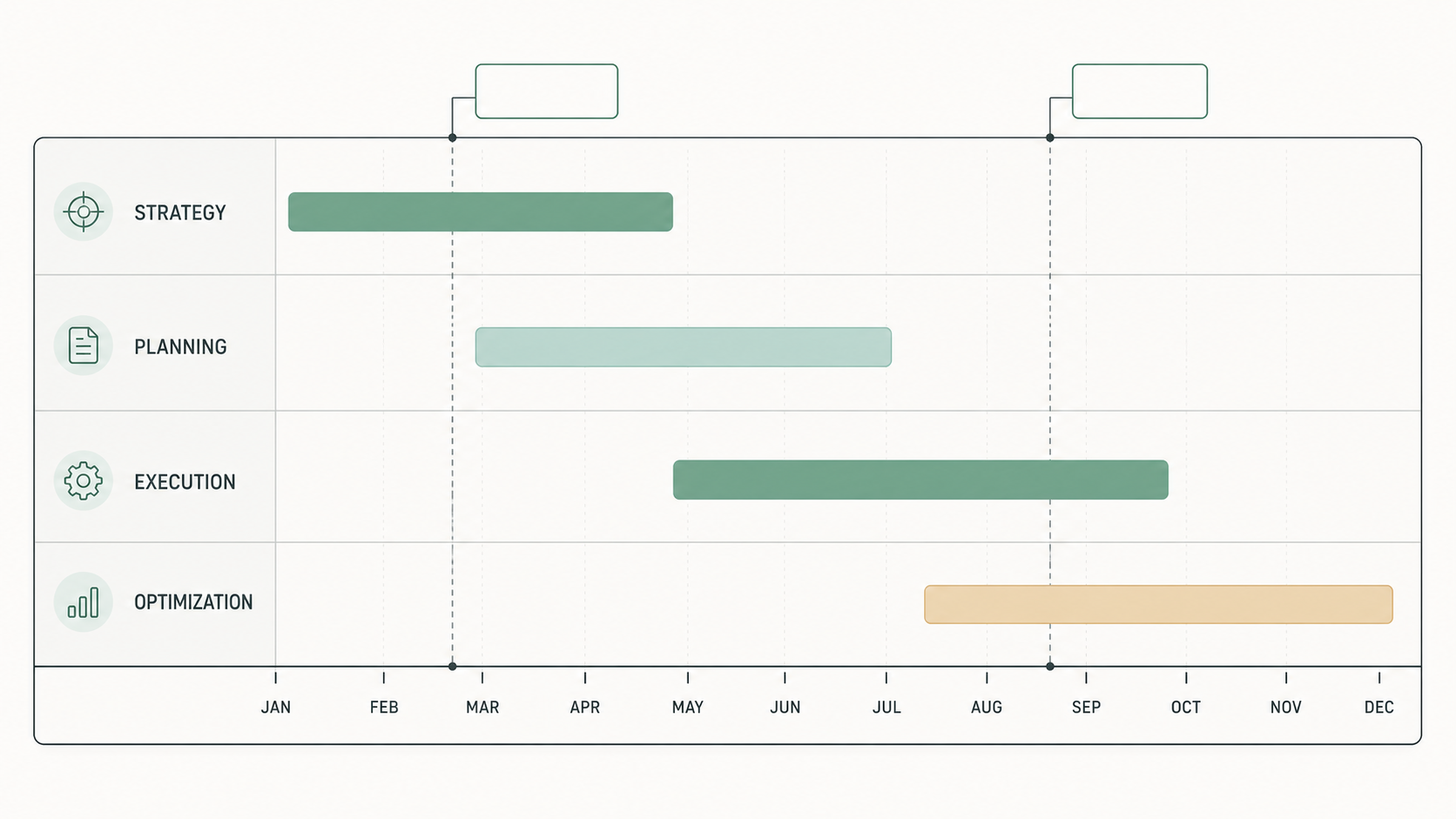
How fast does each idea pay off, and when should it run?
Payback ranges from weeks to quarters, and several ideas have a natural window in the year. Anything in a “weeks” row belongs in this month; anything in a “quarters” row belongs in a plan.
| Idea group | First signal | Full effect | Window in the year |
|---|---|---|---|
| Profile, categories, booking link (1, 4, 5) | 2–4 weeks | 1–2 months | Any time; before any paid push |
| Review system and replies (2, 3) | 4–8 weeks | Continuous — recency matters | Before benefit-year visit surges |
| Listing consistency (6) | 4–8 weeks | 1 quarter | After any address, phone or hours change |
| Service-line pages (7) | 1–2 months | 2–4 quarters | 1–2 quarters ahead of that line’s peak |
| Pre-booking question content (8) | 1–2 months | 2–4 quarters | Cost and insurance answers before the January reset |
| Physician bios, pricing approach (9, 10) | 1–2 months | 2 quarters | After a provider joins or leaves |
| Referral program (11) | 1 quarter | 2–4 quarters | Start of a fiscal year, with source tracking |
| Sponsorships and patient video (12, 13) | 1–2 quarters | Persistent while published | Local event calendars; produce off-peak |
| Retargeting and paid search (14) | Days | Ends when spend ends | Capacity gaps and peaks only |
| AI citability work (15) | 1–2 quarters | Ongoing | Continuous; re-measure monthly |
The seasonal windows in US healthcare are real but generic: deductibles reset at the start of the plan year, pushing elective procedures toward its end; insurance-change questions cluster around open enrollment; school and sports physicals cluster in late summer. Your clinic’s own curve is in its data — bookings by month for two years plus query trends in Search Console. We publish no seasonal demand percentages: a dermatology clinic and an orthopedic group do not share a curve.
Worked example — review math, not a benchmark. A clinic seeing 400 visits a month asks every satisfied patient for a review. If the desk asks 60% of them (240 requests) and 5% follow through, that is 12 reviews a month, 144 a year — enough to move a profile from thin to competitive in most local packs. Halve the ask rate and you halve the result: the deciding variable is desk discipline, not budget.
What these marketing ideas will not fix
- Capacity and scheduling. If new patients wait three weeks for a slot or the phone goes to voicemail at noon, visibility produces lost calls, not revenue.
- A weak service mix. Marketing changes who knows about the clinic, not what it can profitably deliver.
- Reputation earned by real experience. A review system amplifies the average visit; it cannot outrun a genuinely bad one.
- Speed. Nothing here is a same-week revenue lever except paid media, which stops when spend stops.
- Compliance risk. Anything using identifiable patient information needs written authorization first.
For context on a full program over time: a healthcare organization in Oklahoma reported 30% more new patients contacting the office after finding the website through Google Search, following technical SEO, service-page and content work — one client-reported outcome over a multi-quarter engagement, not a projection for your clinic.
How do I pick my first three ideas?
Pick one free idea, one local idea, and one content asset, and queue the rest. Running fifteen tactics at once is how clinic budgets evaporate without a single channel reaching measurable volume.
| Clinic situation | Free idea | Local idea | Content asset |
|---|---|---|---|
| New clinic, open under 12 months | 1 — complete the profile | 6 — listings from day one | 9 — physician bios |
| Established, invisible in the map pack | 2 — review system | 1 — categories audit | 8 — pre-booking questions |
| Strong map pack, weak organic | 4 — own the Q&A | 6 — insurer directories | 7 — service-line pages |
| Multi-location group | 1 — a profile per location | 6 — listing governance | 7 — service line × location |
| Specialty clinic dependent on referrals | 3 — review replies | 12 — local sponsorship | 11 — referral program |
Once chosen, the three need a frame and a calendar: fold them into a marketing strategy, then sequence execution as a 90-day marketing plan with owners and dates.
Key takeaways
- The free layer comes first because Google says it matters: relevance from complete information, prominence from reviews and links, distance unchangeable.
- Review incentives are off the table — Google removes paid reviews and prohibits payment, discounts, or free services in exchange for them.
- Review replies are a compliance surface: confirming someone was a patient, or referencing their care, discloses protected health information.
- Content ideas — service lines, pre-booking questions, bios, pricing — compound: cheap to produce, slow to mature, durable once ranked.
- Paid ideas amplify, they do not found: ads against an incomplete profile and thin reviews buy visibility into a trust gap.
- AI answers are a real research surface (32% of US adults, KFF, February–March 2026), and the way in is the third-party sources engines cite.
- Sequence by payback: profile and listing work moves in weeks, content in quarters; seasonality comes from your own data, not published averages.
FAQ
What is the most effective marketing idea for a clinic?
Completing and actively managing the Google Business Profile. Google states local results are based on relevance, distance and popularity — and completeness, correct categories and review volume are the parts a clinic controls for free. Nothing else here matches its effort-to-impact ratio in the first month.
What marketing ideas for clinics are free?
Ideas 1–6: completing the Business Profile, requesting reviews systematically, replying to reviews, owning the profile Q&A, connecting online booking, and fixing name, address, phone and hours across directories. Service-line and question content (7–8) are free too when written in-house.
How do I market a new clinic?
Start local, from day one: a complete Business Profile with the correct primary category, consistent listings including insurer directories, a review process at checkout, and physician bio pages. Add service-line pages next, then pre-booking content.
Do social media giveaways work for clinics?
Rarely, and they carry avoidable risk. Giveaways must follow each platform’s promotion rules, and in healthcare they drift into HIPAA territory as soon as entrants or winners become identifiable as patients. They cannot be used to collect reviews either — Google prohibits incentives outright.
How much should a clinic spend on marketing?
We publish no percentage-of-revenue rule, because no verifiable figure covers both a solo practice and a multi-location group. A defensible method: cost the free layer in staff hours, cap paid media at what one service line’s open capacity can absorb, and hold spend flat until you can report cost per booked appointment.
Not sure which three ideas fit your clinic?
The simplest free audit starts with one clinic or selected location, one priority market and one patient language. It shows current visibility across Google Search, Google Maps, Google AI Overviews, ChatGPT, and Gemini, plus competitor gaps and prioritized fixes.