
Medical practice marketing is the system that keeps a private practice’s schedule full: patients find the practice in Google Search and Maps, trust what they see, and book. For most practices, local SEO and reviews outperform every other channel — because patients choose nearby providers they can verify.
TL;DR
- Google’s local ranking documentation names three factors — relevance, distance and prominence — and states that more reviews and positive ratings can help local ranking (Google Business Profile Help).
- Medical queries return a Google AI Overview 44.1% of the time, against 20.5% of all searches (Ahrefs, 146,122,391 SERPs, September 2025).
- 32% of US adults used AI chatbots for health information in the past year (KFF Tracking Poll, fielded February 24 – March 2, 2026, n=1,343).
- Our measurement, 2026-08-03: asked “Best healthcare SEO agencies,” Perplexity named eight agencies — every one sourced from an agency-published listicle. Assistants quote third-party surfaces, not your homepage.
- Client-reported: an Oklahoma healthcare organization reported 30% more new patients after search work. Rotgar retainers start at $3,000 per month.
Get a free audit — one clinic or selected location, one priority market and one patient language.
What does marketing a private medical practice actually require?
A private practice needs five things working in sequence: a correct Google Business Profile, a steady review flow, a fast website with a page per service, content answering pre-booking questions, and paid search only as a bridge. It does not need the brand funnel a hospital system runs.
The constraints decide that. A practice of one to ten physicians has no marketing department; the budget competes with payroll and rent; the approver is a physician with a full patient load; and the market is a few square miles — what Google’s distance factor encodes. Private medical practice marketing is therefore a system, not a campaign calendar — and whether you hire a medical practice marketing agency, company or consultants, the system below is what any of them should build.
Which marketing channels work for a private practice — and in what order?
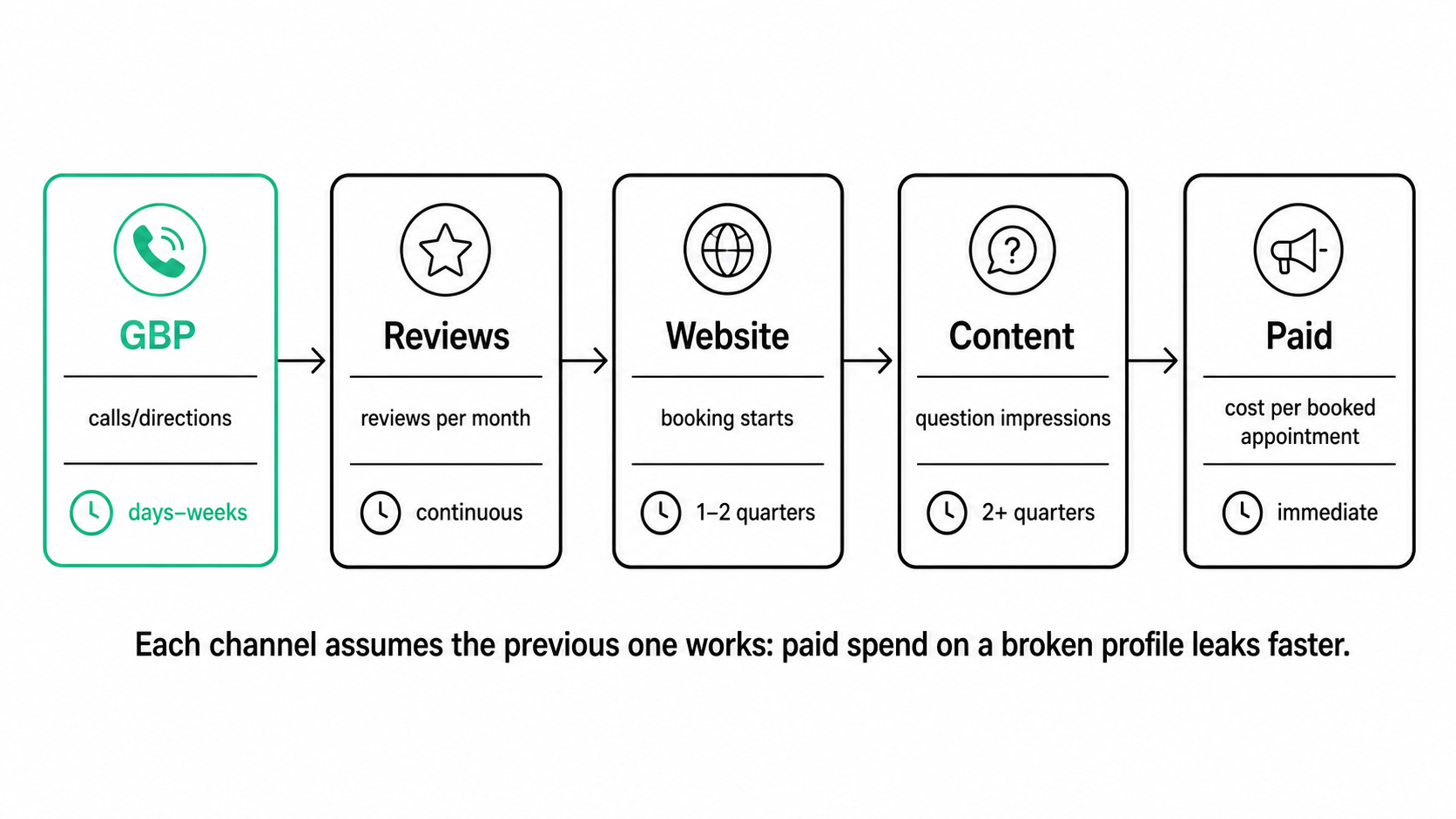
In order: Google Business Profile, reviews, the practice website, patient-question content, then paid search. Each later channel assumes the earlier ones work — reviews and content amplify a profile and site that already convert, while paid spend on a broken foundation only leaks faster.
- Google Business Profile and the local pack. The map block of three listings shown for “near me” and specialty-plus-city searches — for most practices the largest single source of new-patient calls, often with no website visit at all. It needs the correct primary category (your specialty, not “physician”), complete data and review volume; measure it in calls and direction requests.
- Reviews as a system, not a hope. Google states more reviews and positive ratings can help local ranking, and patients read them before booking. The model is an ethical, HIPAA-aware ask at the same point in every visit. A practice with 15 reviews loses the pack to one with 150.
- The website and medical office SEO. Fast, mobile-clean, one page per service,
PhysicianandMedicalClinicschema, consistent name-address-phone data, a booking path that works one-handed — where SEO for medical clinics and medical website SEO actually live, and where broader healthcare SEO plugs in. - Content that answers patient questions — costs, procedures, recovery, insurance. Google gives extra weight to E-E-A-T on health topics and asks whether content shows first-hand expertise and visible authorship (creating helpful content): for a practice, physician-reviewed pages with a named clinician byline.
- Paid search — a bridge only. PPC rents visibility and stops with the budget. It earns its place while organic compounds, or for a service line with no search presence yet.
The strategic layer is our medical practice marketing strategy guide; its dated version, the marketing plan for a medical practice; tactics, marketing ideas for clinics. Channel 1 is its own discipline: local SEO for medical practices.
How does the plan change as the practice grows?
The channel order never changes; who executes it does. A solo practice buys visibility with the owner’s time; a practice of two to four hits the ceiling of that time; from five physicians up the constraint becomes governance — providers, locations and pages that must stay consistent.
| Practice stage | Binding constraint | Build first | Primary metric | Who executes |
|---|---|---|---|---|
| New / solo | No profile, no reviews, no history | Correct GBP category and data; review ask from patient one | Calls and direction requests | Owner + front desk |
| 2–4 physicians | Owner’s hours; site can’t carry the specialties | Page per service; mobile and technical fixes; provider bios | Bookings from organic + pack | Front desk + outside help |
| 5–10 physicians | Consistency across providers and sites | Location pages; NAP consistency; question calendar | Non-brand organic bookings | Practice manager + agency |
| Multi-site group | Governance and duplication | Templates, schema at scale, review workflow per site | Cost per booking by location | Marketing owner + agency |
What should a medical practice marketing budget cover?
There is no public benchmark for private-practice budgets we will publish as fact, so this table separates what costs money from what costs time and carries only numbers we can attribute. A percentage-of-revenue rule quoted without a source is a guess.
| Budget line | What actually drives the cost | Number we can attribute |
|---|---|---|
| Profile and reviews | Staff time and process discipline | None — this is time, not spend |
| Website and technical SEO | Age and platform of the site; number of services | — |
| Ongoing agency work | Market competition; number of locations | Rotgar retainers from $3,000 per month, scoped after the audit |
| Paid search (bridge) | Auction prices in your specialty and metro | Our US keyword core, July 2026: buying-side terms here reach $158 CPC (seo for medical practice, 210/mo) |
The $158 figure is a B2B keyword from our own research — it shows how expensive this category’s auctions run, not what a patient click costs — so your specialty’s terms need their own check. And the cheapest line is the one practices skip: a correct primary category costs nothing and caps everything above it when wrong.
Agency, consultant, or DIY: what fits your practice?
Hire an agency when you need execution and have nobody in-house. Hire a consultant when you already have a capable person who needs direction, not hands. Do it yourself when you are solo and early — the profile-and-reviews layer is genuinely doable in-house, and we say that as an agency.
| Best fit for | What you get | What it costs you | |
|---|---|---|---|
| DIY (in-house) | Solo or brand-new practices; a few owner hours a week | Profile, review requests, basic site upkeep | Owner time; no technical depth |
| Consultant | Practices with someone in-house who can execute | Strategy, audits, a roadmap — your team implements | Fees plus your execution capacity |
| Agency | 2–10 physicians needing end-to-end execution | Technical SEO, content, local, reporting | Retainer; some control |
The case for an agency appears when the owner’s hour is worth more seeing patients than editing meta tags.
Do patients now find practices through AI answers?
Increasingly, yes — as a layer on top of search, not a replacement. Medical queries return a Google AI Overview 44.1% of the time versus 20.5% of all searches (Ahrefs, 146.1M SERPs, September 2025), and 32% of US adults told KFF they used AI chatbots for health information in the past year (poll, n=1,343).
What that means is unglamorous. Google states there are no additional requirements or special optimizations to appear in AI Overviews or AI Mode, and no AI-specific markup to add (Search Central). The inputs are what the five channels already produce; what assistants quote are third-party surfaces.
Our own data, honestly framed. On 2026-08-03 we ran a four-prompt pilot of our AI-visibility battery on one surface (Perplexity, anonymous session, European IP — not a US measurement). The prompt “Best healthcare SEO agencies” returned a ranked table of eight agencies; every source behind it was an agency-published listicle, including the one ranked first, which cites its own self-published score. Rotgar appeared in none — citation rate 0/4, our zero point. The lesson transfers: assistants build local answers from third-party lists, directories and profiles, so what gets a practice named is profile accuracy, review presence and consistent description wherever it already exists. See how to rank in ChatGPT and what generative engine optimization is.
+30% new patients — a healthcare organization in Oklahoma
A healthcare organization in Oklahoma reported 30% more new patients contacting the office after finding the website through Google Search — following technical SEO, service-page and content work. (Client-reported outcome.)
That engagement was private-practice scale: an outdated site failing on mobile and search, rebuilt around the channels above. We publish the figure as the client reported it publicly. Full story in the Oklahoma case.
Rotgar is a healthcare SEO and AI search agency that helps medical and dental practices acquire patients from Google Search, Google Maps, and AI assistants like ChatGPT and Gemini — Clutch 5.0 across 26 verified reviews, founder in SEO since 2008.
What marketing will NOT fix in a private practice
Healthcare SEO is the process of optimizing a medical organization’s website, Google Business Profile, and online reputation so patients find its providers and services in Google Search, Maps, and AI answers. It amplifies a practice; it does not replace one. It will not:
- Answer the phone. If the front desk misses calls or books slowly, spend leaks at the last step.
- Override a damaged reputation. A 3.2-star average reflecting real operational problems needs operational change first; review systems surface what patients experience, they don’t rewrite it.
- Rank a misconfigured profile. The wrong primary category caps local visibility whatever sits on top of it.
- Deliver next month’s schedule. Visibility compounds over quarters; paid search is the bridge while the system builds.
How Rotgar works with private practices
Every engagement starts with an audit, not a contract. The simplest free audit starts with one clinic or selected location, one priority market and one patient language. It shows current visibility across Google Search, Google Maps, Google AI Overviews, ChatGPT, and Gemini, plus competitor gaps and prioritized fixes.
The work then follows the channel order: foundation (GBP categories, speed, mobile usability, medical schema, booking paths) → a HIPAA-aware review process the front desk can run → service pages and physician-reviewed content → monthly reporting on calls and bookings, not traffic charts. HIPAA governs how patient information may be used in marketing (45 CFR §164.508); we work HIPAA-aware and leave legal sign-off with the practice. Retainers start at $3,000 per month.
Get a free audit — see where your practice is visible, and where it isn’t. Prefer to talk it through first? Book a 30-minute call.
Key takeaways
- The order is the strategy: profile → reviews → website → content → paid. Jumping to paid on a broken foundation buys faster leakage.
- Of Google’s three local factors, the one you fully control is relevance — category, completeness, and what the profile says.
- Reviews are ranking input and conversion input at once; volume and recency beat a one-time push.
- Health is AI-heavy — 44.1% of medical queries return an AI Overview versus 20.5% overall — yet Google says no special markup is needed. What it takes is accurate third-party surfaces: the local layer’s work.
- Build budgets from cost drivers, not a sourceless percentage rule; and match the execution model to size — DIY solo, a consultant where in-house capacity exists, an agency for 2–10 physicians who need the work shipped.
FAQ: medical practice marketing
What is medical practice marketing?
Medical practice marketing is the set of activities that makes a private practice findable and bookable: local search visibility, Google Business Profile, patient reviews, the website, content and — selectively — paid ads. For small practices it is measured in appointments, not clicks.
How do I market my private medical practice?
Start with what produces patients fastest: complete and correctly categorize your Google Business Profile, build a steady review flow, give every service its own page. Then add content answering pre-booking questions, and use paid search only as a bridge while organic compounds.
Is SEO worth it for a small medical practice?
Yes — local SEO in particular, because small practices compete inside a defined radius where the local pack decides who gets called. In Rotgar’s client work, profile, category and review work produces the earliest wins; content and authority build over later quarters.
Should I hire a marketing agency or a consultant?
Hire an agency when you need execution — technical work, content, local SEO, reporting — and have nobody in-house. Hire a consultant when you have a capable person who needs strategy, not hands. A solo practitioner with more time than budget can start with profile and reviews alone.
How much does medical practice marketing cost?
At Rotgar, ongoing engagements start at $3,000 per month after a free audit. Across the market, cost varies with competition, location and scope, and we do not publish industry averages we cannot source. A quote given without looking at your market is a guess.
Get a free audit — one clinic or selected location, one priority market and one patient language.