
Local SEO for healthcare is the work that puts a medical practice into Google’s local pack — the map with three listings that appears above all other results when a patient searches for care nearby. For most practices, those three spots generate more calls than the entire rest of the page.
TL;DR
- Google names three factors behind local results — relevance, distance, prominence — and states plainly: “There’s no way to request or pay for a better local ranking on Google” (Google Business Profile Help).
- Google’s guidelines say to “Use as few categories as possible to describe your overall core business,” and allow separate profiles for individual practitioners such as doctors (representing your business on Google) — the two rules medical profiles break most.
- The profile reports owner metrics directly: calls, direction requests, bookings, website clicks (GBP performance metrics). Local SEO is reported in those, not in ranking screenshots.
- 32% of US adults turned to AI chatbots for health information in the past year (KFF, fielded February 24–March 2, 2026, n = 1,343) — and Google states there are “no additional requirements to appear in AI Overviews or AI Mode” (Search Central).
- A Boston dental practice reported significant growth in keyword visibility and leads after technical and local SEO work (client-reported, directional).
Rotgar runs local SEO as a dedicated discipline inside its broader healthcare SEO program — profile, reviews, website signals, and citations managed as one system.
How does Google rank local healthcare searches?
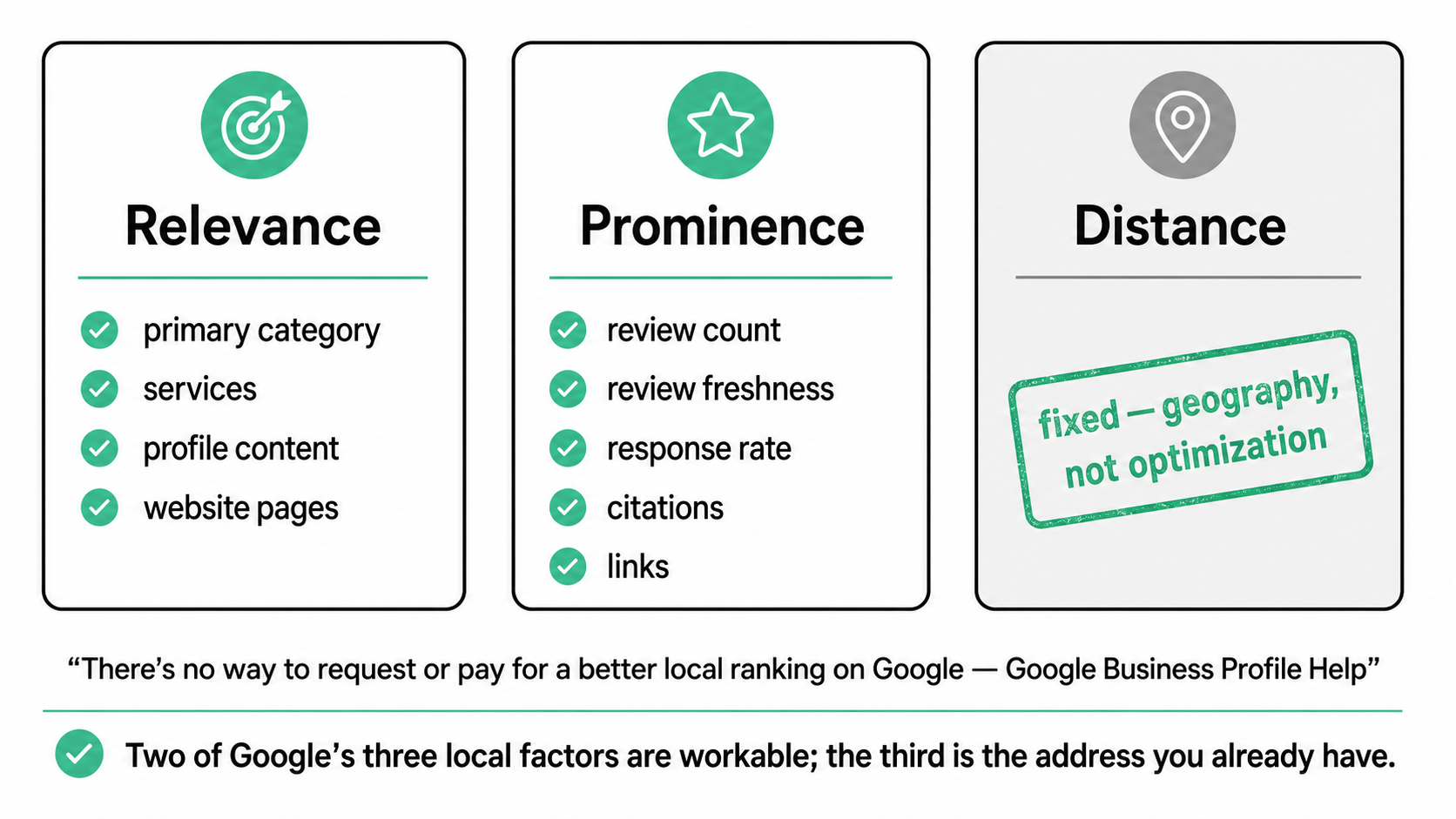
Google’s documentation names three factors for local results: relevance (how well a Business Profile matches what someone is searching for), distance (how far each business is from the searcher), and prominence (how well-known a business is). That framework defines the boundary of the discipline — for a clinic evaluating local SEO for medical practices and a physician looking at local SEO for medical professionals alike.
| Factor | Google’s definition | Can a practice optimize it? |
|---|---|---|
| Relevance | “How well a Business Profile matches what someone is searching for” | Yes — primary and secondary categories, services, profile content, website pages |
| Distance | “How far each business is from the customer who’s searching” | No — it is geography, not optimization |
| Prominence | “How well-known a business is” | Yes — reviews, citations, links, offline reputation |
Two consequences follow. First, Google states there is “no way to request or pay for a better local ranking” — anyone selling guaranteed pack positions is selling a lever Google says does not exist. Second, proximity-flavored demand (“urgent care nearby,” “dermatologist close to me”) is won by a complete profile and a strong review base, not by pages repeating proximity phrasing in headings: Google assembles the pack from Business Profile signals first, and the website’s job is to confirm them. That is why the map sits above every other result on commercial medical queries, where healthcare marketing meets the patient — often without a website visit at all.
What belongs on a medical Google Business Profile?
Google Business Profile (GBP) is the free listing that feeds Google Maps and the local pack — for a medical practice, the single highest-leverage local asset. Categories, services, hours, booking path and photos decide relevance. In the practice audits we run, a generic primary category, an empty services list and no booking link are the three most common gaps.
| Element | Medical-practice standard | Why it matters |
|---|---|---|
| Primary category | The specialty itself (Dermatologist, Orthopedic surgeon, Medical clinic) — never a generic “Doctor” | Google’s guideline is to pick categories that complete “this business IS a,” using as few as describe the core business |
| Secondary categories | Every additional service line actually offered | Extends relevance without diluting the primary entity |
| Services / procedures | Listed individually with descriptions | Feeds relevance for treatment-level queries |
| Attributes | Accessibility, appointment requirements, insurance-related attributes where available | Filters and patient-facing qualifiers |
| Booking link | Direct link to the scheduling path | Bookings are a reported metric, not a guess |
| Hours | Accurate, holiday hours included | Wrong hours cost real patients and generate one-star reviews |
| Photos | Real exterior (findability), interior, team | Exterior photos help patients confirm they are at the right building |
| Posts and Q&A | Active; public questions answered | An unanswered public Q&A is a neglected storefront |
| Practitioner listings | Individual physician profiles where eligible, correctly related to the practice | Google permits profiles for doctors and similar professionals who are publicly facing and contactable at the location |
Two guideline rules catch medical groups specifically. Solo practitioners inside a branded organization are named as [brand]: [practitioner name] — not as a second copy of the clinic. And for multi-location groups, “All locations must have the same name unless the business’s real world representation consistently varies from location to location”: one profile per location, consistent naming, no address stretched across sites. At system scale this becomes governance rather than a checklist — that layer sits on our hospital SEO page.
How much do reviews matter for a medical practice?
Reviews do double duty. Google reads their quantity, freshness and response activity as prominence signals, and the patient choosing between three listings reads them as the decision itself. A practice with 40 reviews from three years ago loses to one with a steady recent flow — on both axes at once.
The working standard is unglamorous: a compliant way to ask every satisfied patient, a response to every review, and a velocity that looks natural because it is.
The HIPAA-aware response protocol. HIPAA — the U.S. health data privacy law — requires written authorization for marketing uses of protected health information (45 CFR §164.508). Review responses sit in the same zone for a simpler reason: replying in a way that confirms the reviewer is a patient discloses the relationship publicly. Even “we’re sorry your visit fell short” confirms it. Our working protocol for negative reviews — an operating practice, not legal advice:
“Thank you for the feedback. We take all concerns about experiences with our practice seriously. Because we protect everyone’s privacy, we can’t discuss specifics here — please contact our office directly so we can address this properly.”
Neutral, confirms nothing, moves the conversation offline. Positive reviews get an equally careful reply: gratitude without reference to any treatment or visit. Practices that have no protocol usually solve the problem by not responding at all — and silence is itself a weak prominence signal.
What does the practice website contribute to local rankings?
The website does not win the pack on its own, but it confirms what the profile claims and catches the traffic the pack sends. Five elements do the work.
- NAP consistency. Name, address and phone number match the profile exactly — every abbreviation included.
- Location pages. Multi-location groups need a real page per location: unique staff, services and hours, not one paragraph with the city swapped.
- Embedded map and contact block. The location’s map plus full NAP on the page itself.
- Medical schema.
PhysicianorMedicalClinicstructured data tying the page to the entity, its address and its services. - Mobile speed. The pack is a mobile surface; a slow mobile site leaks the calls it generates.
Physician-level pages carry an extra burden: health content is judged under stricter quality expectations — the subject of our page on SEO for doctors.
Which citations matter for healthcare?
Citations — mentions of the practice’s name, address and phone number across the web — feed prominence and confirm the entity. For healthcare they fall into three classes, and consistency across them matters more than their order.
| Class | Examples | Role | Effort |
|---|---|---|---|
| Medical directories | Healthgrades, Zocdoc, Vitals, insurer directories | The sources Google expects a real practice to occupy | Medium — one-time build, periodic audit |
| General local platforms | Yelp, Apple Maps, Bing Places, major data aggregators | Baseline entity confirmation across the map ecosystem | Low — mostly setup and cleanup |
| Local media and partnerships | Local press, sponsorships, community organizations, hospital affiliations | Strongest per mention; hardest to fake | High — earned over quarters |
The rule across all three: the NAP is identical everywhere, or the citation weakens the signal instead of building it. Duplicate and outdated listings — a former address, a legacy name after a merger — are a common cause of a profile that “should” rank and does not.
Who do AI assistants recommend when patients ask? Our own measurement
Local demand is no longer only a Google surface. On August 3, 2026 we ran the first pilot of our fixed prompt battery on Perplexity in a clean anonymous session. Asked for the best healthcare SEO agencies, the engine returned a ranked table of eight companies assembled from two agencies’ own listicles.
| Prompt (verbatim) | Rotgar named | What the engine returned | Where it came from |
|---|---|---|---|
| “Best healthcare SEO agencies” | No | A ranked table of eight agencies, First Page Sage at #1 | First Page Sage’s own listicle, which ranks itself #1 with a self-assigned “AI Visibility Score 4.9/5,” plus Intrepy’s own listicle |
| “Who provides generative engine optimization services?” | No | No brands named — categories only | Directories and roundups (Clutch, DesignRush, agency blogs) |
| “Where can I get an AI visibility audit?” | No | Tool vendors with free-audit pages | Vendor sites, Reddit threads, YouTube |
Citation rate: 0 of 4 — the expected zero point. Honest frame: four B2B prompts, one surface, a European IP. The structure transfers; the numbers do not.
The structure is what a clinic should read. The engine evaluated no one — it relayed a list somebody else published. The patient-facing version (“best pediatric dentists in the area,” “top orthopedic clinics”) works the same way, pulling from directories, review platforms and roundups: exactly the citation and review layer this page is about. Nor is there a markup shortcut — Google states there are “no additional requirements to appear in AI Overviews or AI Mode, nor other special optimizations necessary.” That discipline is a separate topic; see what AI visibility is.
Case: local visibility for a Boston clinic (client-reported)
A dental practice in Boston (APPW Clinic) engaged Rotgar for technical and local SEO aimed at proximity-driven demand: profile and category work, review signals, the website’s local foundation. The client reported a significant lift in keyword visibility and incoming leads — directional, published without invented figures. Details are in the Boston clinic case. On the search side, a healthcare organization in Oklahoma reported 30% more new patients contacting the office after finding the website through Google Search, following technical SEO, service-page and content work (client-reported outcome).
What local SEO will NOT fix
Local SEO is powerful and bounded. It will not:
- Outrank a damaged reputation. A 2.8-star average is an operations problem; no profile optimization buries it.
- Beat distance. A practice will not hold pack positions across a metro it is not in — prominence extends reach at the margin, it does not move the pin.
- Work around a wrong primary category. Fixing it means rebuilding the profile foundation, not layering tactics on top.
- Buy a position. Google is explicit that ranking cannot be requested or paid for.
- Answer the phone. If the front desk misses the calls the pack generates, the spend leaks — fix intake alongside SEO.
How does Rotgar run local SEO for healthcare?
Rotgar is a healthcare SEO and AI search agency that helps medical and dental practices acquire patients from Google Search, Google Maps, and AI assistants like ChatGPT and Gemini. Local work runs as a managed sequence:
- Pack and profile audit. Where the practice appears today against named competitors, and where the profile is incomplete.
- Profile build-out. Categories, services, attributes, booking path, photos — the medical checklist above.
- Review system. A HIPAA-aware request-and-response workflow the front desk can actually run.
- Website and citations. NAP alignment, location pages, medical schema, and the three citation classes.
- Reporting in owner metrics. Straight from the profile, using Google’s own definitions.
| Reported metric | Google’s definition | What it tells the owner |
|---|---|---|
| Calls | “The number of times a customer clicked on the call button on your Business Profile” | Direct demand the pack generated |
| Directions | “How many people asked for directions to your business” | Intent to physically visit |
| Bookings | “The number of bookings people completed” | Scheduling path performance |
| Website clicks | “The number of times people clicked on the website link on your Business Profile” | Handoff volume to the site |
| Searches | “The search terms people used to find your business” | Which queries the profile actually wins |
For practices that need the wider acquisition system — service pages, content, demand beyond the pack — local work plugs into the full medical practice marketing program. The simplest free audit starts with one clinic or selected location, one priority market and one patient language. It shows current visibility across Google Search, Google Maps, Google AI Overviews, ChatGPT, and Gemini, plus competitor gaps and prioritized fixes.
Key takeaways
- Distance is fixed, so local SEO is profile relevance plus earned prominence — and Google states rankings cannot be requested or paid for.
- The profile is the asset: specialty-level categories, complete services, a booking link and correct hours decide whether a medical listing is eligible for the pack at all.
- Individual physicians can hold their own profiles, and multi-location groups must keep names consistent across locations — the guideline rules medical groups break most often.
- Reviews are a ranking signal and the patient’s decision filter at once; a HIPAA-aware protocol that never confirms patient status is what makes responding at scale safe.
- Citations work as three classes — medical directories, general platforms, local media — and an inconsistent NAP subtracts from all three.
- Report in calls, direction requests, bookings and website clicks, using Google’s own metric definitions.
- The third-party layer feeding the map pack also feeds AI answers: our August 3, 2026 pilot showed Perplexity relaying a ranked list assembled from agencies’ own listicles, Rotgar named in 0 of 4 prompts.
FAQ: local SEO for healthcare
What is local SEO for healthcare?
Local SEO for healthcare is the optimization of a medical practice’s Google Business Profile, reviews, website location signals and citations so the practice appears in Google’s local pack and Maps results when nearby patients search for care.
How do I get my clinic into the Google map pack?
Set the correct primary category for your specialty, complete every profile field including services and a booking link, build a steady flow of reviews with responses, keep your name-address-phone identical across the web, and maintain a location page that confirms it all. Google ranks the pack on relevance, distance and prominence — you optimize the first and third.
How important are Google reviews for a medical practice?
Decisive on two axes at once: quantity, freshness and response activity feed Google’s prominence factor, and patients choosing between the three pack listings read reviews as the final filter. In a competitive market a systematic, HIPAA-aware review process is not optional.
Can a practice rank in a neighboring city’s local pack?
Rarely. Distance is a fixed ranking factor: the pack favors practices physically near the searcher. Strong prominence extends reach slightly at the margins, but a practice will not displace well-optimized competitors in a city where it has no location. Multi-city coverage requires real locations with their own profiles.
How do I respond to a negative review without violating HIPAA?
Never confirm the reviewer is a patient — even acknowledging a visit discloses the relationship. Use a neutral response: thank them, state that you take all feedback seriously, note that privacy prevents discussing specifics publicly, and invite direct contact with the office. This is a working protocol, not legal advice; run your policy past counsel.
How long does local SEO take for a medical practice?
Profile and category corrections can move pack visibility within weeks, once Google recrawls the listing. Review velocity and citation work compound over months. In a competitive metro, plan for a quarter of systematic work before stable top-three positions — and expect to defend them continuously.
When patients search for care nearby, three practices get the call. Is yours one of them?
The simplest free audit starts with one clinic or selected location, one priority market and one patient language. It shows current visibility across Google Search, Google Maps, Google AI Overviews, ChatGPT, and Gemini, plus competitor gaps and prioritized fixes.
Get a free audit · Book a 30-minute call · Rated 5.0 on Clutch (26 verified reviews)