
Hospital SEO is the practice of making a hospital’s service lines — bariatrics, orthopedics, cardiology — visible in Google Search and Maps for the patients each line serves. This page is for hospital operators and marketing directors; if you’re looking for marketing jobs, this isn’t it.
TL;DR
- A hospital does not rank as one domain. A bariatric patient and a maternity patient share a website but no search behavior, competitors, or timeline.
- Google names three local ranking factors — relevance, distance, prominence — and says there is “no way to request or pay for a better local ranking” (Google). Thirty locations, thirty prominence problems.
- Google’s guidelines permit one profile per location, plus profiles for public-facing practitioners and for departments with a different primary category — and forbid duplicates (Google).
- Medical queries trigger an AI Overview 44.1% of the time versus 20.5% of all SERPs (Ahrefs, 146,122,391 SERPs, Nov 2025); 32% of U.S. adults used AI for health information last year (KFF, n=1,343, Feb 24 – Mar 2, 2026).
- Client-reported: a New York surgery institute logged roughly 20,000 search impressions in five months after technical SEO plus bariatric-line content.
Why can’t a hospital do SEO “as one website”?
Because a hospital is not one audience. It is dozens of clinical services — service lines — each with its own patients, competitors, and search demand, and Google forms rankings per demand cluster, not per organization. Optimizing “the hospital website” spreads effort across every cluster and wins none.
A service line is a clinical business unit built around a condition or procedure family (bariatric surgery, orthopedics, cardiology) with its own capacity, margin, and referral flow. Competition is line-level too: cardiology meets dedicated heart centers, orthopedics meets specialist groups — competitors with tighter structure and more concentrated reviews. One “our services” page loses in every line at once.
| One-website SEO | Service-line SEO | |
|---|---|---|
| Unit of work | The domain | One clinical line |
| Competitor set | “Other hospitals” | Specialist centers, per line |
| Content | Generic service overviews | Line hub + conditions + procedures + physicians |
| Local layer | Brand-level profile | Per-location profile, tied to lines delivered |
| Measurement | Sessions, “the site grew” | Calls and appointment requests per line |
| Typical failure | Everything ranks page 2 | Unfunded lines stay invisible (a chosen trade-off) |
Service-line SEO: the model
Service-line SEO applies healthcare SEO one line at a time. Healthcare SEO is the process of optimizing a medical organization’s website, Google Business Profile, and online reputation so patients find its providers and services in Google Search, Maps, and AI answers. Five steps, in order:
- Prioritize by margin, capacity, and gap. Fund the top two or three lines; a line already at capacity does not need demand this quarter.
- Build one hub per funded line. An authoritative hub (e.g., bariatric surgery) with condition pages, procedure pages, and physician profiles beneath it — structure Google reads as depth.
- Attach the local layer per location. Every facility delivering the line gets its own profile, categories, and page; lines it does not deliver never appear there.
- Map content to the patient journey of the line. Research questions, comparisons, and pre-booking concerns differ by line — content follows the line, not a blog calendar.
- Measure per line. Rankings, calls, and form submissions attributed to the line; “the site grew” is not a hospital SEO result.
The model sits under our healthcare SEO service. For the strategic layer — positioning, budget, channel mix — see hospital marketing strategy; for execution beyond search, hospital marketing ideas.
Case: bariatric service line, New York
A New York surgery institute engaged Rotgar for its bariatric care line: technical SEO plus service content built around that line — procedures, conditions, and the questions patients ask before surgery. The client reported roughly 20,000 search impressions in the first five months, with new patients arriving from organic search.
Client-reported outcome: the institute does not publish patient counts, and neither do we. The number shows scope, not scale — five months, one line, on a domain that never had to “win hospital SEO” first. Full engagement: the New York bariatric case.
Get a free audit — we map which of your service lines patients can find.
How do you run SEO across dozens of Google Business Profiles?
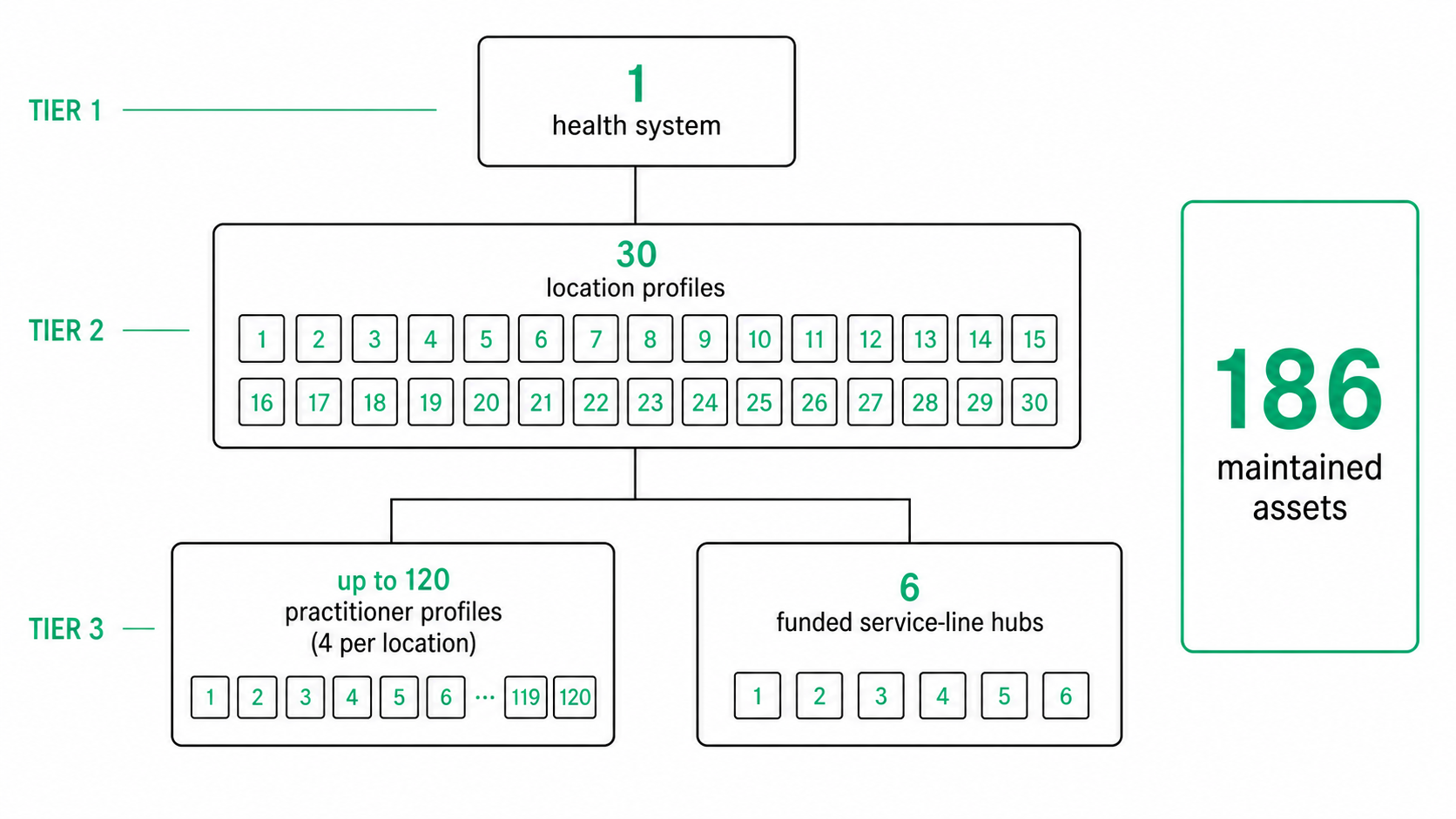
You build an asset architecture, not a listing. Google’s local results depend on relevance, distance, and prominence; distance is fixed by geography, so a system competes on relevance (complete, accurate facility data) and prominence (reviews and links). Thirty locations means thirty independent contests for the local pack — the three-result map block above organic results, fed by Google Business Profiles (GBP). Google’s guidelines are unusually specific about health systems.
| Asset | How many | Google’s rule | Common failure |
|---|---|---|---|
| Location profile | 1 per facility | One page per location; duplicates prohibited | Legacy duplicates from handovers |
| Practitioner profile | 1 per public-facing physician reachable at the location | Permitted; at a branded org, “[brand]: [practitioner name]” | Departed physicians listed; new hires missing |
| Department profile | 1 per department with a different primary category | Permitted; the name must differ too | Built with the hospital’s own category — suppressed |
| Location page on site | 1 per facility | — | Near-duplicates with a swapped city name |
| Line hub page | 1 per funded line, system-level | — | One page per line per location, self-cannibalizing |
Worked example: 30 facilities, 6 funded lines, 4 public-facing physicians each gives 30 location profiles, 120 practitioner profiles, 30 location pages, and 6 line hubs — 186 assets whose categories, hours, and reviews drift as staff move. That is operations, not campaigns: local SEO for healthcare at system scale.
Name, address, and phone data must match across website, profiles, and citations; drift is the default unless someone owns it.
Who reviews clinical content, and how do you keep governance from blocking it?
A named physician reviewer per line, a fixed turnaround, and compliance scoped only to patient data. Health content sits in YMYL — “Your Money or Your Life,” Google’s category for topics that can affect health, financial stability, or safety — and Google states its systems “give even more weight to content that aligns with strong E-E-A-T” for those topics (Google Search Central). The same guidance asks whether pages “carry a byline, where one might be expected”: for hospital content, a workflow requirement rather than a design preference.
| Stage | Owner | Turnaround | Boundary |
|---|---|---|---|
| Brief | Content lead + line manager | 3 days | Reviewer named here, not later |
| Draft | Content team | — | No clinical claim ships unsourced |
| Clinical review | Named physician per line | Fixed SLA (e.g., 5 days) | Accuracy, not tone or SEO |
| Compliance review | Privacy officer | 3 days | Scoped to PHI; not a content veto |
| Byline & publish | Web team | — | Author and reviewer credited |
| Refresh | Content lead | Annual or on guideline change | dateModified genuinely changes |
Two constraints. Testimonials and review responses touch protected health information: under HIPAA, marketing uses of PHI generally require prior written authorization (45 CFR §164.508) — which is why “just reply with the treatment details” is never an option. And the American Hospital Association and American Medical Association rank alongside your service-line pages, setting the register patients expect.
Do hospitals need to optimize for AI answers as well?
Yes, and medicine is the sharpest case. Medical queries trigger an AI Overview 44.1% of the time against 20.5% across all SERPs, and question-form queries 57.9% versus 15.5% (Ahrefs, 146.1M SERPs) — and patient research is question-shaped by definition. The demand is measured: 32% of U.S. adults used AI chatbots for health information in the past year, 77% worried about the privacy of what they share (KFF, n=1,343, February 24 – March 2, 2026).
Our own measurement, honestly framed. On 2026-08-03 we ran the first pilot of our AI-visibility protocol: 4 prompts, one surface (Perplexity), clean anonymous session, EU IP. Rotgar’s citation rate: 0/4 — the expected zero point. The instructive part is what the engine did instead:
| Prompt | What the answer contained | What it cited | Read-across for a health system |
|---|---|---|---|
| “Best healthcare SEO agencies” | Ranked table of 8 agencies | Two agencies’ own listicles — one ranking itself #1 on a self-published “AI Visibility Score 4.9/5” | Whoever publishes the comparison sets the ranking |
| “Where can I get an AI visibility audit?” | Named tools, generic advice | Vendor pages, Reddit ×3, YouTube | Third-party discussion beats brand pages here |
| “What is generative engine optimization?” | Definition plus comparison table | Semrush, Wikipedia, Coursera | Definitional queries go to heavyweights |
Limits: one surface, four prompts, non-US IP — evidence about who gets cited, not a US benchmark.
The read-across is direct. Answering “best bariatric surgeons near me” or “sleeve versus bypass,” an assistant assembles from structured sources — tables, comparisons, named authors — not brochure pages. A line hub with a comparison table, a credentialed byline, and a plain-language FAQ is far more citable than the same content as prose. Mechanics: what generative engine optimization is, how to show up in AI Overviews.
What hospital SEO will NOT fix
- Internal politics. If twelve stakeholders hold a veto on every edit, no agency fixes that from outside; governance comes before retainers.
- A reputation event. Poor reviews or a public incident need operational and PR response first; search amplifies what patients find.
- Slow YMYL lines on a monthly timeline. Lines with entrenched national competitors move in quarters: plan the year, report the quarter.
- Referral development. Search adds a second acquisition door; it does not close the first.
- Capacity. Demand on a line booked out eight weeks creates cancellations, not revenue.
How Rotgar works with hospitals and medical groups
Rotgar is a healthcare SEO and AI search agency that helps medical and dental practices acquire patients from Google Search, Google Maps, and AI assistants like ChatGPT and Gemini. Buyers search for hospital marketing agency, hospital marketing service, hospital SEO company, hospital SEO service — here is what those should mean.
- Audit by service line — visibility and competitive gap per line and location, across Search, Maps, and AI.
- Prioritization — which lines to fund first, by margin, capacity, gap.
- Line hub build-out — hub, condition and procedure pages, physician pages.
- GBP architecture — location, practitioner, department profiles; NAP consistency; reviews.
- Content with clinical review — the workflow above, agreed before the first draft.
- Reporting by line — calls, appointment and direction requests per line.
For multi-specialty groups — whose lines span specialties rather than locations — we run the same model through a dedicated practice.
The simplest free audit starts with one clinic or selected location, one priority market and one patient language. It shows current visibility across Google Search, Google Maps, Google AI Overviews, ChatGPT, and Gemini, plus competitor gaps and prioritized fixes. For a health system we scope it to one service line.
Key takeaways
- The unit of hospital SEO is the service line, not the domain — two or three funded at a time, measured separately.
- Google names only relevance, distance, and prominence, and sells none of them; 30 locations means 30 prominence programs.
- Practitioner and department profiles are permitted and under-used; duplicates are prohibited and everywhere; location pages must be genuinely different pages.
- Clinical review works as a workflow with a named reviewer and a fixed SLA; compliance scoped to PHI stays a check, not a veto.
- At 44.1% AIO frequency the answer layer is unavoidable in medicine, and it rewards tables, named authors, and explicit comparisons.
- Our AI pilot returned 0/4 citations on 2026-08-03 — published for the same reason we label case figures client-reported.
Want to know which of your service lines patients can actually find?
Get a free audit — one clinic or selected location, one priority market and one patient language. Or book a 30-minute call to talk through line priorities first.
FAQ: hospital SEO and marketing
What is hospital SEO?
Hospital SEO is the practice of making a hospital’s service lines visible in Google Search, Google Maps, and AI answers for the patients each line serves. Unlike single-practice SEO it works line by line — bariatrics, orthopedics, cardiology — because each line has its own demand and its own competitors.
How is hospital marketing different from practice marketing?
Scale and structure. A practice markets one location and a narrow service set; a hospital markets dozens of lines across multiple locations with different competitors, margins, and journeys. Hospital marketing therefore needs line prioritization, multi-location profile architecture, and clinical governance.
What is service-line SEO?
Service-line SEO treats each clinical line as its own mini-market: a funded line gets a hub page, condition and procedure content, physician pages, location-level Google Business Profile work, and its own measurement — instead of generic content spread across one domain.
How do you do SEO for a hospital with many locations?
Give every facility one profile with accurate categories, add practitioner profiles for public-facing physicians and department profiles where the category genuinely differs, avoid duplicates, keep name-address-phone data identical, and publish a real page per location. Then run service-line SEO in each market.
How long does hospital SEO take?
Technical and local fixes usually show first — the New York bariatric line reached roughly 20,000 impressions in five months (client-reported). Content and authority compound over quarters. In lines with entrenched national competitors, plan movement across two to three quarters.
Who should own SEO inside a hospital?
The marketing director as accountable owner, a named physician reviewer per line for clinical accuracy, and compliance scoped to patient-data questions only. The failure pattern is diffuse ownership: when web, IT, line managers, and compliance each hold a veto, nothing ships.