
TL;DR
- Medical SEO makes a medical organization findable in Google Search, Google Maps, and AI answers at the moment a patient is choosing a provider. “Medical SEO” and “healthcare SEO” name the same discipline.
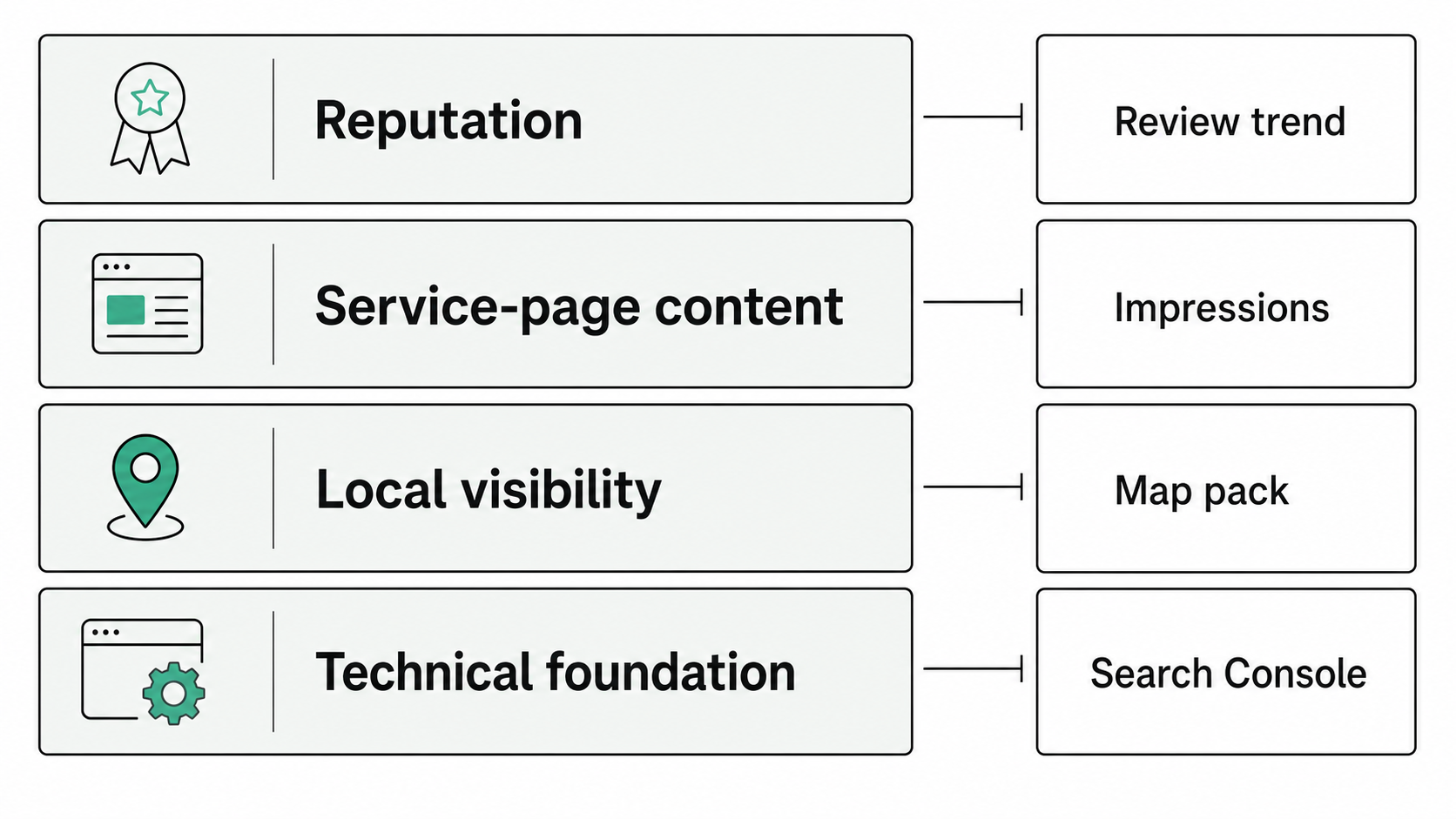
- It has four layers: technical foundation, local visibility (Google Business Profile), service-page content, and reputation. Skipping one caps the other three.
- Healthcare is a YMYL category: Google states its systems give more weight to strong E-E-A-T signals on topics that can affect a person’s health — the reason clinician-attributed content outperforms generic copy on treatment queries.
- Medical queries are disproportionately AI-affected: AI Overviews appeared on 44.1% of medical queries versus 21% of all keywords (Ahrefs, 146M SERPs, September 2025), and 32% of U.S. adults used AI chatbots for health information in the past year (KFF, February 24 – March 2, 2026, n = 1,343).
- Google names three local ranking factors — relevance, distance, prominence — and states that more reviews and positive ratings can help local ranking. That is the map-pack mechanic for every clinic.
Healthcare SEO is the process of optimizing a medical organization’s website, Google Business Profile, and online reputation so patients find its providers and services in Google Search, Maps, and AI answers. Medical SEO and healthcare SEO are synonyms — the search demand behind both phrases is one intent, and this page uses the terms interchangeably. For a practice owner, it answers one question: when patients search before they call, do they find you or somebody else?
What does medical SEO include?
Four layers of work: a technical foundation that lets search engines and AI crawlers read the site, local visibility through the Google Business Profile, service-page content built around what patients actually search, and reputation signals from patient reviews. Each layer produces a different signal and is verified differently.
| Layer | What the work is | Signal it produces | How you verify it |
|---|---|---|---|
| 1. Technical foundation | Speed, mobile usability, crawlability and indexation, medical schema, working booking paths | The site is eligible to appear at all — in results, snippets, AI answers | Search Console indexing and Core Web Vitals; a test booking on a phone |
| 2. Local visibility | Google Business Profile completeness, categories, services, hours, photos, location and practitioner pages | Prominence and proximity signals feeding the local pack and Maps | Map-pack presence for service + city queries; calls and direction requests |
| 3. Service-page content | One page per service line, answering the questions asked before booking, attributed to a named clinician | Topical relevance for treatment and condition queries | Impressions and positions per service page; appointment requests |
| 4. Reputation | Review volume and velocity, response protocol, consistent provider profiles on directories | Trust and prominence signals used by ranking systems and AI assistants | Review count and rating trend; whether pages citing you appear in AI answers |
Google Business Profile is the free listing that determines whether a practice appears in Google Maps and in the local pack — the block of three listings with a map above organic results. For most clinics it is the highest-traffic asset they do not host themselves.
These four layers are what a provider delivers as medical SEO services: technical SEO, Maps optimization, and service content measured in booked appointments, not rankings.
How is medical SEO different from regular SEO?
Medical SEO runs the same mechanics as any other SEO, under stricter evaluation. Healthcare is a YMYL topic — “Your Money or Your Life,” Google’s category for subjects that can affect a person’s health, financial stability, or safety — and Google states its systems give more weight to content demonstrating strong E-E-A-T on exactly those topics.
E-E-A-T stands for experience, expertise, authoritativeness, and trust. In Google’s guidance, trust is the most important of the four; the others support it. That turns generic SEO habits into medical-specific requirements.
| Dimension | General SEO | Medical SEO |
|---|---|---|
| Quality bar | Helpful content wins; authorship is optional | YMYL evaluation: named clinician authorship or review, credentials, medical citations |
| Who can write it | A competent content writer | A writer plus a licensed reviewer; unreviewed treatment content is a liability, not just a ranking risk |
| Role of reviews | Social proof that lifts conversion | A named Google ranking input — prominence: “more reviews and positive ratings can help your business’s local ranking” |
| Compliance | Standard advertising rules | HIPAA-aware handling of testimonials, review responses, and analytics; marketing uses of protected health information are governed by 45 CFR § 164.508 |
| AI exposure | AI Overviews on ~21% of keywords | 44.1% of medical queries triggered an AI Overview (Ahrefs, 146M SERPs, September 2025) |
| Consequence of error | Lost traffic | Lost traffic plus regulatory, reputational, and patient-safety exposure |
| Winning asset | Volume of well-optimized pages | Depth per service line plus verifiable entity and trust signals across the web |
One boundary matters: HIPAA compliance is the covered entity’s obligation, not a vendor’s promise. What an agency can offer is a HIPAA-aware workflow — no patient identifiers in published content, review responses that never confirm a patient relationship, analytics that capture no protected health information. Legal sign-off stays with the practice.
Where do patients actually decide?
Across four surfaces, not one — each with its own entry condition. Ranking first in organic results while being absent from Maps and AI answers is a common and expensive failure mode.
| Surface | What decides visibility | What the practice controls | Metric that matters |
|---|---|---|---|
| Google organic results | Relevance and quality of the service page | Content depth, clinician attribution, technical health | Impressions and clicks per service line |
| Google Maps / local pack | Relevance, distance, prominence (Google’s stated factors) | Profile completeness, categories, reviews, location pages | Calls, direction requests, map-pack presence |
| Google AI Overviews | Being indexed and snippet-eligible; no special markup exists | Extractable, self-contained answers on the page | Whether the AI answer cites your pages |
| AI assistants (ChatGPT, Gemini, Perplexity) | Which third-party sources the assistant retrieves and trusts | Entity consistency, directory and review presence | Citation rate across a fixed prompt set |
Two verified facts explain the bottom two rows. Google Search Central states there are “no additional requirements to appear in AI Overviews or AI Mode, nor other special optimizations necessary” — no AI text file, no special schema; a page must be indexed and snippet-eligible. And the demand is real: a KFF Tracking Poll fielded February 24 – March 2, 2026 among 1,343 U.S. adults found 32% had used AI chatbots for health information in the past year, 65% of them for “quick or immediate information.”
The local rules are older and published. Google Business Profile Help names relevance (“how well a Business Profile matches what someone is searching for”), distance (“how far each business is from the customer who’s searching”) and prominence (“how well-known a business is”), and states that “more reviews and positive ratings can help your business’s local ranking.” Distance is fixed; relevance and prominence are the entire local program.
Which sources do AI assistants use for healthcare queries?
Third-party lists, not vendors’ own service pages — at least on the surface we measured. On 2026-08-03 we ran a pilot of our fixed prompt battery in Perplexity (clean anonymous session, English). On “Best healthcare SEO agencies,” the answer was a table of eight agencies, and the most-cited sources were agencies’ own ranked listicles — including one that placed itself at number one on a self-published metric (“AI Visibility Score 4.9/5”). No independent evaluation appeared. Rotgar was not mentioned or cited.
Honest frame: four prompts, one surface, European IP; the full protocol runs 16 prompts monthly across Google AI Overviews, ChatGPT, Gemini, and Perplexity, so we treat this as directional about source structure, not a U.S. market measurement. Two conclusions transfer to a clinic:
- Recommendation queries are answered from other people’s pages. When a patient asks an assistant for a dermatologist, the answer is assembled from directories, review platforms, and roundups — those pages, not only your site, decide whether your name appears.
- Self-published claims are not filtered. Assistants currently repeat self-made rankings and metrics with little scrutiny — an argument for verifiable trust signals (real reviews, consistent provider profiles, dated data) rather than for inventing scores.
What does a medical SEO strategy cover?
A medical SEO strategy sequences the four layers into a program with a measurement plan: visibility audit → technical foundation → Google Business Profile and location pages → service-page content → review acquisition → measurement against calls and booked appointments. Skipping the audit or the technical layer is the most common reason programs stall in month four.
Sequence matters because the layers compound: content on a site that cannot be crawled produces no signal, and reviews collected without a complete Business Profile land on an asset that does not rank. One reference point from our client work. A healthcare organization in Oklahoma reported 30% more new patients contacting the office after finding the website through Google Search — following technical SEO, service-page and content work. (Client-reported outcome.) The full framework, phase by phase, is in our guide to healthcare SEO strategy.
What medical SEO is NOT
Medical SEO is a visibility discipline with hard boundaries. It is not:
- Advertising or PPC. Paid search rents attention that stops with the budget; SEO builds visibility that compounds. The two are complements, not substitutes.
- A one-time setup. Rankings in medical niches depend on ongoing content, review flow, and technical maintenance; a single optimization pass decays.
- Medical advice to patients. This is about how a practice is found, not how patients are diagnosed or treated. Clinical content requires clinician authorship and review.
- A guarantee of positions or timelines. Nobody controls Google’s rankings or a generated AI answer; guaranteed positions are a promise sold in place of a process.
- A HIPAA compliance program. Marketing work can be HIPAA-aware, but compliance obligations, authorizations under 45 CFR § 164.508, and legal sign-off stay with the covered entity.
How does AI search change medical SEO?
It changes the target, not the foundation. AI answers are assembled from what SEO already builds: an indexable site, consistent business profiles, structured content, third-party corroboration. What changes is the shape content must take — self-contained answers an assistant can quote — and the metric, which becomes citation rate rather than position.
| What stays the same | What changes for a medical practice |
|---|---|
| The site must be crawlable, fast, and indexed | The unit of competition becomes a quotable passage, not a ranked page |
| Service pages still need depth and clinician attribution | Answers must be extractable in the first 40–60 words of a section |
| Reviews and profile consistency still drive local prominence | Directory, review, and community pages become the sources assistants cite about you |
| Measurement is still against calls and bookings | Add citation rate across a fixed prompt set, measured monthly |
For the practice-level version of this work — what to change on a physician’s site and how to measure it — see AI SEO for doctors. For the underlying discipline and its research base, our hub article on generative engine optimization covers the mechanics in full; this page deliberately does not repeat them.
Key takeaways
- Medical SEO makes a medical organization findable in Google Search, Maps, and AI answers; medical SEO and healthcare SEO are the same discipline.
- The work is four layers — technical, local, service content, reputation — each with its own verification method. A program missing a layer is capped by that gap.
- Healthcare is YMYL: Google weights strong E-E-A-T more heavily on health topics, and trust is the most important of the four components.
- Medical search is unusually AI-exposed — 44.1% of medical queries triggered an AI Overview versus 21% of keywords overall (Ahrefs, 146M SERPs, September 2025).
- Patients already ask assistants: 32% of U.S. adults used AI chatbots for health information in the past year (KFF, February–March 2026, n = 1,343).
- Local rankings follow three stated Google factors — relevance, distance, prominence. Distance is fixed; the other two are earned.
- Our pilot (Perplexity, 2026-08-03) showed recommendation answers built from third-party lists and self-published claims — a clinic’s presence in directories and review platforms matters as much as its own pages.
FAQ
Is medical SEO the same as healthcare SEO?
Yes. They are two names for the same discipline, and search engines treat the queries as one intent. “Medical SEO” is more common among individual practices and physicians; “healthcare SEO” among hospitals, groups, and agencies. The work — technical, local, content, reputation — is identical under either name.
Why is medical SEO harder than regular SEO?
Because healthcare is a YMYL category. Google states its systems give more weight to strong E-E-A-T signals for topics affecting health, so content needs demonstrated expertise and clinician review, trust signals carry more weight, and patient-related data requires HIPAA-aware handling. Generalist tactics that work in e-commerce routinely fail on treatment queries.
Does medical SEO include Google Maps?
Yes. Google Business Profile optimization and local pack visibility are core layers, not add-ons. Google names relevance, distance, and prominence as its local ranking factors and states that more reviews and positive ratings can help. For many practices, patient contact starts as a call placed straight from the listing.
How long does medical SEO take to work?
Technical and local improvements usually surface first, often within the first months; content and authority work compounds over quarters. In competitive medical niches, meaningful movement is a two-to-three-quarter plan, not a two-week one. Promises of instant results are a reliable warning sign.
Can I do medical SEO myself?
Parts of it. Completing a Google Business Profile, requesting reviews, and fixing obvious site issues are realistic in-house tasks. Technical SEO at scale, clinician-reviewed service content, and competing in YMYL results usually require specialists. A common split: reviews and profile upkeep internally, the rest outsourced.
Is medical SEO HIPAA compliant?
Medical SEO itself involves no patient records, so HIPAA questions concentrate in testimonials, review responses, and analytics touching patient interactions. The working standard is HIPAA-aware operations: no patient identifiers in content, review responses that never confirm a patient relationship, no tracking that captures protected health information. Marketing uses of protected health information require patient authorization under 45 CFR § 164.508 — an obligation that stays with the practice.
Want to see where your practice currently stands?
The simplest free audit starts with one clinic or selected location, one priority market and one patient language. It shows current visibility across Google Search, Google Maps, Google AI Overviews, ChatGPT, and Gemini, plus competitor gaps and prioritized fixes.