
TL;DR
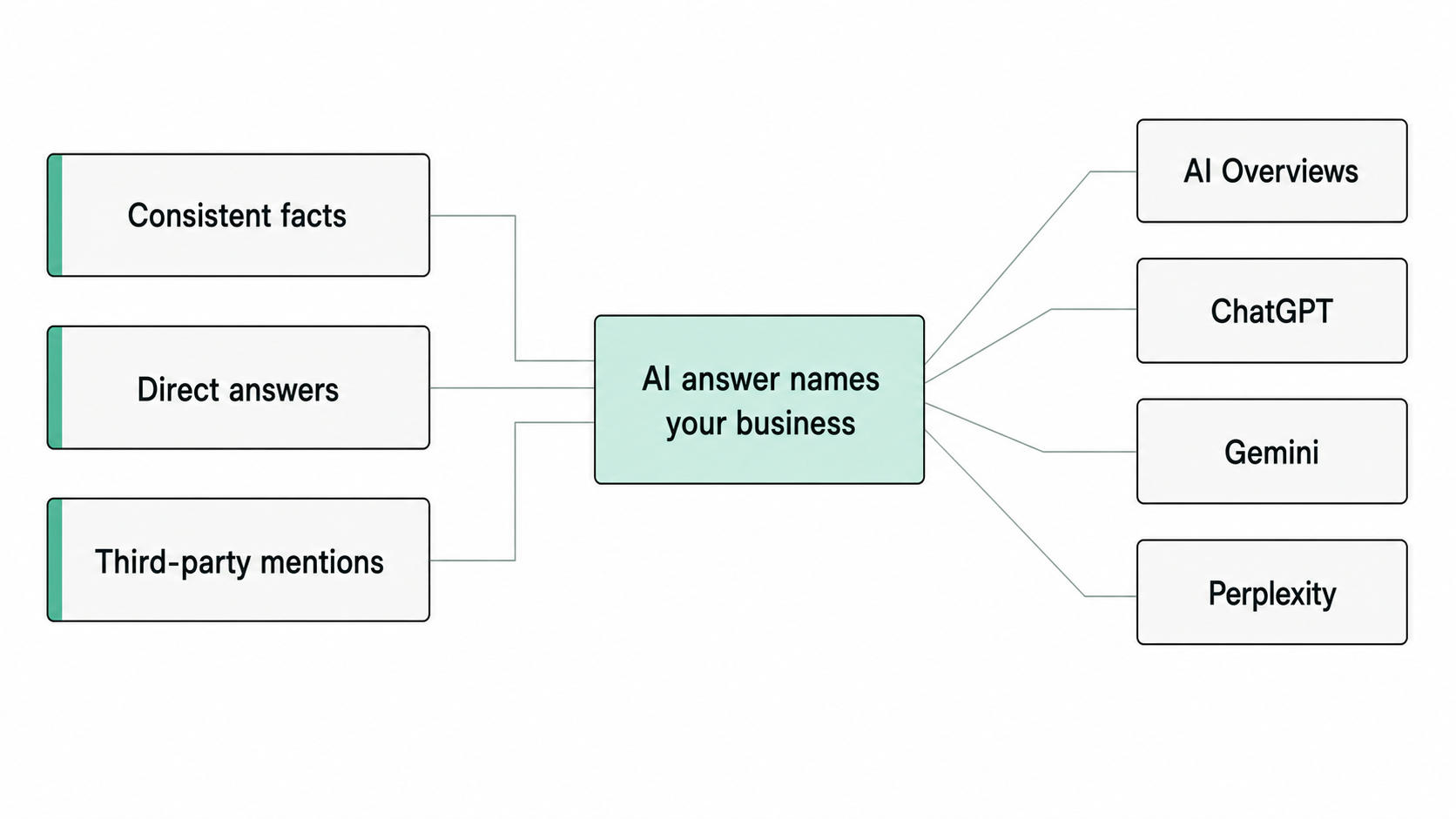
- Three things decide whether an AI assistant names your business: consistent facts about you across the web, pages that answer real customer questions plainly, and mentions on sites the assistant already trusts.
- There is no secret markup. Google’s documentation states there are “no additional requirements to appear in AI Overviews or AI Mode, nor other special optimizations necessary.”
- Why it matters now: in a Pew Research study of 68,879 Google searches (March 2025), 18% produced an AI summary, and users clicked a traditional result on 8% of those visits versus 15% without one.
- Off-site mentions beat links as a predictor: across 75,000 brands, Ahrefs found branded web mentions correlated 0.664 with AI Overview mentions versus 0.218 for backlinks (correlation, not causation).
- In our pilot (Perplexity, 4 prompts, August 3, 2026) the assistant invented no names — it repeated third-party listicles, directories, and Reddit threads.
To show up in AI searches, your business needs three things: consistent facts about who you are across the web, pages that answer real customer questions in plain language, and mentions on sites AI systems already trust. Below are five actions that build all three — each with a way to check it’s working.
When a patient or a client asks ChatGPT “who should I go to?”, the assistant answers with a name — and if nobody has done this work for you, that name is a competitor’s.
What decides whether AI assistants mention your business?
AI assistants like ChatGPT, Gemini, and Google’s AI Overviews build answers from sources they can verify: your website, business directories, reviews, and third-party articles. They mention businesses whose facts are consistent, whose content answers the question directly, and whose name appears on sites the AI already trusts.
Specialists call this AI visibility, and define it precisely: AI visibility is the degree to which AI assistants and AI search features mention, cite, or recommend a brand in generated answers — measured by citation rate across a fixed set of prompts and platforms. The term is unpacked on our page about what AI visibility means.
Being mentioned elsewhere is the ingredient owners underestimate. Ahrefs studied 75,000 brands and AI Overview mentions and found branded web mentions had the strongest correlation of the factors tested (0.664), well ahead of backlinks (0.218) — while stating explicitly that correlation is not causation. The web talking about you matters at least as much as the web linking to you.
There is a business reason to care. Pew Research found that when an AI summary appeared, users clicked a traditional result on 8% of visits versus 15% without one — while Semrush reports the average AI search visitor is 4.4 times as valuable as an average organic visit by conversion rate.
Which AI surface should you start with, and what is the first move?
Start with the surface your customers actually use, and do the one thing that unblocks it. All four below run on the same foundation — an indexed, crawlable site with consistent facts — but each has a different first move and a different check (as of August 2026).
| AI surface | What it is | Where its answers come from | Your first move | How you check it |
|---|---|---|---|---|
| Google AI Overviews | The answer box on top of Google results | Google’s regular search index | Confirm the page answering that question is indexed and not blocked from snippets | Search the exact question, logged out, and read the answer box |
| ChatGPT | Chat assistant that searches the live web when needed | Live web results plus trained model knowledge | Check that robots.txt does not block OAI-SearchBot | Ask the question, then ask it to list its sources |
| Gemini | Google’s chat assistant | Google’s index plus trained model knowledge | Same foundation as AI Overviews: indexed pages, consistent facts | Ask it and note whether you are named |
| Perplexity | Answer engine that shows sources beside every answer | Live retrieval, sources always shown | Get listed in the directories and roundups it cites for your category | Ask the question, open the Sources tab |
One note on the ChatGPT row, because it trips people up. OpenAI runs several separate crawlers: OAI-SearchBot surfaces sites in ChatGPT’s search features, GPTBot collects content for model training, and ChatGPT-User handles actions a person triggers. They are controlled independently in robots.txt, so blocking GPTBot is a legitimate choice about training data, while blocking OAI-SearchBot opts you out of ChatGPT’s search answers. Plenty of sites block both by accident, with a copied “block all AI bots” snippet.
What are the five things you can do this month?
Five actions, from foundation to measurement. Each is something an owner can do personally or delegate in one sentence.
- Get your facts straight everywhere. Name, address, phone, services, and hours identical on your website, your Google Business Profile, and every directory; on your site, Organization schema states the same facts in machine-readable form. Conflicting facts are the most common reason an assistant hedges instead of naming you — the first layer of what specialists call AI search optimization.
- Answer the questions your customers actually ask. Collect 5–10 real questions you hear on the phone or in the waiting room, and give each a page or a clearly headed section that puts the answer in the first two or three sentences. No warm-up paragraph — assistants quote direct answers, not introductions. The detailed version: how to rank in ChatGPT answers.
- Earn mentions on sites AI already trusts. Reviews on the platforms your industry uses, directories, local publications, association listings, honest answers in community threads. In our own run, Reddit was cited three times in one answer — more than any individual publisher.
- Fix the technical basics. Your site must be indexed, load reasonably fast, and must not block AI crawlers in robots.txt. Google’s guidance on AI features and your website confirms AI Overviews and AI Mode need no extra markup and no AI text files. Our AI search checklist walks the checks one by one.
- Check once a month whether it’s working. Write down 10–16 customer questions, run them in ChatGPT, Gemini, and Google AI Overviews in a clean logged-out session, and record whether your business is named — same questions, same day each month. If you would rather have specialists run it, that is what our AI search optimization for medical practices does.
What do AI assistants actually cite when someone looks for a business like yours?
They cite other people’s lists. On August 3, 2026 we ran the first slice of our fixed prompt battery — 4 prompts on Perplexity, clean session, English, European IP — and one pattern held across every commercial question: the assistant named businesses only where a third party had already ranked them.
- “Who provides generative engine optimization services?” — no brands named in the answer body. The citations were listicles and directories: Clutch’s category page, DesignRush, and agency roundups.
- “Where can I get an AI visibility audit?” — named specific tools directly, and cited Reddit three times, more than any single publisher. Community threads are a first-class source on “where do I get X” questions.
- “Best healthcare SEO agencies” — Perplexity reproduced a self-published agency roundup almost verbatim, publisher’s own number-one placement included.
The fourth prompt, a plain definition question, cited only established reference publishers.
Honest framing: this was a pilot — four prompts, one surface, one session, a European IP rather than a US one — and our own citation rate was 0/4, the expected zero point for a site that had just published this material. Its value is structural: it shows which sources get pulled into commercial answers, and that lines up with the Ahrefs data above. The instruction is unglamorous — be present, accurately, in the directories, review platforms, roundups, and threads that already rank for your category.
How do you check whether it’s working, without special tools?
Fix the questions, fix the surfaces, count the mentions, repeat monthly. You need real customer questions and a clean browser session — nothing else. The number you track is a citation rate: checks that named your business, divided by checks you ran.
A worked example. A three-person practice writes down 12 questions its patients ask and runs each on three surfaces — ChatGPT, Gemini, Google AI Overviews: 12 × 3 = 36 checks per month. In month one the business is named in 5, so 5/36 = 14%. The point is not the 14%, it is that next month the same 36 checks re-run and the number either moves or does not.
| Month | Questions × surfaces | Checks | Times named | Citation rate | What changed |
|---|---|---|---|---|---|
| 1 (baseline) | 12 × 3 | 36 | 5 | 14% | Baseline recorded; facts unified |
| 2 | 12 × 3 | 36 | 7 | 19% | Six customer-question pages live |
| 3 | 12 × 3 | 36 | 11 | 31% | Two directory listings and a local publication mention added |
Rules that keep the number honest: never change the question list, always use a logged-out session, record the date, and note which competitors were named instead of you — often more useful than your own score.
What mistakes keep small businesses out of AI answers?
Most are not technical. They are misreadings of how these systems pick sources — usually the belief that there is a switch to flip, or that the work stops at your site.
| Common mistake | Why it keeps you out | What to do instead |
|---|---|---|
| Waiting for a special “AI markup” or paid placement | Google states no additional requirements or special optimizations exist for AI Overviews and AI Mode | Spend the time on indexing, facts, direct answers |
| Copying a “block all AI bots” snippet into robots.txt | It blocks OAI-SearchBot too — the crawler behind ChatGPT’s search answers | Decide each crawler separately: allow OAI-SearchBot, choose consciously on GPTBot |
| Different name, address, or hours across profiles | Assistants prefer facts verifiable in more than one place; conflicts make them hedge | One canonical fact set everywhere, plus Organization schema on your site |
| Burying the answer under a warm-up introduction | Assistants extract short self-contained passages; an intro gives nothing to quote | Question as the heading, answer in two or three sentences, detail after |
| Working only on your own website | Branded mentions correlated 0.664 with AI Overview mentions versus 0.218 for backlinks (Ahrefs, 75,000 brands) | Directories, reviews, local press, association listings, community answers |
| Buying “guaranteed placement in ChatGPT” | Organic AI answers are not purchasable inventory | Pay for work on the signals; treat any placement guarantee as a red flag |
| Judging progress by rankings, or checking once | AI answers are not ranked positions, and one reading is noise as platforms re-crawl | A fixed prompt list, re-run monthly, scored by citation rate |
What showing up in AI searches will NOT do
- It does not replace Google SEO. AI answers are assembled from the same foundation: indexed content, trust, consistent facts.
- It does not work instantly. Platforms update their sources over time; the effect compounds over months.
- Nobody can guarantee a mention. A promise of “guaranteed placement in ChatGPT” is a red flag: the output is generated, not sold.
- It is not paid placement. You cannot buy your way into an organic AI answer (as of August 2026).
- It does not replace good service. AI retells your reputation, it does not create one.
Where do you go next?
Pick by task, not terminology.
| If you want to… | Go to | What you get there |
|---|---|---|
| Follow the whole process | AI search optimization guide | The full method, in order |
| Get named in ChatGPT specifically | How to rank in ChatGPT answers | The factors behind inclusion, and how certain each is |
| Get into Google’s AI Overviews | How to show up in AI Overviews | Eligibility checks, snippet controls |
| Work from a printable list | AI search checklist | Every check by layer, with a “done” test |
| Score the monthly check as one number | AI visibility score | The scoring method, with a worked calculation |
Key takeaways
- Three signals decide whether an assistant names your business: verifiable facts, direct answers to real questions, and mentions on sources it trusts.
- There is no special markup — Google states no additional requirements or special optimizations exist for AI Overviews and AI Mode.
- Off-site presence outweighs link building as a predictor: branded web mentions correlated 0.664 with AI Overview mentions versus 0.218 for backlinks across 75,000 brands (correlation, not causation).
- Commercial questions get answered from third-party lists: in our August 2026 Perplexity pilot, category prompts returned directories, listicles, and Reddit — not vendors’ own pages.
- Check crawler rules first: OAI-SearchBot governs visibility in ChatGPT’s search answers and is separate from GPTBot, which covers training data.
- Measure with a fixed prompt list, not rankings: questions × surfaces = checks, mentions ÷ checks = citation rate, re-run monthly. Pew found AI summaries cut traditional result clicks from 15% to 8% of visits, while Semrush puts an AI search visitor at 4.4× the value of an organic one.
FAQ
How to get my business to show up in AI searches?
Do the five things on this page: consistent facts everywhere, direct answers to the questions your customers really ask, mentions on sites the assistants already cite, sound technical basics including crawler access, and a monthly check against a fixed list.
Is showing up in AI searches the same as SEO?
Not exactly. It stands on the same foundation — a crawlable site, trusted mentions, clear facts — but adds two things classic SEO never needed: content an assistant can quote without context, and measurement by a fixed question set instead of keyword positions.
How long does it take to show up in ChatGPT or Gemini answers?
Weeks to months, depending on the foundation you already have (as of August 2026). Consistent facts and content that answers real questions speed things up; earning third-party mentions takes longest, since it depends on other people publishing. Monthly checks show which way you are moving.
Do I have to pay to appear in AI answers?
No. Organic AI answers are not sold as inventory. What can be paid for is work on the signals — your site, your facts, your mentions — in-house or by a specialist team. Any offer of “guaranteed placement in ChatGPT” describes something nobody controls.
How can I check if my business shows up in AI searches?
Ask ChatGPT, Gemini, and Google AI Overviews the real questions your customers ask, in a clean logged-out session, and note whether your business is named and which competitors appear instead. Repeat monthly against the same list — mentions divided by checks is your citation rate.
Does this work for a small local business?
Yes — local facts and reviews carry real weight, because they are exactly the verifiable signals these systems look for, and a local category has far fewer competing sources than a national one. For medical practices, the same rules apply under stricter trust standards: accuracy and consistent credentials matter more, not less.